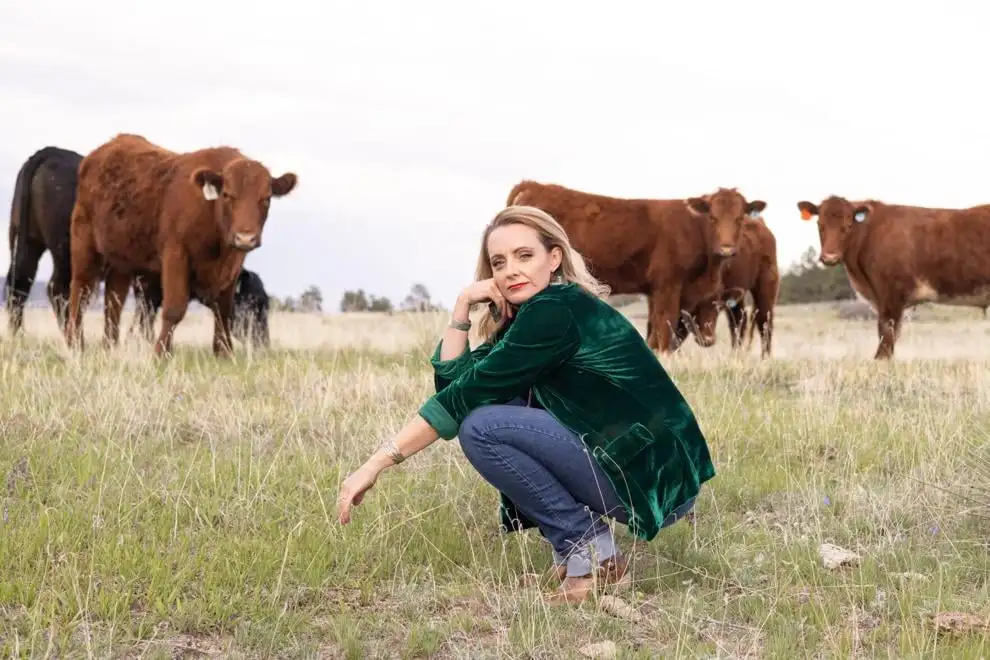
Sarah Bohnenkamp is a leadership coach who feels that if the industry can work together to make the small shifts, it will help to break down barriers between the industry and consumers.
Sarah was born and raised in Idaho and worked in the financial world in Arizona, where she met her husband, Chris. Sarah became the director of training in her company and helped organizations with leadership development and sales. She and Chris eventually moved to Colorado, where he grew up, and settled in Parker. Sarah no longer wanted to work in the financial industry and, in her words, “believed in the whole idea of anti-average.” She continued, “I couldn’t just go and work for a small, mediocre credit union, and thought ‘There’s got to be another way.’”
Sarah applied for an opening at American National CattleWomen (ANCW) as a program manager. She had always been a cowgirl at heart, growing up around horses and agriculture in the “potato country” of Idaho.
Sarah used her leadership skills to run the National Beef Ambassador program, helping young women develop their leadership skills, and assisting with other Beef Checkoff-funded programs.
“I got hired by ANCW and found a deep love for working within agriculture, not only doing the leadership development, but I love the policy aspect,” Sarah told WLJ.
Sarah said she had the opportunity to work with Agriculture Secretary Tom Vilsack on checkoff reform, and it was an interesting lesson in leadership with the history and legacy of the checkoff program and the emotion and opinions regarding the program.
She said the time with ANCW and her previous experience led her to start her own business, Sarah J. Bohnenkamp Coaching and Consulting, focused on leadership and coaching with leaders and organizations in agriculture. Sarah said each client is different, but the focus always includes leadership brand and effective communication.
Keys elements of leadership
“Can you identify what your leadership brand is?” she asked. The leadership brand is how you want people to feel and how you want to be. What are the beliefs that you know are true because everything flows from the inside out like an internal compass?
“Once you determine your leadership brand, everything else becomes really easy because you use that lens to make your decisions,” Sarah said. “You use that lens to manage your people, and you use that lens to decide what you won’t do.”
The second part of leadership is communication is code for leadership and vice versa. Leadership is about being an effective communicator and the most essential skills are curiosity and empathy. She said the agriculture industry is good at education, but it needs to be better at listening and asking more questions to gauge how the other side feels in order to connect around a shared understanding.
The third piece of leadership is being “anti-average.” While the agriculture community talks about continuous improvement and sustainability, it cannot “rest on its laurels” and continue to say, “Look at all the great things we are doing,” Sarah said. It must continue to look at ways of improvement.
Sarah said producers and the industry should first seek to understand and not overinflate themselves. “This may sound real hippie-dippie, but I think we have to move at it with a lot more love and a lot less fight,” Sarah said. “If we could approach the whole conversation, the whole opportunity with a little bit more love, then I think that we would be having to waste so much energy on the walls and the barriers.”
Sarah works with the Montana Farm Bureau and their ACE (Advocate. Communicate. Educate.) Leadership Program participants on their leadership brand and coaching them through executing big ideas and project management.
Sarah’s said her passion for horses sometimes spills into her leadership discussions where she can speak the “language of the herd” or ask “What would the lead mare do?”
Sarah said producers should engage with others in ways that feel comfortable, and there is no “right” prescription for what works best. Producers think there is a need to reach out to lawmakers or have the right video on social media, but the best conversations often are those with our neighbors (aka grassroots), she said. Additionally, producers should talk about the truth and shouldn’t feel the need to hide practices such as dehorning, castration, branding and pain management.
Sarah said, “We shouldn’t be shy about the topics and if we’re shy it’s just a mirror that’s showing us that perhaps something needs to be shifted.” Producers shouldn’t be hiding behind the curtain; traceability is one of those hot-button issues the industry hides behind because many don’t want to share their information. Sarah said traceability is an issue that leadership has to happen around.
Sarah said another opportunity for leadership is participation in associations and volunteering for boards. She often hears people talk about the need to connect with peers, go to conferences and make a difference, and participation in associations is a perfect way to do those things.
“If we don’t have strong leaders coming up, we won’t have the next generation that’s interested in serving,” Sarah said. “That’s going to be a problem for us in the long term. So I think that’s a big conversation.”
To entice young leaders into associations and boards, Sarah said the conversation should be more than what is being offered through scholarships, internships and travel opportunities. The associations should create meaningful dialogues and connections and not shy away from risky topics, she said.
“Just dare to be friggin different,” Sarah said. “Dare to piss someone off. That sounds pretty bold, but we’re so afraid of making people uncomfortable, even when we preach that growth is spurred outside of your comfort zone. I think that when you are trying to market to everyone, then you speak to no one. Associations need to be a little bolder and make some stances, some bold beliefs that people can get excited about.” — Charles Wallace, WLJ contributing editor