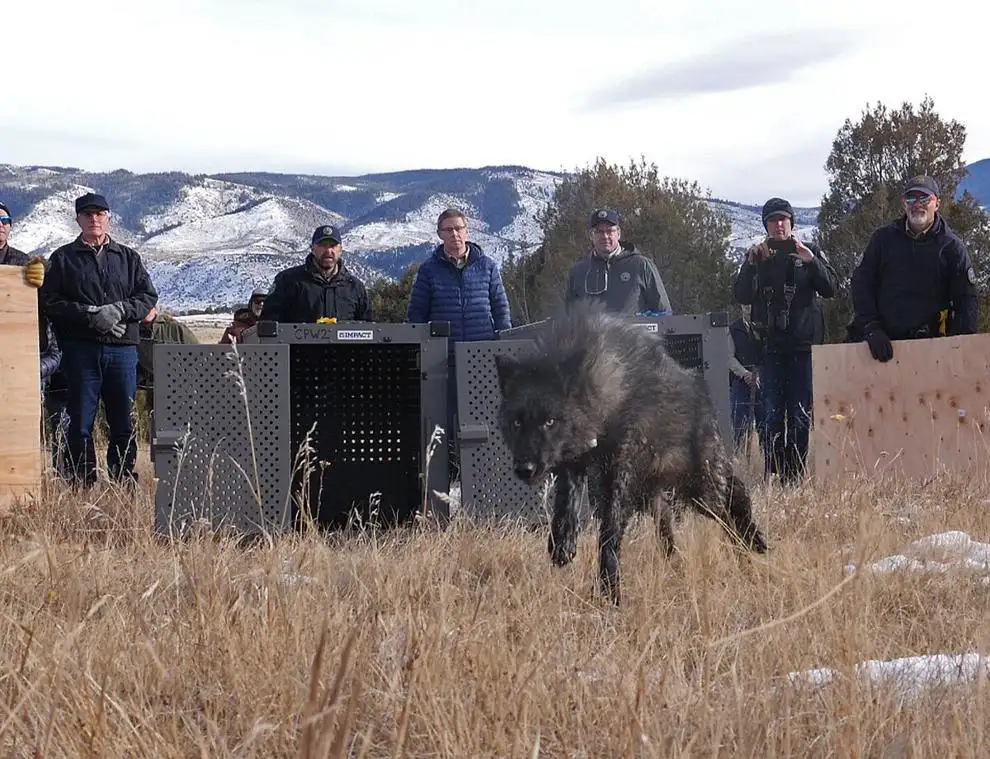
Colorado Parks and Wildlife (CPW) reported continued growth of the state’s gray wolf population during the 2025-2026 biological year, with a minimum population count of 32 wolves statewide. The update was released on May 7 in CPW’s third annual gray wolf report covering April 1, 2025, through March 31.
Of the 32 wolves identified in Colorado, CPW said 24 were part of established packs while eight were considered dispersing wolves moving outside pack territories. During the reporting period, the agency recognized four packs—Copper Creek, King Mountain, One Ear and Three Creeks. Most wolf activity remained centered in northwest Colorado, although some wolves traveled into other areas of the state.
“This year’s annual report highlights CPW’s continued efforts to refine and improve our wolf program on all levels, ranging from monitoring to conflict minimization and compensation, and public engagement,” said CPW Director Laura Clellan.
CPW documented four litters born during the reporting year, a development officials said, indicating wolves are continuing to establish packs and reproduce in the state.
“Pup recruitment into the wolf population this year was very high, which is a sign of wolves’ ability to find one another, pair, reproduce, and make a go of it in Colorado,” said Wolf Conservation Program Manager Eric Odell. “While we do not know what the future will hold, this is an encouraging sign of the biological success of our program and displays a positive trend in our wolf population size.”
The One Ear pack was the state’s largest, with a minimum count of nine wolves, including at least five surviving pups. The Copper Creek pack had six wolves, Three Creeks had five and King Mountain had four.
Mortalities and removals
CPW reported 10 wolf mortalities during the biological year, with an estimated adult survival rate of 61%. According to the report, one wolf died from natural causes, six from anthropogenic causes and three deaths remain under investigation.
Documented causes of death included legal shootings outside Colorado, a vehicle strike, entrapment, capture-related mortality and lethal removal tied to livestock depredation management.
The report detailed the lethal removal of wolf 2405 from the Copper Creek pack after repeated livestock depredations in Pitkin County. CPW said several producers continued experiencing losses even after using nonlethal deterrents and removing potential attractants.
After consulting with the U.S. Fish and Wildlife Service, the agency determined lethal removal was allowed under state and federal law and removed the wolf on May 29. Additional depredation incidents were later reported in the area, though attempts to remove another wolf were unsuccessful.
CPW also attempted to lethally remove an uncollared wolf linked to chronic depredation in Rio Blanco County, though those efforts were unsuccessful.
Compensation tops $750,000
The agency emphasized continued investment in nonlethal conflict minimization efforts. During the reporting period, CPW conducted 78 site assessments, deployed more than 13 miles of fladry across 15 locations and used 61 scare devices statewide.
The agency also launched its Colorado Range Rider Program in partnership with the Colorado Department of Agriculture. Eleven contracted riders worked across northwest Colorado counties during the 2025 grazing season, assisting 34 livestock producers.
CPW confirmed 43 wolf depredation incidents during the reporting year involving 19 cattle, 23 sheep and one working dog. The agency paid $43,275.06 in direct compensation for those losses and approved more than $709,000 in additional claims related to missing livestock, lower conception rates and reduced livestock weights.
Funding for nonlethal programs came from several sources, including Colorado’s “Born to Be Wild” license plate program, which generated more than $1.8 million during the reporting period.
The report noted CPW continues working with state, federal, Tribal and university partners on wolf monitoring, conflict management and research as Colorado’s wolf restoration effort moves forward. — Charles Wallace, WLJ contributing editor