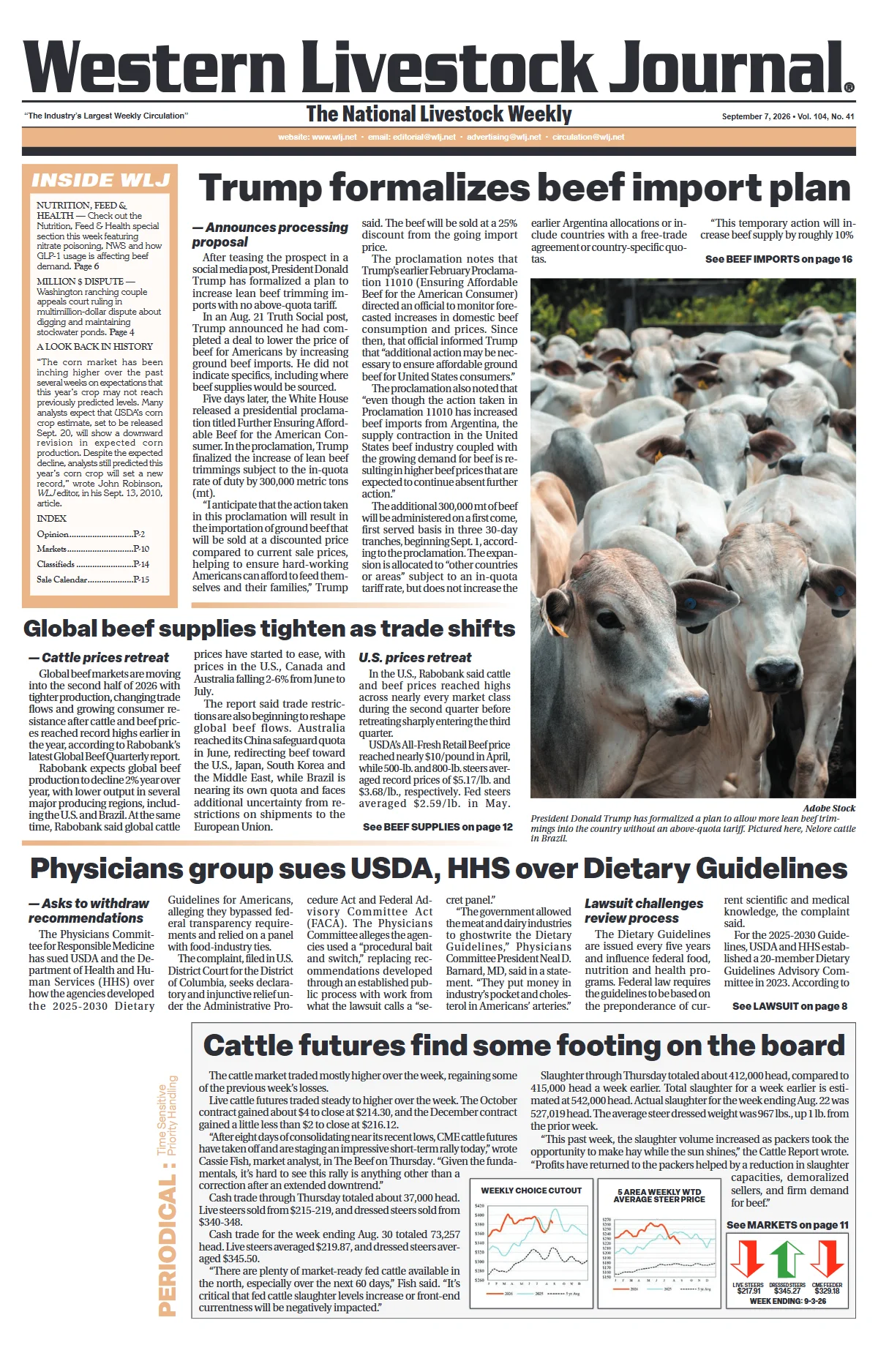
Global beef markets are moving into the second half of 2026 with tighter production, changing trade flows and growing consumer resistance after cattle and beef prices reached record highs earlier in the year, according to Rabobank’s latest Global Beef Quarterly report.
Rabobank expects global beef production to decline 2% year over year, with lower output in several major producing regions, including the U.S. and Brazil. At the same time, Rabobank said global cattle prices have started to ease, with prices in the U.S., Canada and Australia falling 2-6% from June to July.
The report said trade restrictions are also beginning to reshape global beef flows. Australia reached its China safeguard quota in June, redirecting beef toward the U.S., Japan, South Korea and the Middle East, while Brazil is nearing its own quota and faces additional uncertainty from restrictions on shipments to the European Union.
U.S. prices retreat
In the U.S., Rabobank said cattle and beef prices reached highs across nearly every market class during the second quarter before retreating sharply entering the third quarter.
USDA’s All-Fresh Retail Beef price reached nearly $10/pound in April, while 500-lb. and 800-lb. steers averaged record prices of $5.17/lb. and $3.68/lb., respectively. Fed steers averaged $2.59/lb. in May. However, Rabobank noted that ample frozen beef inventories gave wholesale buyers room to resist additional price increases, helping trigger an 8-16% cattle price correction. The report estimated the decline reduced producer revenues by roughly $200-500 per head.
Imports continue to offset declining domestic production. Rabobank reported U.S. beef imports increased 11% from a year earlier during the first half of 2026 to a record 3.3 billion lbs., led by larger shipments from Australia, Mexico and Argentina. The report noted Australia and Brazil could become increasingly dependent on U.S. buyers as their access to China becomes more restricted.
Rabobank said U.S. cattle buyers are also preparing for the return of Mexican feeder cattle, with the prospect of additional supplies already weighing on market expectations. While initial shipments are expected to be limited, the reopening could gradually increase feeder cattle availability as trade returns to more normal levels.
Canada, Mexico navigate supplies
In Canada, Rabobank said cattle supplies are building. July 1 cattle-on-feed inventories reached a record for the month, as cattle imports from the U.S. have nearly doubled from a year earlier since August 2025. Meanwhile, first-half fed cattle marketings fell 6%, and steer carcass weights topped 920 lbs. in July.
The report said Canadian consumers are becoming more value conscious as retail beef prices remain near record levels. Export demand is providing some support, particularly after China restored access to Canadian beef in January. Rabobank said January-May beef exports increased 6% to 215,800 metric tons, with China accounting for most of the growth.
Rabobank described Mexico’s market as one of abundant domestic cattle supplies and noted a gradual return to U.S. exports following the New World screwworm-related trade disruption.
The report estimated initial shipments through Sonora at about 11,000 head per month, with certification, inspection and logistical requirements limiting early volumes. Rabobank said Mexican feedlots remain well supplied, supported by stronger Central American cattle imports, improved pasture conditions and favorable feed costs.
Mexican beef production remains steady, but Rabobank said domestic demand faces pressure from abundant, competitively priced chicken and pork. Consumer pressure and less discretionary spending on higher-priced proteins are expected to limit beef consumption growth through year-end.
Inflation, weather and consumers
Rabobank’s North American Agribusiness Quarterly report described a mixed economic picture across the region. U.S. inflation appears to have peaked at 4.2% in May before easing to 3.4% in July, while employment growth has slowed. Inflation is also cooling in Mexico and Canada, with both countries reporting notable monthly price declines. However, Rabobank cautioned that geopolitical uncertainty and rising energy costs could put renewed pressure on inflation.
Rabobank said food-away-from-home inflation continues to outpace food-at-home inflation, supporting restaurant revenues but contributing to softer traffic. The report pointed to early signs of recovery among lower-income consumers, while stressing that restaurants will need to compete on value, consumer priorities and execution as diners remain sensitive to higher prices.
Weather remains another variable. Rabobank said El Niño is strengthening, with a 97% chance of persisting into early spring 2027. The report favors wetter fall conditions across the Midwest and South, while California could have its best opportunity in years for meaningful reservoir recharge this winter. — Charles Wallace, WLJ contributing editor