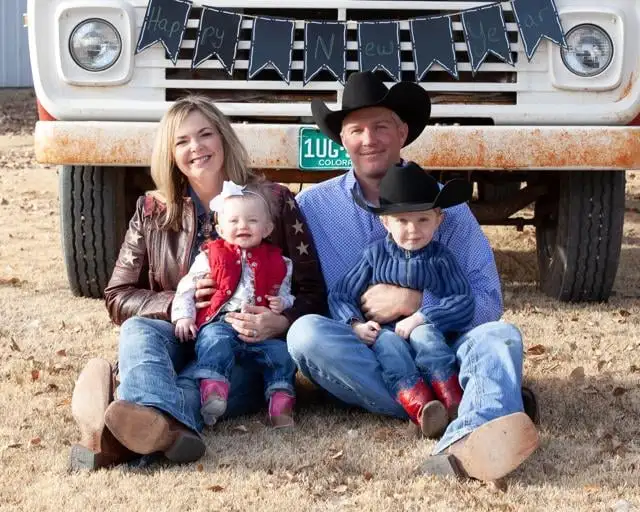
Emily Parry’s love for horses since childhood has provided her opportunities that she may not have had otherwise, leading her to become the executive director of the Colorado Reined Cowhorse Association (CRCA).
Emily began showing and judging horses in 4-H, which grew into judging at Northeastern Junior College and Colorado State University and eventually earning her National Reining Horse Association judge’s card after graduation. She also was a ring steward for many years where she ensured the safety of the arena and the exhibitors inside it, and a scribe of writing the judges’ scores on each exhibitor’s score sheet.
Emily went on to compete with cow horses, and in 2013 she won the American Stock Horse Association National Championship Show in the non-pro division, and the CoWN (Colorado, Wyoming and Nebraska Stock Horse Association) Stock Horse Regional Championship.
Emily joked that she took time out from competing and became the “broodmare” to two children, Ransom, now eight years old, and Paige, six.
Emily said she and her husband, Ryan, board horses on their property to offset the cost of their own horses and she is slowly getting back into showing. Additionally, she started Parry Prairie LLC in 2017. Through this, Emily puts on a horse show series throughout the summer at their home, along with various clinics and a youth ranch horse Bible camp each year. Last year, she attended the American Quarter Horse Association Versatility Ranch Horse World Championships and a few other cow horse shows. Still, her focus has been on her new position at CRCA.
CRCA
Emily relayed the funny story of how she came into the executive director position. In 2010 and 2011, Emily helped run events for CRCA and met Tawny Fye, current president of CRCA. More than a decade later in December 2022, Tawny called Emily and asked if she would be interested in the executive director position. Emily answered that she would be interested but felt overwhelmed when she saw the job description.
During an interview with some of the CRCA board members, they asked why she would be a good fit for the position. Emily answered that she didn’t think she would be an excellent fit due to all the details in the job description, and spent the next hour or so answering why she wouldn’t be a good fit for the position.
Emily joked that it was probably one of the worst interviews she gave. When she was halfway home, Tawny called her with the good news that she was the new executive director and that the board members said it felt like a family member had come back.
“I think that is what makes CRCA so unique and so special: It is like your cow horse family,” Emily told WLJ. “They are just a wonderful group of people and they thankfully had my back this past year.”
CRCA, founded in 1996, is one of 30—including six international—affiliates of the National Reined Cow Horse Association (NRCHA) but CRCA boasts the most shows and entries of any other affiliate in the U.S.
The shows begin with the World Show Warm Up in January in Castle Rock, CO, and continue throughout the year in Colorado, Nebraska and Wyoming with five events. Last year, CRCA had six events, which are typically preparations for shows at the national level along with opportunities for exhibitors to improve themselves and their horses all while having a good time.
Emily hopes to keep growing the association with new sponsorships while maintaining great relationships with their current sponsors.
“I think we’re on a good trend of just building on the connections and relationships by showcasing the cow horse and we need to keep trying to preserve the culture and the history of our sport,” Emily said.
Last year, Emily said they paid out $436,048 for events that totaled over 1,500 horses. They also livestreamed the shows and had about 23,000 viewers from 45 states and 12 countries. Emily said it is an exciting step towards growing the association and the sport.
The interest in the horse world and cow horses has grown since the pandemic. As interest in cow horses has increased, so too have the prices for them. Emily said pre-COVID-19, a cow horse would sell for $15,000-30,000, but can now sell for well over $60,000 depending on how broke the horse is, among other factors.
Training the horses
Emily said competing requires a good trainer and a solid horse, so more people hesitate to compete.
“What’s so exciting about the cow horse is not only do they do the reining portion, they also do the herd work, which is similar to cutting,” Emily said. “We have a hallmark of our event called fence work, where you are showing the horse can be in the correct position to control the cow.”
Each event has different levels and divisions based on experience and whether riders are amateur or professional. There are entry level classes for folks just learning where they “box” the cow, to the box drive class and eventually they can work toward going down the fence.
Emily said the training is extensive and begins with two-year-old horses, teaching them the foundation for working cows and building trust. Horses are trained using methods derived from the traditional Spanish vaquero. Depending on the horse’s age, the equipment entails different bits, bridles and reins.
Horses will begin working with a snaffle bit before they move to the bitless hackamore. Emily noted the snaffle bit was not part of the original vaquero training. They also use mecate reins made from a horse’s tail or mane, mohair or nylon in several thickness options. Mecate reins include one length of rope to make a loop around the horse’s neck, with the remainder used as a lead rope tied around the saddle horn.
When the horse is four or five years of age, the horse trains in a hackamore, which works the horse with its chin and nose rather than its mouth. When the horse is six, they transition to a “bosalito,” or little hackamore, underneath a spade bit or a bit having specific characteristics per NRCHA rules, and from the mecate reins to the romal reins.
Romal reins consist of two parts, the reins and the romal. The reins connect to the bit and the single romal cord makes up the remaining half. The romal is a piece of braided rawhide on the end of the reins. During this stage of training, the rider uses one hand to work both the mecate and romal reins to control the horse until the horse transitions to being under the control of just the bit and the romal reins.
Emily said most trainers say it takes at least four to five years to have a solid cow horse, and the great thing is there are cow horses 18 or 19 years old still showing.
“I don’t think there is anything cooler than a finished bridlehorse because you can do anything on it,” Emily said. “You can go rope and check pastures, you can do trail riding and they are good minded—and of course, going down the fence is very exciting.”
At three years old, every October, the best cow horses are tested in the NRCHA Snaffle Bit Futurity in Forth Worth, TX. Emily said it is a testament to the training for the horses to go through the three events of herd work, rein work and cow work several times during the event.
Other involvement
In addition to becoming the executive director of CRCA in the past year, Emily also keeps her plate full helping with the family’s Angus business, Parry Angus, along with assisting her local 4-H chapter and at the children’s school.
Ryan and his parents, Steve and Joanne Parry, sell registered Angus bulls yearly on the family’s operation nine miles north of Sterling, CO. In addition to the Angus operation, the Parrys farm 1,500 acres of irrigated corn and alfalfa and 2,000 acres of pasture, where the herd grazes on grass in summer and on cornstalks in winter.
Emily said she helps when necessary with chores such as moving pairs or checking on pastures but jokes that it is an excuse to ride the horses and it’s therapy for her.
Emily is also the horse events coordinator for the local 4-H chapter and ensures the horse show at the Logan County Fair runs smoothly.
“I really like 4-H and I like giving back to it as it was such a great program growing up,” Emily said. “And part of it is selfish: I want the program to be there when my kids grow up.” — Charles Wallace, WLJ contributing editor