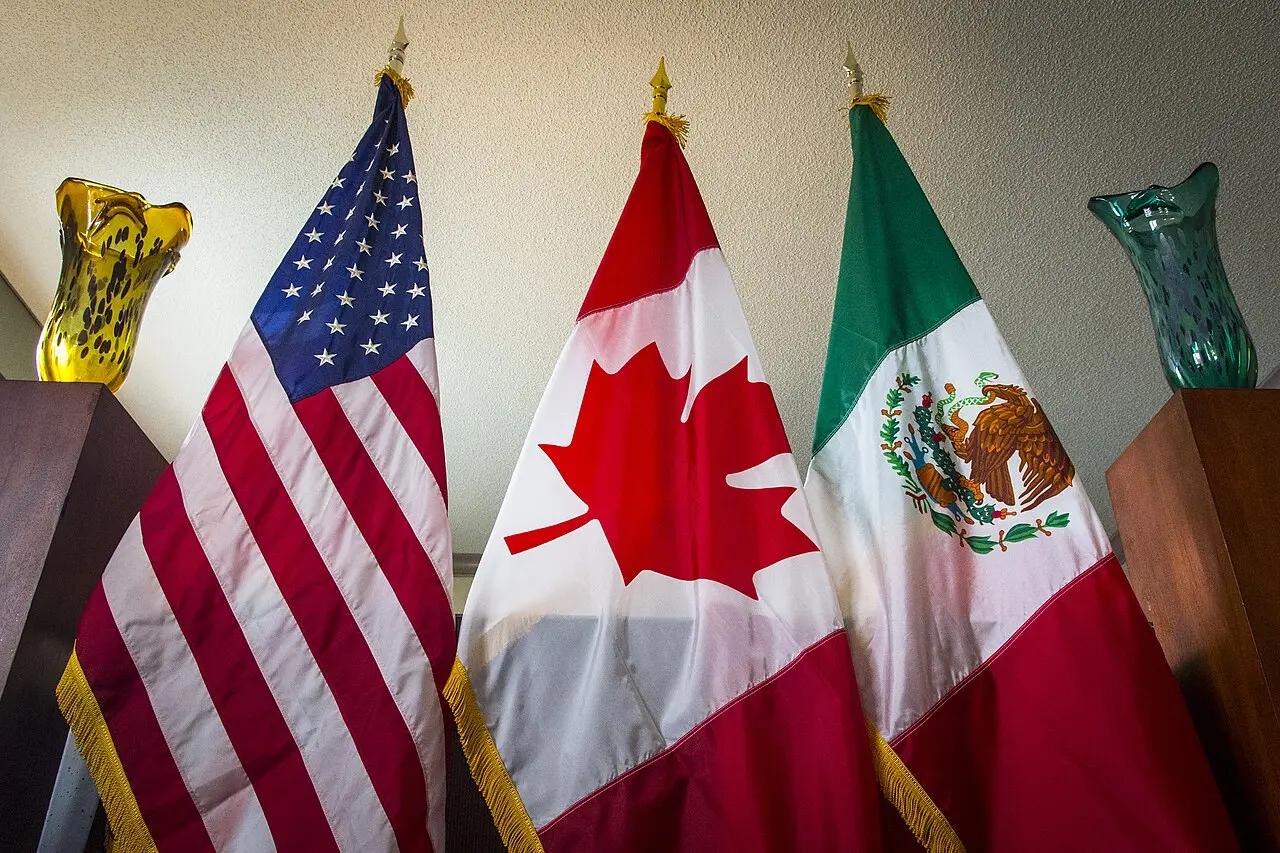
As renegotiation questions loom around the future of the United States-Mexico-Canada Agreement (USMCA), agricultural leaders from across the food and fiber sectors urged lawmakers to preserve the agreement during a June 10 hearing before the House Agriculture Committee.
Representatives from the meat, dairy, soybean, produce, forestry and business communities testified that USMCA has become one of the most important trade frameworks supporting U.S. agriculture. While most witnesses acknowledged improvements could be made during the upcoming review process, they warned that abandoning or significantly weakening the agreement would create uncertainty for producers already facing economic challenges.
The hearing took place amid renewed questions about the agreement’s future. According to CBC, President Donald Trump said June 10 he was “not looking to renew” the agreement when it comes up for review on July 1. Although USMCA remains in effect until 2036, any member nation can withdraw by providing six months’ notice.
Witnesses at the hearing argued that trade between the nations has become too important to risk disrupting.
Meat Institute calls USMCA crucial
Among those that testified included Michael Schumpp, senior director of international affairs for the Meat Institute.
Schumpp told lawmakers that Canada and Mexico remain indispensable markets for U.S. meat exports and play a critical role in maintaining a competitive livestock industry.
“In 2025, U.S. meat and poultry exports exceeded $23 billion and exports to Canada and Mexico accounted for $8 billion of that trade,” Schumpp testified. “That represents 35% of our total U.S. meat and poultry exports.”
Schumpp said Canada ranked as the fourth-largest export market for U.S. beef and pork and the second-largest destination for poultry exports in 2025. Mexico was the top-value market for U.S. pork and poultry and the third-largest destination for U.S. beef. Schumpp added that those markets are especially valuable because they purchase products that often command higher prices abroad than domestically.
According to Schumpp, exports to Canada and Mexico added approximately $91 per fed steer and more than $28 per market hog last year.
“Maintaining this robust U.S. meat trade with Canada and Mexico is crucial to reclaiming America’s agricultural trade surplus,” he said.
Schumpp warned that withdrawing from or significantly altering USMCA could reduce producers’ profitability, increase consumer costs and encourage additional meat-processing investment outside the U.S.
During questioning, Schumpp also stressed the importance of livestock movement across North America, noting that cattle and hogs frequently cross borders multiple times through feeding and processing systems before entering domestic or export markets. Disrupting those supply chains, he said, would affect feedlots, processors and producers alike.
“The integrated supply chains across North America reduce dependence on adversarial countries for critical food and agricultural inputs,” Schumpp said.
Other sectors voice support
While the meat industry focused heavily on preserving existing market access, other witnesses echoed that sentiment and highlighted specific provisions they would like strengthened.
Jamie Beyer, an executive committee member of the American Soybean Association, echoed concerns about preserving market certainty.
Beyer said Canada and Mexico purchased approximately $4 billion worth of U.S. soybean products during the most recent marketing year, accounting for more than 13% of total soybean complex exports.
Beyer called USMCA the “gold standard” of trade agreements and urged policymakers to approve a full 16-year extension.
“As soybean farmers continue to face a challenging economic landscape, failure to renew USMCA would be catastrophic,” she said.
Michael Lichte, chief insights and optimization officer for Dairy Farmers of America, described Mexico as a major success story for U.S. dairy exports. However, he said Canada continues to fall short of fulfilling dairy market-access commitments negotiated under USMCA.
Lichte pointed to Canada’s administration of dairy tariff-rate quotas, arguing that access negotiated by U.S. dairy producers has not translated into meaningful commercial opportunities. For example, he testified that less than 10% of available yogurt quota access was utilized in 2025.
“Access that exists on paper is not consistently translating into real market opportunities,” Lichte said.
Dave Puglia, president and chief executive officer of the Western Growers Association, stressed the importance of maintaining tariff-free trade in produce while strengthening labor and food-safety enforcement provisions.
Canada and Mexico account for roughly two-thirds of all U.S. fresh produce exports, according to Puglia. He urged negotiators to ensure food-safety oversight in Mexico meets standards comparable to those required of U.S. producers.
Neil Herrington, senior vice president for the Americas Program at the U.S. Chamber of Commerce, broadened the discussion beyond agriculture, noting that more than 13 million American jobs depend on trade with Canada and Mexico.
Herrington cited a recent Purdue University study estimating North American trade agreements save U.S. households roughly $700 annually in food costs. He warned that abandoning duty-free trade within North America would likely increase food prices and place additional pressure on consumers already struggling with inflation.
Witnesses argued that the USMCA has provided stability for farmers, ranchers, processors and agribusinesses, enabling long-term investments based on reliable market access and helping North American agriculture remain competitive globally. — Charles Wallace, WLJ contributing editor