Since the first detection in South Texas on June 3, additional cases of New World screwworm (NWS) have been detected in the U.S.
As of June 11, six cases of NWS were identified in the U.S. A total of four cases have been reported in beef calves in Texas, along with one goat in Texas and one dog in New Mexico.
“The U.S. Department of Agriculture’s Animal and Plant Health Inspection Service, alongside state partners in Texas and New Mexico, continues to lead an aggressive response to New World screwworm in the United States,” USDA said.
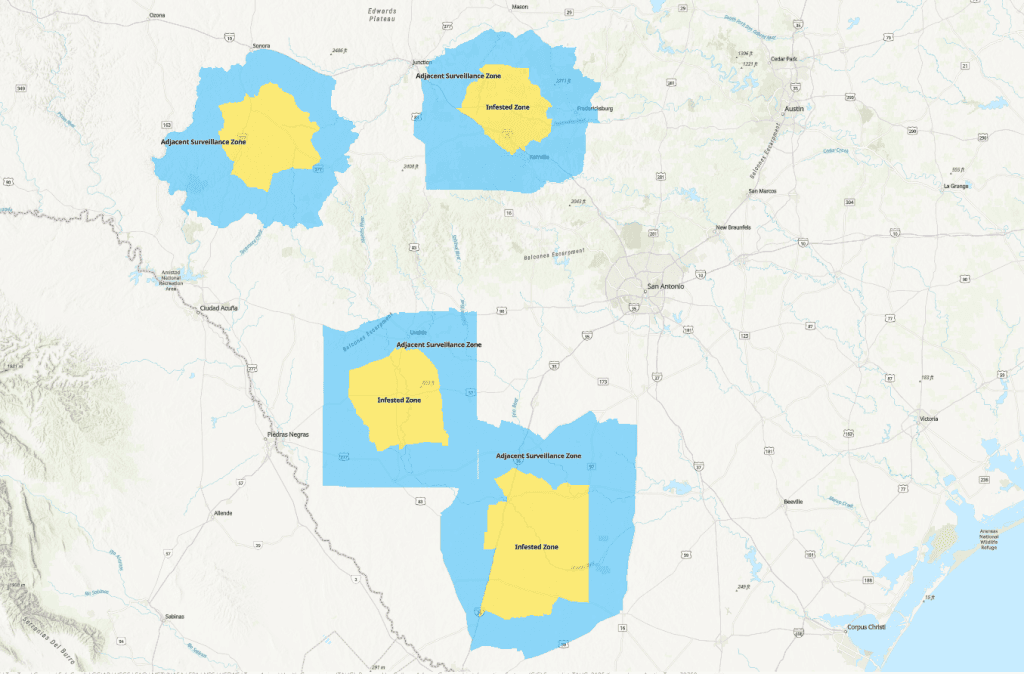
In Texas, two NWS cases were reported in calves in Zavala County, two cases were reported in La Salle County and one case was reported in a goat in Gillespie County. In New Mexico, one case was reported in a dog in Lea County.
The Texas Animal Health Commission (TAHC) set 12-mile infested zone quarantines in Gillespie, Kerr, Kimble, La Salle, Webb, Uvalde and Zavala counties following the detections. Animals in the infested zones may not move outside the zone without prior authorization and a certificate following inspection and treatment. Unauthorized movement is subject to administrative penalties and/or criminal prosecution.
Following the detection in New Mexico, the New Mexico Livestock Board issued an emergency declaration allowing for additional state and federal assistance to combat the pest. The case was believed to be an isolated incident, but as the dog’s recent travel and exposure history was unknown, animal health officials conducted additional inspection and increased outreach in the area.
USDA has expedited the targeted release of sterile flies and will continue to deploy ground release chambers in areas that report detections of NWS.
USDA press conference
On June 8, USDA Secretary Brooke Rollins hosted a press conference from Kerrville, TX, to provide updates on NWS.
“These developments obviously represent a serious threat to our livestock and wildlife, but they haven’t caught us off guard,” Rollins said. “We have been tracking this pest for a long time, and we have fought before, and we will do so again.”
Rollins announced that USDA is advancing several next-generation tools and technologies submitted through the department’s New World Screwworm Grand Challenge, which closed earlier this spring. Through the program, the Animal and Plant Health Inspection Service (APHIS) is investing up to $100 million to support projects intended to combat the NWS.
“You will hear of some of those innovations coming out week by week by week,” Rollins said.
Rollins also noted that the construction of the NWS sterile fly production facility at Moore Air Base in Edinburg, TX, is being fast-tracked to get up and running as soon as possible.
Texas Gov. Greg Abbott (R) also spoke at the press conference, emphasizing the importance of checking animals daily.
“Check for any wounds, even small wounds like tick bites or navels of newborns or other openings,” Abbott said. “Treat wounds promptly and work to reduce fly populations around your operations. Report immediately any suspicion of New World screwworm in wounds to the Texas Animal Health Commission.”
Any suspected cases can be reported to the TAHC 24-hour call line at 1-800-550-8242. Any suspected cases in wildlife can be reported to the Texas Parks & Wildlife Department biologists at 512-389-4505.
Associate Administrator for APHIS and Director of the New World Screwworm Directorate Michael Schmoyer also announced USDA would be conducting a trial to look at the use of ivermectin in feed for wildlife populations to control infestations.
During the Q&A portion of the press conference, Rollins was asked about Texas Agriculture Commissioner Sid Miller’s comments on ranchers not reporting NWS cases over fears of government-mandated quarantines.
“That is a very unserious comment from a perhaps unserious ag commissioner with just a few months left,” Rollins responded. “It is also a very dangerous suggestion.”
She added, “From my perspective, (ranchers) have been nothing—as you would expect—but patriotic; (they) know they’re part of the battle. We’re all on the same team and we have to solve this together.”
Livestock import restrictions
On June 9, Mexico announced it was temporarily suspending livestock imports from the U.S.
“Through this action, the health protection of the livestock herd in the northwest of the country is strengthened, where the presence of the cattle screwworm plague is not currently recorded, specifically in the states of Baja California, Baja California Sur, Chihuahua, Sinaloa and Sonora, with the purpose of preserving its zoosanitary status,” the country’s Ministry of Agriculture said in a news release translated from Spanish.
The temporary pause on imports applies to cattle, horses, pigs, sheep, goats, birds and ferrets.
Canada also announced it would implement temporary import restrictions on livestock entering Canada from affected areas. The Canadian Food Inspection Agency said animals that originate from or that were present in Texas within 21 days prior to border crossing will not be accepted into Canada.
“While our colder climate is not hospitable for the long-term establishment of the fly in Canada, they can survive shorter periods of time in the summer months,” the agency said. “Taking this action now is an appropriate risk mitigation measure to prevent its introduction and protect animal health.”
Derrell Peel, Oklahoma State University Extension livestock marketing specialist, said the move was largely political as it will affect a very small volume of trade.
“Although there is significant bilateral cattle trade between Canada and the U.S., very few Texas cattle are typically involved,” Peel said. “Canada is well north of the climate boundary for NWS and the threat is minimal.”
Several U.S. states also announced tighter veterinary requirements for livestock entering from Texas, including Colorado, Florida, Georgia, Louisiana, Montana and Tennessee.
NWS senior advisor appointed
On June 8, USDA announced the appointment of John Bellinger as the new senior advisor for New World screwworm preparedness. In his role, Bellinger will help explore all available technologies to combat the pest, USDA said.
“John’s roots in Texas where New World screwworm is at ground zero, and his private sector experience in the related food safety and cattle industries, will help the administration advance our response and protect U.S. livestock,” Rollins said.
Bellinger currently serves on the Texas A&M Board of Regents as chair of the Committee on Research. He is the co-founder and former CEO of Food Safety Net Services, along with the founder and CEO of Agri-West International. Bellinger also is the former chairman of the U.S. Meat Export Federation and the Southwest Meat Association.
The most up-to-date NWS information may be found at screwworm.gov. — Anna Miller Fortozo, WLJ managing editor