The U.S. is not running out of farmland overnight, but the land base supporting agriculture is changing in ways that could make it increasingly difficult for farmers and ranchers to access and keep productive ground.
A new Market Intel report by American Farm Bureau Federation (AFBF) Economist Daniel Munch finds that while millions of acres continue moving among cropland, pasture and conservation uses, development and a coming generational transfer of farmland ownership are creating long-term challenges that extend well beyond simple acreage totals.
Development continues to expand
Although the U.S. still maintains a vast agricultural land base, the long-term trend points toward continued conversion of rural land to developed uses (see Figure 1).
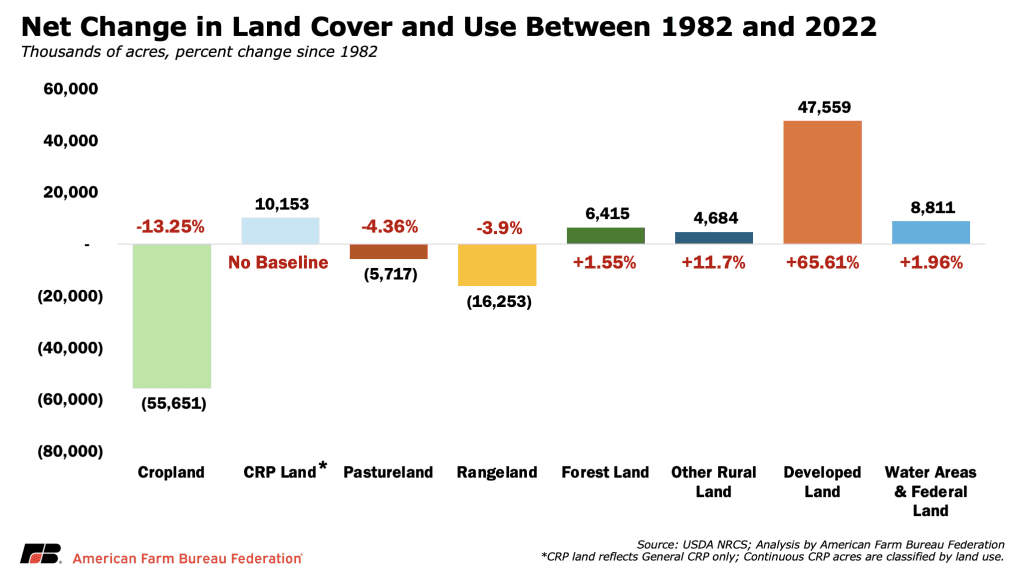
According to the report, cropland declined by 55.7 million acres between 1982 and 2022, a 13% decrease roughly equivalent to the size of Kansas. During the same period, rangeland declined by 16.3 million acres, or about 4%, while pastureland fell by 5.7 million acres, also about 4%. In contrast, developed land expanded by nearly 48 million acres, a 66% increase approximately equal to the size of Nebraska.
The AFBF analysis shows that over the past 40 years, developed land saw the largest increase of any land-use category, while cropland posted the biggest overall decline. At the same time, forestland, other rural land and Conservation Reserve Program (CRP) acreage all grew, showing the land base continues to shift among multiple uses, not just development.
Munch cautioned against assuming every acre leaving cropland was paved over.
Many acres moved into pasture, forest or conservation uses and remain connected to agriculture. Others may eventually return to production depending on commodity prices, livestock demand, drought conditions or conservation contracts.
While development remains agriculture’s most permanent land-use pressure, its pace has moderated since the rapid expansion of the 1990s.
The analysis shows new development peaked between 1992 and 1997, when approximately 10.8 million acres entered developed uses. During each of the last two five-year reporting periods, newly developed land totaled between 3 million and 3.4 million acres.
Munch said that slower pace should not be confused with an end to farmland conversion.
Munch noted that millions of acres continue entering developed uses every five years, particularly in regions experiencing population growth, transportation expansion and new economic development. Development also comes from multiple land types. Munch’s analysis showed forestland supplied the largest share of newly developed acreage during the study period, followed by cropland, pastureland and rangeland.
Land shifts within agriculture
The report notes that movement between agricultural land uses remains common (see Figure 2).

“The biggest recent exchange was not cropland to development, but cropland and pasture moving back and forth,” Munch wrote.
Between 2017 and 2022, approximately 357 million of the 365 million acres classified as cropland remained in crop production. When land did change uses, the largest shift was into pastureland, accounting for 5.65 million acres. By comparison, only about 687,000 acres were converted directly from cropland to developed uses such as housing, commercial buildings or roads during that same period.
Cropland also gained acreage from other uses. Pasture contributed more than 4.1 million acres back into crop production, while another 2.1 million acres came from land leaving CRP.
The report notes that CRP itself should be viewed carefully in long-term comparisons because it was created in 1985, after the 1982 baseline used in the National Resources Inventory. In addition, the inventory tracks only General CRP separately, while Continuous CRP acres remain classified according to their existing land cover.
Ownership changes present a challenge
Beyond land-use changes, Munch said ownership patterns may present an even greater challenge for future producers (see Figure 3).

The report found that 39% of U.S. agricultural land is rented, a share that has remained relatively stable for decades. In 2024, more than 2 million landowners rented out nearly 348 million acres for agricultural production. Cropland accounted for 59% of those rented acres. Non-operating landlords controlled 276.1 million acres, or nearly 79%, of all rented agricultural land.
According to Munch, ownership patterns are becoming an increasingly important factor in determining who has access to agricultural land. He found that privately owned properties account for about 105 million rented acres, while trusts and family legal entities control another 146.6 million acres. Munch noted that more than one-third of non-operating landlords are age 75 or older, and together they control more than 40% of the rented acres owned by non-operating landlords.
Despite the age of many landowners, Munch said relatively little farmland is expected to change hands through traditional sales in the near future. Less than 5% of owned farmland is projected to be sold or gifted over the next five years. Instead, he found that about 10% is expected to move into trusts and another 15% will be transferred through wills and estate plans, meaning many decisions about future land access will remain within families rather than the open market.
According to Munch, those decisions will largely determine whether land remains available to farmers or shifts toward other ownership priorities.
For producers, Munch argues, the challenge extends beyond preserving acreage. The more pressing question is whether productive land remains available, affordable and workable for the next generation of farmers and ranchers as development pressures and succession decisions reshape rural America.