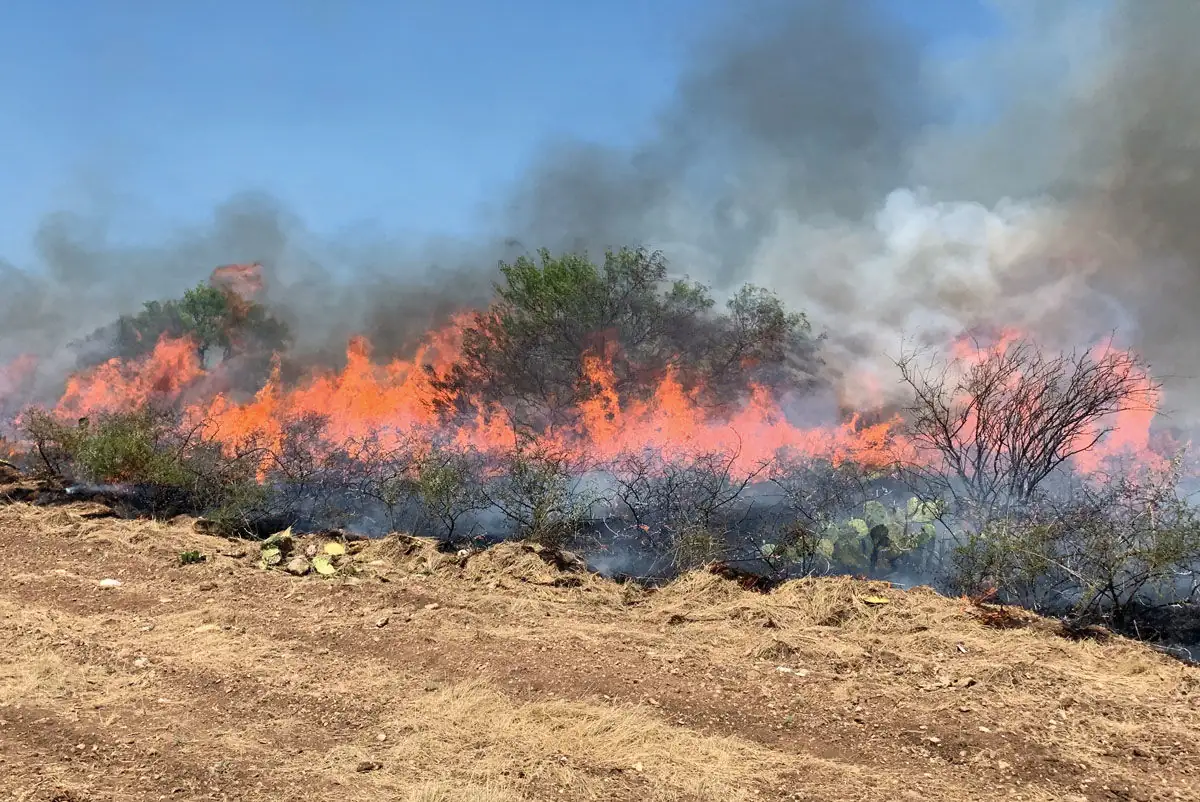
Texas’ winter/spring wildfire season is about to begin. Fire experts predict it could be a particularly active season because of La Niсa this year. The weather pattern often brings drier, warmer weather and strong wind; the perfect recipe for fire.
“Mid-February through mid-April is the peak of winter/spring fire season,” said Brad Smith, the predictive services department head at Texas A&M Forest Service, a division of Texas A&M AgriLife.
“Coincidentally, that lines up with when La Niсa presents itself.”
La Niсa refers to a cyclical weather pattern characterized by drier, warmer conditions. Meteorologists at the National Weather Service’s Climate Prediction Center (CPC) issued a La Niсa advisory in November 2020. This means the conditions were present at the time. CPC later extended the advisory in February, with predictions the condition will last through April or May.
Despite the historic freeze and snow from Winter Storm Uri in February, Smith said La Niсa is still in play. That means the fire season concerns still exist.
“The precipitation was beneficial and has delayed the start of the fire season, but it was not enough to prevent it,” Smith said. “Despite the February precipitation, the Drought Monitor still shows 75 percent of the state at some level of drought or abnormally dry.”
Winter fire season in Texas
“I sometimes call it the dormant season,” Smith said. “We have the cold winter weather that freezes and kills our grasses or sends them into dormancy.”
Winter winds dry already dead or dormant grasses even more, turning them into excellent fuel for wildfires. They also help spread fires once they start.
La Niсa takes those conditions and makes them worse. Where Texas winters are normally dry, La Niсa brings even less precipitation and warmer temperatures.
Historically, La Niсa years have seen more, bigger fires that burn more acres. For example, over 5.7 million acres have burned in Texas since 2005 during the winter/spring seasons in La Niсa years. This compares to 280,511 acres burned during non-La Niсa years. Texas A&M Forest Service fire experts attribute this to the extended drying and the strength of the weather during La Niсa years.
Wildfire outbreaks
According to Smith, La Niсa conditions increase the risk for “high impact fire weather events.” Key among these are Southern Plains Wildfire Outbreaks (SPWOs). Smith described these as situations with strong winds and “a lot of great ingredients for large fires that are very difficult to control.”
He cited records showing that SPWOs account for only 3 percent of the reported winter/spring wildfires, but 49 percent of the acres burned.
“These SPWOs over the past 15 years have been the biggest threat to property and public safety,” said Smith. “Because of our experience over the past years with La Niсa winter fire seasons, we expect large fires. I think there’s a good chance we will see one, if not more, SPWOs this season as well.”
Soil moisture
“Our winter/spring fire season will end when the grass turns green,” said Smith. “When we get warm enough temperatures, and enough precipitation and soil moisture, the grasses will green.”
That usually happens in May in the High Plains of Texas, an area that is particularly susceptible to winter/spring fires, under neutral conditions. But La Niсa conditions are not neutral. The combination of less precipitation and higher temperatures means soil moisture levels are typically lower for longer during La Niсa years. This is the case currently.
According to the U.S. Drought Monitor, soil moisture is currently lower than average for the state. That condition is expected to persist through the end of April at least. Similarly, the CPC projects Texas has a strong to moderate likelihood of seeing above normal temperatures and a moderate likelihood of seeing below normal precipitation rates in the next three months under La Niсa.
“We still have a lot of time to dry out and incur some of these large wildfires,” Smith said. — Kerry Halladay, Texas A&M AgriLife Extension