Nationwide
This week was defined by a significant precipitation divide, highlighted by a major deluge across parts of the South and Gulf Coast. 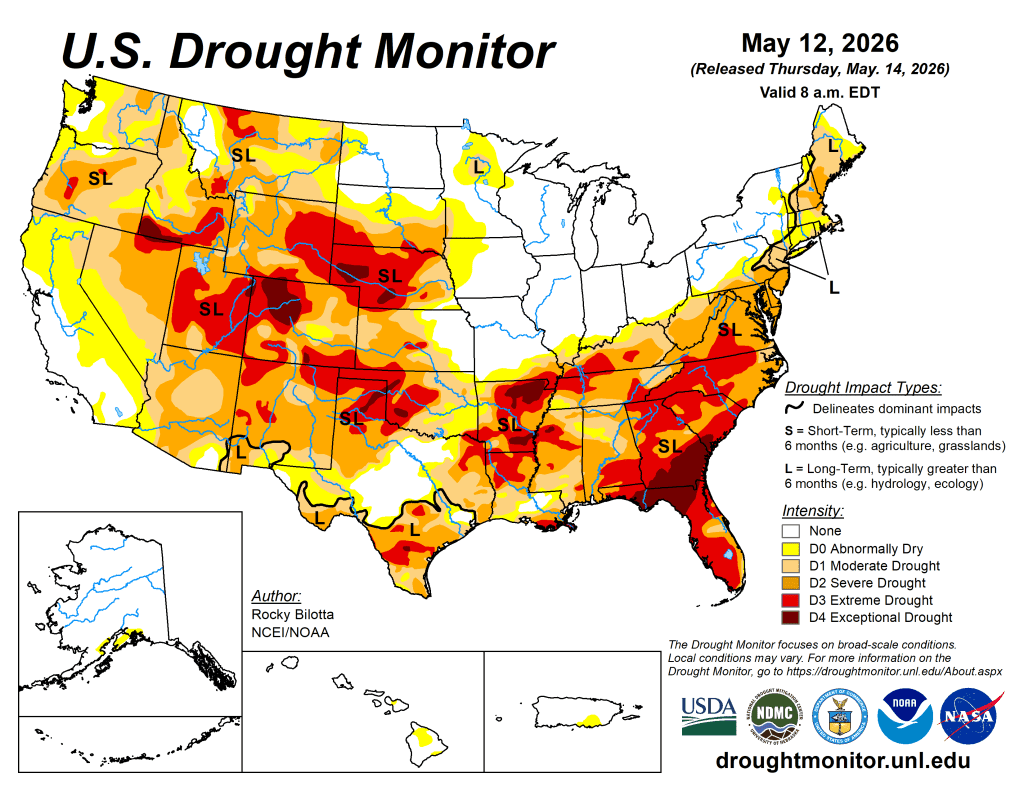
Persistent storm systems funneled heavy moisture into Louisiana, Mississippi, and Alabama, where total rainfall reached 4-6 inches—and in some coastal pockets even higher—representing departures of 3-5 inches above seasonal norms. While an active frontal corridor brought a secondary band of moderate rain (1-3 inches) from Texas through the Ohio Valley and into the Northeast, the Western U.S. remained exceptionally dry, with most areas west of the Rockies receiving less than 0.1 inch of rain. This lack of moisture, paired with blustery winds, triggered extreme fire danger across the Upper Mississippi Valley, though the period concluded with a pattern shift as a significant Pacific low-pressure system finally moved onshore to deliver moisture to the Northwest.
Temperature patterns showed an equally sharp geographical split, with unseasonable warmth gripping the West and parts of the South while a late-spring chill lingered over the North. In the Southwest and South Texas, summer-like heat took a firm hold as Rio Grande Village, Texas, hit a national high of 105 F and Death Valley consistently reached the triple digits; overall, the Western U.S. averaged 5-15 F above normal.
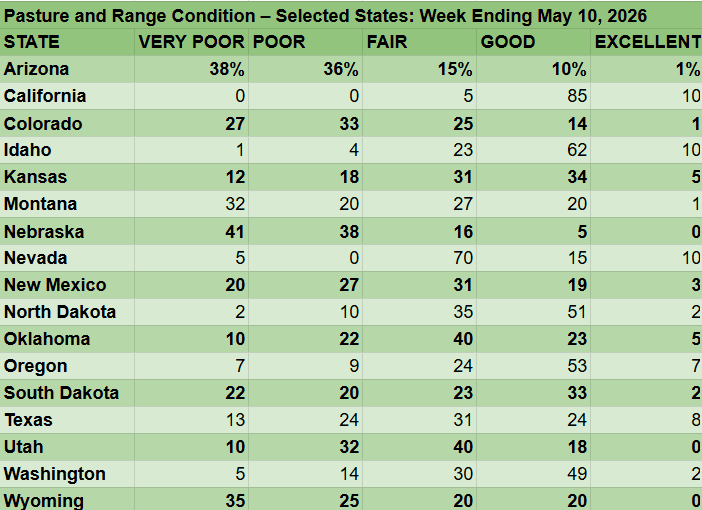
Conversely, a significant cool-down settled over the Northern Plains and Upper Midwest, where the Dakotas and Minnesota experienced temperatures 5-15 F below seasonal averages. This thermal contrast was further sharpened by winter-like conditions in high-elevation regions of the West, where stations in Utah recorded lows as cold as 10 F, even as record-challenging warmth began to expand across the Pacific Northwest and the Southern Border states.
The West
The West was characterized by unseasonable warmth and widespread dryness across the Pacific Coast and Great Basin, contrasted by cooler, more active conditions in the Rocky Mountains this week. 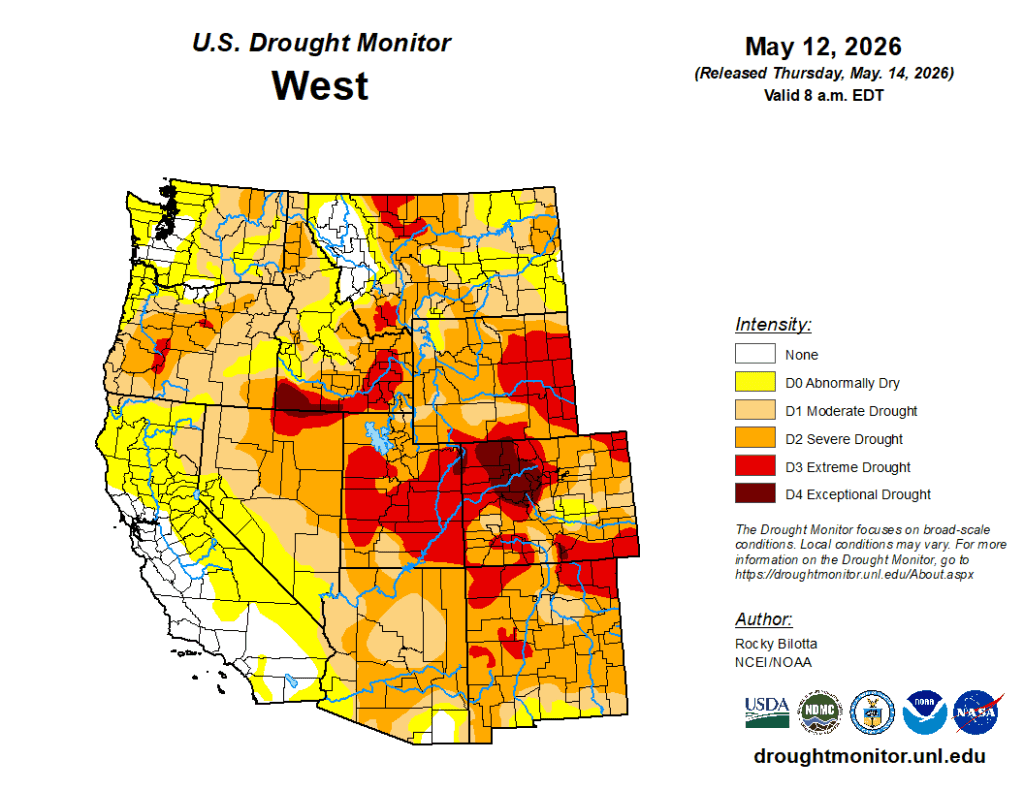
The eastern portion of the region—specifically eastern portions of Montana, Utah, and New Mexico—remained notably cooler, with departures ranging 3-6 F below normal. However, most of the region, particularly in parts of Oregon, California, and Nevada, experienced significant temperature departures of 6 F to over 12 F above normal, with actual average readings in the Desert Southwest reaching the 80s and 90s.
This heat was paired with minimal moisture, as coastal and interior basin states recorded less than 0.1 inches of rain, resulting in precipitation deficits of 0.6 to 1.5 inches below seasonal averages.
Exceptional (D4) drought was expanded in southern Idaho, while extreme (D3) drought was introduced in Oregon and expanded in Montana, Idaho, and Nevada this week. Severe (D2) and moderate (D1) drought were expanded in Oregon, Idaho, and Montana. Severe (D2) drought was also introduced in northern Washington and expanded in northern Nevada. Conditions deteriorated over parts of southwest Washington and northwest Oregon, resulting in the expansion of abnormal dryness (D0) in these areas. Conversely, localized moisture resulted in improvements in moderate (D1) to severe (D2) drought and abnormal dryness (D0) in southern Arizona, while moderate (D1) drought improved in parts of western Nevada.
The High Plains
Anomalous warmth dominated most of the High Plains this week, while precipitation was defined by a significant east-west gradient. The eastern portions of the region remained under a persistent late-spring chill with average temperatures falling 4-10 F below seasonal norms. This area was also exceptionally dry, receiving less than 0.05 inches of rain, which resulted in precipitation deficits of 0.6 to 1.2 inches. 
Persistent dryness resulted in the expansion of exceptional (D4) drought in Nebraska, while moderate (D1) to extreme (D3) drought was expanded in northeastern Wyoming, South Dakota, Nebraska, and Kansas. In contrast, the western High Plains across Wyoming, much of Colorado, and western portions of South Dakota and Nebraska, experienced unseasonable warmth, with departures ranging from 2-6 F above normal. This warmth was accompanied by an active moisture corridor through the southern High Plains; while northern and eastern reaches were dry, portions of Colorado and adjacent areas of Wyoming and Kansas recorded 0.7 to 1.6 inches of precipitation, ranging from 0.3 to 0.9 inches above normal. This above-normal precipitation resulted in the removal of exceptional (D4) and the reduction of extreme (D3) drought in Wyoming, and improvements from severe (D2) to exceptional (D4) drought in Colorado and from severe (D2) to extreme (D3) drought in western Kansas.
The South
The Southern region experienced a stark contrast in both precipitation and temperature during the week, defined by torrential Gulf Coast rains and a significant late-spring chill across the interior. 
Precipitation was most intense across the central Gulf Coast, particularly in Louisiana and southern Mississippi, where weekly totals reached 7 to over 9 inches. These amounts represent exceptional departures of 6 to 7.5 inches above normal. Moderate (D1) to Exceptional (D4) drought was reduced in southern and eastern portions of Texas, and in parts of Louisiana, Mississippi, and southern Tennessee. Abnormal dryness (D0) was improved in parts of Texas and southern Louisiana.
Conversely, drier conditions prevailed in West Texas, Oklahoma, and much of the Tennessee Valley, where precipitation was generally 1.5 to 3 inches below average. Exceptional (D4) was introduced in southwest Oklahoma and from the Texas Panhandle into northwest Oklahoma, and expanded in parts of Arkansas and northern Mississippi. Extreme (D3) expanded in the northern portions of Texas and western Oklahoma. Heat persisted in southern Texas, where average temperatures reached the 80s and 90s, representing departures of up to 5 F above normal. However, a powerful cold anomaly gripped the northern, eastern, and central portions of the region. In these areas, temperatures were broadly 5 to 10 F below normal for the week. — UNL Drought Monitor