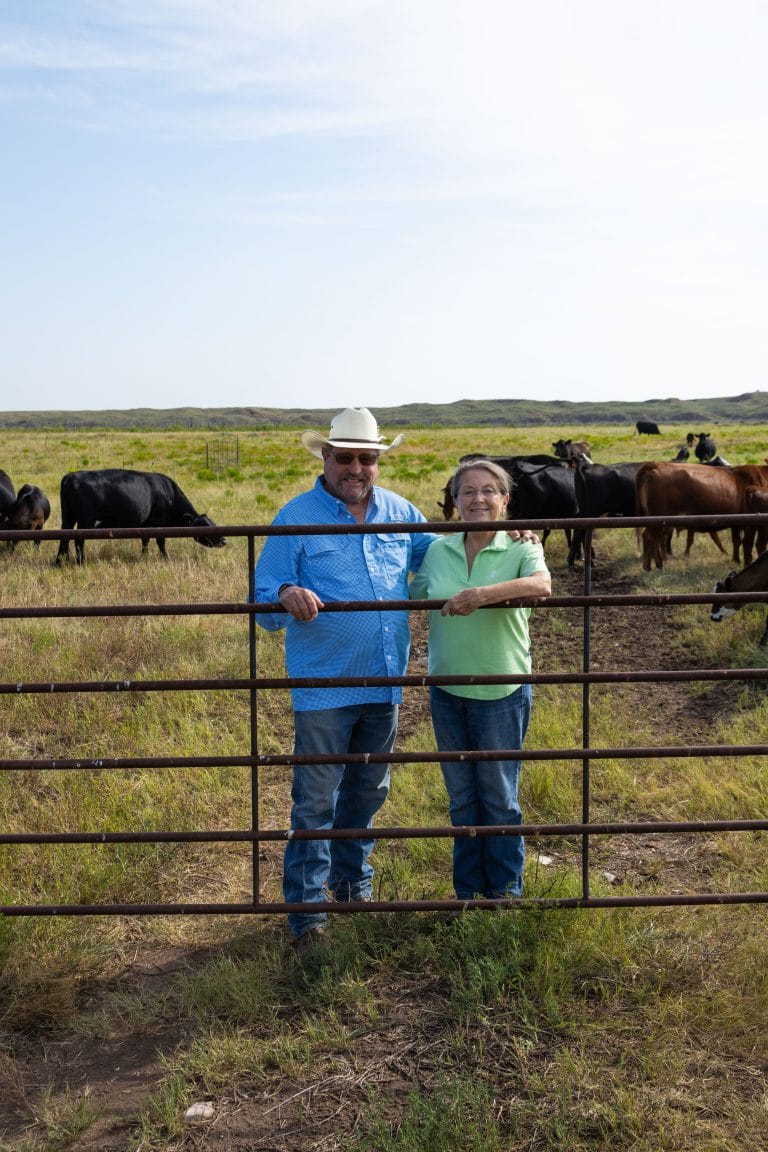
For Matt Perrier, ranching isn’t just a profession—it’s a calling rooted in family heritage and industry leadership.
Through his leadership roles and dedication to education and advocacy, Matt has become a respected voice in the beef industry. Whether managing cattle, serving on industry committees or sharing insightful conversations through his podcast, “Practically Ranching,” Matt remains invested in the future of American ranching.
Background
Born and raised on the family’s Dalebanks Angus ranch in Eureka, KS, Matt earned his degree from Kansas State University in the mid-’90s and set out to gain experience beyond his home state. His first stop was Pennsylvania, where he worked with the Pennsylvania Beef Council, engaging with food service and retail customers to promote beef.
Matt was in this role for just under a year when an opportunity arose with the American Angus Association—the exact position he had hoped for but one that wasn’t readily available when he graduated in 1996. When the opportunity finally came, Matt took the job and moved to Fort Worth, TX, covering New Mexico and Texas as a regional manager for the association for several years. Eventually, he relocated to the association’s headquarters in St. Joseph, MO, and spent several more years in the commercial programs department. However, in 2004, when one of the longtime employees at Dalebanks Angus decided to move on, Matt and his wife, Amy, decided to return to the ranch.
“I remember my dad calling me and asking if I knew anyone looking for a job,” Matt told WLJ. “Amy and I talked and prayed on it, we had just had a year-old baby girl and decided that it may be time to make the move back to our family operation.”
The ranch
Dalebanks Angus traces its roots back to 1867 when Matt’s ancestors settled in the Flint Hills. Despite the name, no one named Dale or Banks ever owned it—it was a farm name brought over from England. The ranch introduced registered Angus cattle in 1904 when Matt’s great-grandfather, E.L. “Bert” Barrier, intrigued by a new breed known for its efficiency and marbling, traveled to the American Royal to see them firsthand.
“The reason they went to the Royal was because Mr. Barrier had heard of a new breed of cattle that had just been around in the States,” Matt said. “They were black, they didn’t have horns and he’d never seen such a thing. So, they went up the Royal and looked and looked, but couldn’t find any of these Aberdeen Angus cattle until finally, they saw a little display under the ramp at the old American Royal building. They didn’t buy any that year but made some connections.”
A year later, in 1904, Barrier purchased his first registered Angus cows and the family ranch has raised them ever since, making Matt the fourth generation of Angus producers.
Matt shared that his parents, Carolyn and Tom, remain deeply involved in the operation, with his dad still out every day handling various tasks, including much of the office work. Matt and Amy have five children: Ava, a college senior; Lyle, a college freshman; Hannah, a high school junior; Henry, an eighth grader; and their youngest, Hope, a kindergartener.
“We’re pretty spread out,” Matt said, “but we have lots of cow hands and plenty of help.”
Matt and Amy have always encouraged their children to explore opportunities beyond the ranch. “We believe it’s important for them to go out into the world, gain experience and work in different industries,” he said. “If they choose to come back, we want it to be because they truly want to—not because they feel obligated.”

In addition to family, the operation also relies on two dedicated non-family employees who help keep everything running smoothly.

Beyond the ranch, Matt has been deeply involved in industry organizations. He has served as president of the Kansas Livestock Association and the Beef Improvement Federation, and has worked on committees for the National Cattlemen’s Beef Association.
His leadership extends into advocacy and education, ensuring that ranchers have the tools to succeed. “If we don’t step up and tell our story, someone else will,” Matt emphasized. “And they might not get it right.”
The podcast
In the spring of 2022, Matt decided to step away from social media for 40 days during Lent. When he returned the Monday after Easter, he was struck by the online discourse. Coming off COVID-19 and several black swan events, tensions in the industry were high.
“I was appalled. Facebook was lit up with hate and anger, all directed at a couple of segments of our industry,” Matt recalled. “And while the frustration wasn’t necessarily misplaced, there was no other side presented—no nuance. The comments came fast and furious, and everyone just piled on, blaming corporate feed yards, the packers, this association or that association.”
Seeing the negativity, Matt felt compelled to create a platform for more balanced discussions. “I got frustrated because I saw good people commenting, and I knew they had their reasons,” Matt said. “But I thought, there’s got to be a way we can have a discussion—not just a tirade, not just lambasting this or that person or entity.”
That realization ultimately led to “Practically Ranching,” a space where meaningful conversations could occur within the industry.
Matt shared the backstory behind the name of his podcast, explaining, “We’re not actually ranching—we’re practically ranching because we’re talking about it. We also try to keep it very practical.”
The podcast covers everything from cattle marketing and genetics to rural culture and mental health. Matt’s guests include industry experts and fellow ranchers, all of whom offer valuable perspectives.
“I don’t want it to be an echo chamber,” he explained. “I invite guests with different opinions because that’s how we learn and grow as an industry.”
Listeners have responded positively, and the podcast continues to gain traction. “Some people tune in for the market discussions, while others enjoy the cultural aspects,” Matt said. “It’s about creating a well-rounded conversation.”
As the podcast grows, so does Matt’s influence. “I never set out to be a mentor, but I get messages from listeners saying an episode helped them make a business decision or see an issue differently. That’s what keeps me going.”
Matt recalled a recent conversation with another podcaster who asked what his favorite episode was. Matt said he paused for a moment before responding, “The next one.”
“That’s what I love about doing this,” Matt explained. “Whether I’m listening to someone else’s podcast or recording my own, it’s the curiosity—the excitement of what’s next, who I get to talk to. That’s my favorite part.”
Thinking forward
Looking ahead, Matt remains optimistic about the beef industry. “Consumers are embracing beef again,” he says. “We’ve moved past the era where people felt guilty about eating red meat. Now, they’re recognizing its value in a healthy diet.”
He also sees a shift in how the industry tells its story. “For years, we let others define us. Now, we’re taking back that narrative, showing consumers that beef production is sustainable, humane and vital to rural economies.”
Matt believes the role of technology and innovation will only grow. “Data-driven decision-making is going to be a game changer,” he predicts. “Ranchers are becoming more analytical, whether it’s genetics, grazing strategies, or marketing. Those who embrace technology will be ahead of the curve.”
For Matt, the work never stops. Whether managing cattle or recording his next podcast episode, he remains committed to ensuring that ranching thrives for generations.
“Ranching is more than a job,” he said. “It’s a responsibility—to our families, our communities and the future of agriculture.” — Charles Wallace, WLJ contributing editor