As discussed in a previous article, mature cow body weight has increased by an average of 7.7 pounds per year in the last 60 years. Recently, the industry has focused attention on the large increases in hot carcass weight observed in 2024 and 2025, in which hot carcass weight increased by more than 20 lbs. and 24 lbs., respectively. Producers often assume that heavier carcasses are simply the result of larger cows, but the relationship between the two is more modest than many expect.
Hot carcass weight has increased at an average rate of about 4.8 lbs. per year over time. The rate of increase differs slightly between sexes, with heifer carcass weights increasing about 0.8 lbs. per year faster than steers (Figure 1).
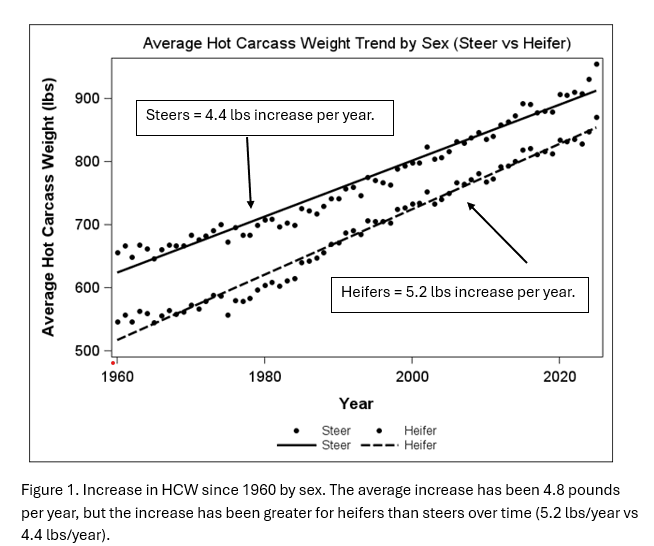
While the recent increases in 2024 and 2025 appear dramatic, they are not unprecedented. Similar year-to-year jumps occurred in 1994, 1998, 2002, 2006, 2012, 2015 and 2020, showing that periodic spikes in carcass weight are part of a longer-term pattern.
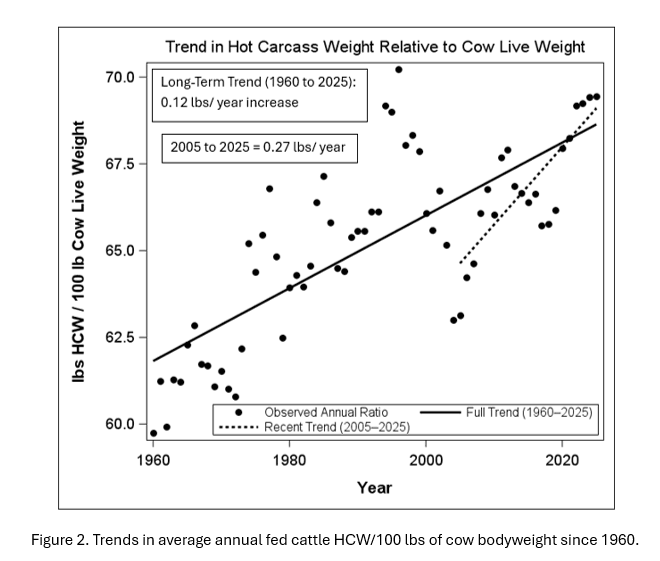
Looking at national data provides a similar perspective (Figure 2). The amount of carcass weight produced per 100 lbs. of cow body weight has increased only gradually (0.12 lbs./year). In the early 1960s, cattle produced about 60 lbs. of hot carcass weight for every 100 lbs. of cow body weight. Today, that figure averages around 69 lbs. per 100 lbs. of cow weight—an increase of only about 9 lbs. over the past 66 years.
An analysis of a research cow herd in Arkansas reported that carcass weight increased by about 0.3 lbs. for each pound increase in cow body weight. In other words, larger cows do tend to produce calves that finish with heavier carcasses, but cow size alone explains only a portion of the overall increase. As cows get larger the efficiency of hot carcass weight production per cow body weight decreases.
This indicates that improvements in carcass weight are not driven solely by larger cows. Other factors play major roles, including genetic selection for growth and carcass traits, the use of growth-promoting technologies, improved nutrition and feeding management, and economic incentives in the cattle market. For example, tight cattle supplies and relatively small discounts for heavier carcasses have encouraged feedlots to feed cattle longer, allowing more weight to be added before harvest.
Bigger cows are only part of the carcass weight story for the beef industry. Increasing cow size is a very inefficient way to increase total beef production. — Paul Beck, Oklahoma State University Extension beef cattle nutrition specialist