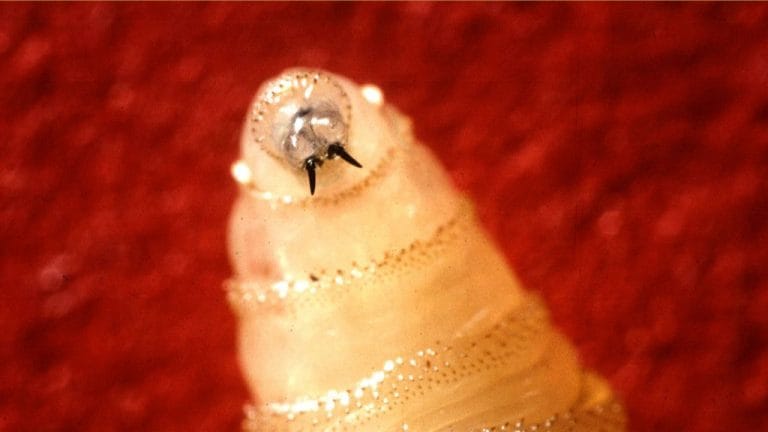
A multidisciplinary team of researchers from across the Texas A&M University System are developing fast‑acting, low‑residue wound treatments to deploy immediately when New World screwworm (NWS) infestations are detected in livestock.
The $1.86 million project is being led by the Texas A&M Engineering Experiment Station (TEES) and Mustafa E. S. Akbulut, Ph.D., associate professor in the Artie McFerrin Department of Chemical Engineering.
“This project reflects the core of our mission as a land‑grant engineering college,” said Robert H. Bishop, Ph.D., vice chancellor and dean of the Texas A&M College of Engineering. “We are bringing scientific innovation directly to a national biosecurity threat, delivering solutions that protect producers, safeguard the food supply and strengthen the resilience of U.S. agriculture.”
NWS, a parasite that feeds on living tissue, is surging across Central America and Mexico, with more than 150,000 animal cases reported. Recently, cases have been reported in Texas and New Mexico, with federal models estimating that a large outbreak in Texas alone could cause more than $1.8 billion in livestock losses. This devastating pest can cause gruesome death to livestock, companion animals and wildlife if left untreated.
While the Sterile Insect Technique remains the backbone of regional suppression, it cannot treat an already‑infested animal, leaving ranchers and veterinarians without a rapid, on‑animal solution.
“Releasing sterile flies is how you beat screwworm across a whole region, but it works over months,” Akbulut said. “It does nothing for the infested calf standing in the chute today. We are building that missing piece: a fast, single-application wound treatment that vets and ranchers can pull off a shelf the moment an animal is found.”
The TEES‑led team is developing three field‑ready formulations that combine reduced doses of synthetic macrocyclic lactones with botanical synergists such as neem and eugenol. The formulations include a wound‑conforming foam for high‑retention coverage, a bio‑adhesive spray for rapid application and an immersion wash for high‑throughput treatment.
Together, these prototypes aim to deliver rapid death of larvae and destruction of their life cycle while minimizing chemical residues.
“The emergency drugs we have can kill screwworm larvae, but they dose the whole animal to treat a single wound,” Akbulut said. “We are designing a foam and a spray that stick to the wound and use a much smaller dose of the drug.”
Researchers will test how well the product kills young parasites and check how long it potentially stays in cattle so ranchers can make more informed decisions around the health and safety of their animals. These data will support a future regulatory pathway for national deployment.
The project will also produce stockpile‑ready operating procedures, quality‑control specifications and a cost‑benefit framework to support USDA planning and emergency response. — Texas A&M Engineering