
Mexico’s Secretariat of Agriculture, Livestock, Rural Development, Fisheries and Food (SAGARPA) announced in October 2017 that the country is proposing beef grading standards that closely resemble the grading names used in the United States.
The proposed standards prompted the U.S. Meat Export Federation (USMEF) to submit comments to the SAGARPA on Dec. 19 outlining its concerns about how English grade names could be used interchangeably with Spanish names.
USMEF points out that the draft regulation posted, known in Mexico as NOM, introduces a Mexican beef grading system that borrows the grade names “Prime,” “Choice,” “Select,” and “Standard,” directly from the UDSA system.
In written comments, USMEF President and CEO Dan Halstrom said, “By stating that Spanish grade names are also known as ‘Prime,’ ‘Choice,’ ‘Select,’ and ‘Standard,’ the NOM appears to be saying that these names should be used interchangeably. USMEF is concerned that the use of English names interchangeably with Spanish names has the potential to sow confusion in the marketplace and diminish the value that the U.S. beef industry derives from the USDA grading system.”
Halstrom continued his comments asking SAGARPA to not use the English grade names that are proposed in NOM-004-SAGARPA-2017.
USMEF noted that while the proposed Mexican system is similar to USDA’s grading system there are significant differences that make using interchangeable grade names problematic. Specifically, on a technical level USMEF outlined these concerns:
• Marbling scores (as shown by the pictures) proposed under the Mexican standard are much lower (a full score or more) than the marbling scores corresponding to the same name in the U.S. standard.
Halstrom offered an example saying, “If a purchaser requested Premium under the Mexican standard, they would receive product similar to a grade of High Choice under the U.S. standard. From a palatability standpoint, the purchaser would be expecting the quality level of Premium (or Prime under the U.S. standard), but only receive product that has the eating quality of High Choice. This will be confusing to end users because the grade names are identical, but have different marbling scores and thus will offer different eating quality.”
• No distinction for bull or bullock carcasses is included in the standard. This means carcasses from intact males could be graded the same as carcasses from castrated males, even though there is a clear quality difference in meat from intact versus castrated males.
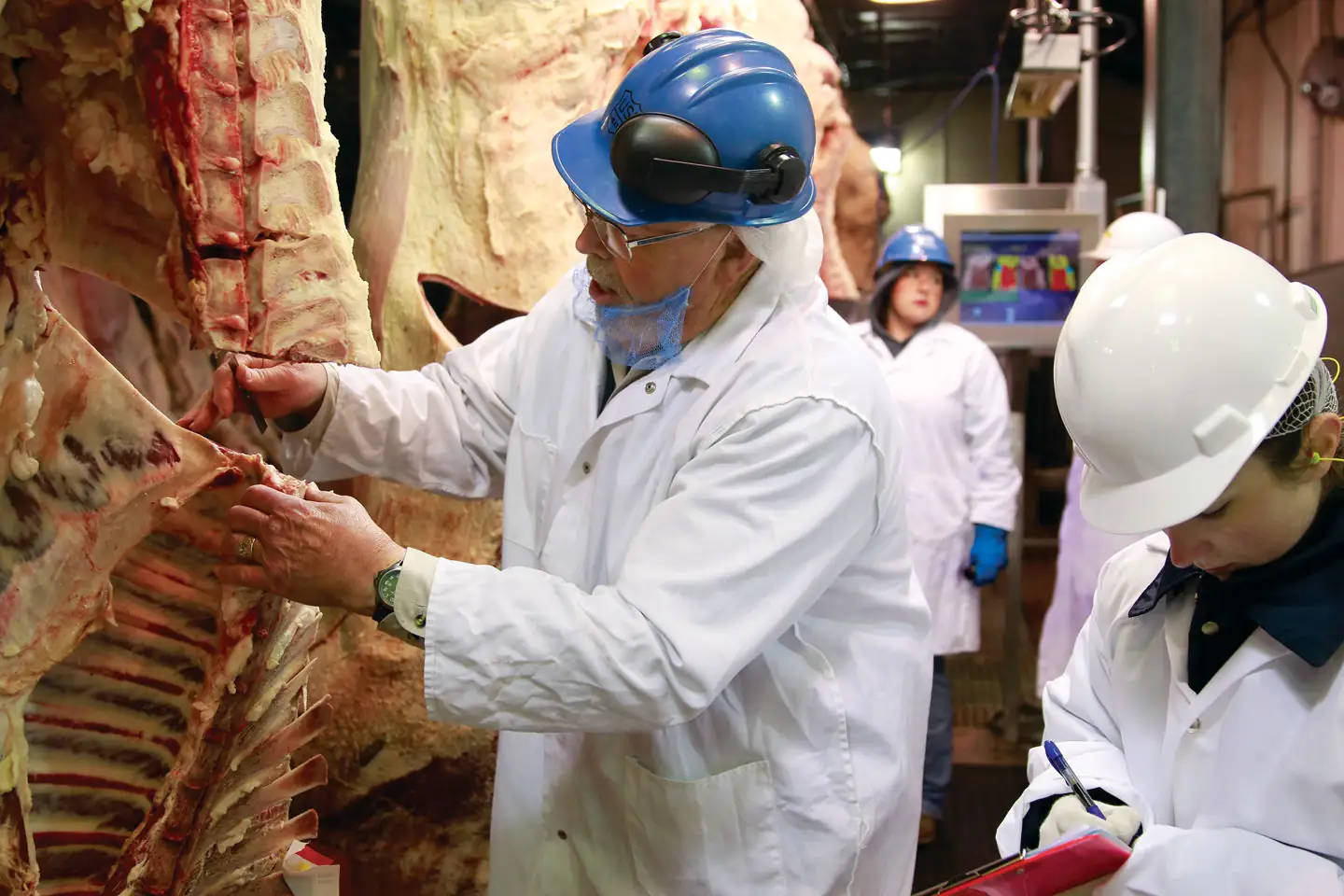
Among other concerns is the proposed Mexican system would employ graders from private sector certification bodies instead of graders employed by the government, as is the case in the U.S. Additionally, those graders will be required to pass an initial exam by the certification body, but unlike graders in the U.S. they won’t be given any training at the outset, or on an ongoing basis while employed as graders.
After outlining concerns, Halstrom said, “Because of the many differences between the U.S. and proposed Mexican systems, beef carrying any of the Mexican grades will not be comparable to beef that has been given the parallel USDA grade. This will pose a problem in the marketplace because today these grade names are uniquely associated with the USDA grading standards, are well-known in Mexico and around the world, and have been in use for many years.”
Explaining that the U.S. beef industry has derived significant benefits from the USDA beef grading system because grade names add value, Halstrom said, “The industry is very concerned that it will see this value diminished if Mexico introduces a beef grading system that uses the grade names that are uniquely associated with the USDA grading system.”
USDA’s Foreign Agricultural Service (FAS) responded by email to questions from WLJ, noting that Mexico does not currently have a grading system for domestically produced beef and saying the FAS post in Mexico City has been following the proposed regulations closely.
Thad Lively, USMEF senior vice president for trade access, responding to questions from WLJ, said, “The real point is that the Mexican system would assign English language grade names to beef that does not meet the USDA standard.”
Lively went on to say consumer confusion is a concern, adding, “but also loss of intellectual property (dilution of USDA grade names) that the industry and USDA has invested millions in and which is worth a great deal to the U.S. beef industry.”
While the timeline for Mexico to implement the proposed grading standards is unknown at this time, Lively said, “We are in close contact with allies in the Mexican industry who share our concerns and tell us the Mexican government is open to amending the grading system prior to its final adoption.” — Rae Price, WLJ editor


