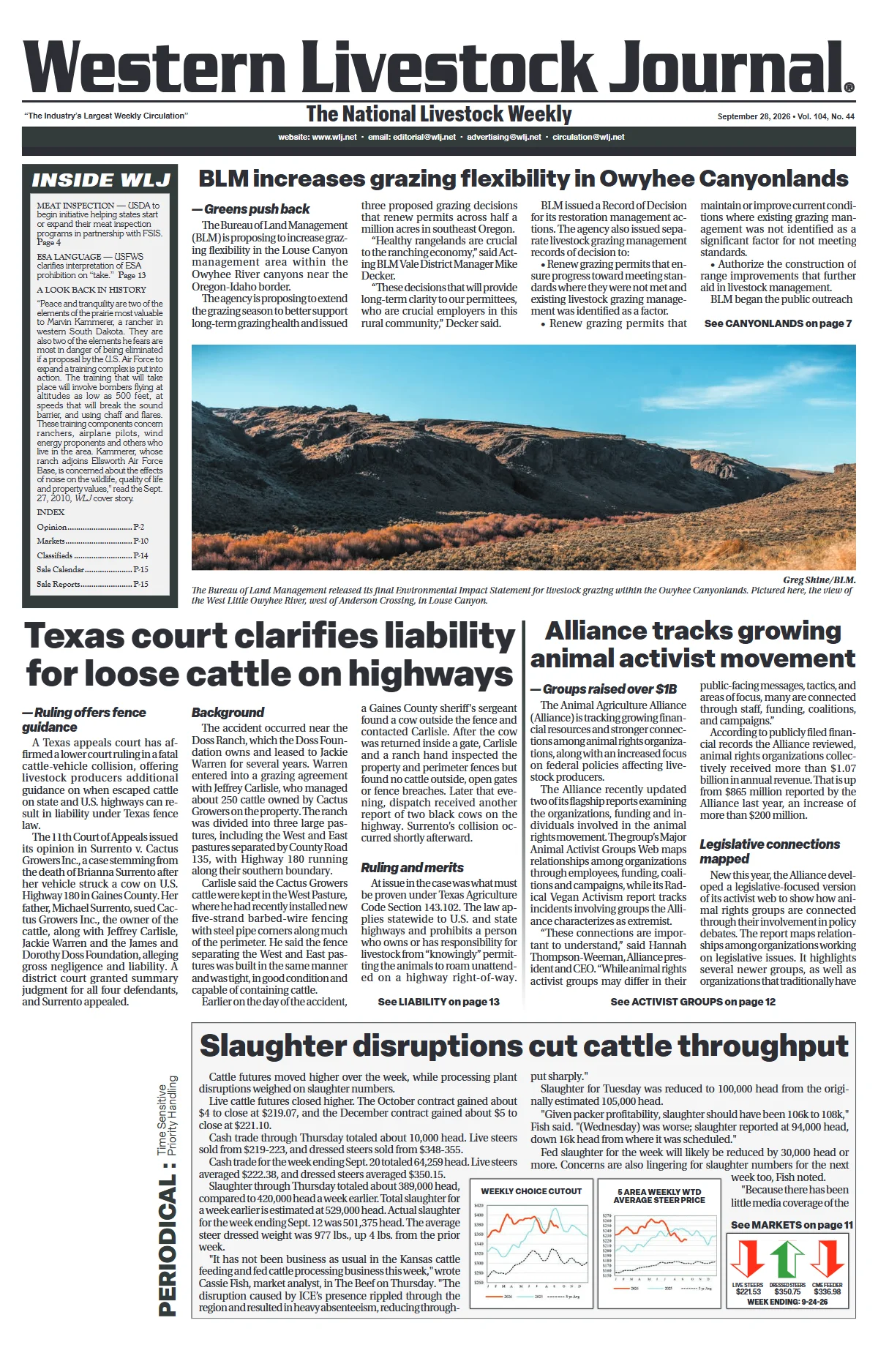
The Animal Agriculture Alliance (Alliance) is tracking growing financial resources and stronger connections among animal rights organizations, along with an increased focus on federal policies affecting livestock producers.
The Alliance recently updated two of its flagship reports examining the organizations, funding and individuals involved in the animal rights movement. The group’s Major Animal Activist Groups Web maps relationships among organizations through employees, funding, coalitions and campaigns, while its Radical Vegan Activism report tracks incidents involving groups the Alliance characterizes as extremist.
“These connections are important to understand,” said Hannah Thompson-Weeman, Alliance president and CEO. “While animal rights activist groups may differ in their public-facing messages, tactics, and areas of focus, many are connected through staff, funding, coalitions, and campaigns.”
According to publicly filed financial records the Alliance reviewed, animal rights organizations collectively received more than $1.07 billion in annual revenue. That is up from $865 million reported by the Alliance last year, an increase of more than $200 million.
Legislative connections mapped
New this year, the Alliance developed a legislative-focused version of its activist web to show how animal rights groups are connected through their involvement in policy debates. The report maps relationships among organizations working on legislative issues. It highlights several newer groups, as well as organizations that traditionally have not been heavily involved in agricultural policy but have entered the debate since the last farm bill was drafted.
The Alliance developed the resource to give livestock organizations, lawmakers and policymakers more background on groups seeking to influence policies affecting farmers, ranchers and the broader food system.

Emily Ellis, marketing and communications director for the Alliance, told WLJ that the organization has noticed a shift in where some of that activity is taking place.
“Over the last several years, there has been a noted trend of animal rights groups focusing on local legislation like city-wide ballot measures,” Ellis said. “However, this year we’ve noticed increased activity at the federal level.”
Ellis said much of the recent federal activity has focused on proposals affecting state livestock production laws, such as California’s Proposition (Prop) 12. The Alliance has also tracked organizations with ties to established animal rights groups that present themselves as representing agricultural interests, with Ellis pointing to Farm Action and the American Meat Producers Association (AMPA) as examples.
The activist web identifies several organizations formed since the 2018 Farm Bill, including AMPA, Farm Action, Animal Wellness Action, Our Honor, Pro-Animal Future, the Animal Activism Collective and the Center for Responsible Food Business. The Alliance’s graphic also traces current and former staff connections, project collaborations and funding relationships between newer organizations and more established groups.
AMPA is one of two organizations added to the Alliance’s broader activist web this year, along with the International Council for Animal Welfare (ICAW). According to the Alliance, AMPA was founded in 2025 with a focus on policy and has opposed provisions in the 2026 Farm Bill addressing state livestock production laws such as Prop 12. The Alliance also reports that AMPA leadership has ties to Humane World for Animals, formerly the Humane Society of the United States.
ICAW is another recently formed organization, with staff who previously worked with groups including The Humane League and Mercy For Animals, according to the Alliance. The group has focused on grassroots activism and efforts to organize local protests targeting restaurant and retail policies involving fur, foie gras and cage-free eggs.
Activist incidents tracked
The Alliance also updated its Radical Vegan Activism report, which provides an overview of incidents and tactics it tracked during 2025.
According to Alliance figures, the report documented 41 incidents of vandalism, 36 cases involving animal theft or release and 23 trespassing incidents. The Alliance also reported that nearly one in four attacks it classified as animal rights extremist activity targeted farmers or food workers.
“This year’s findings show that the animal rights movement continues to be well-funded and highly connected, using a range of tactics that can threaten the safety and security of the entire food supply chain,” said Abby Kornegay, the Alliance’s director of issues and engagement.
Kornegay said tracking organizations, individuals, funding sources, and activist tactics is part of the Alliance’s effort to keep livestock producers and others throughout animal agriculture informed about emerging campaigns and potential security concerns. — Charles Wallace, WLJ contributing editor