Subscribe to WLJ
Advertisement
Environment

USFWS seeks input on wolf, grizzly bear management

WLJ
Mar. 20, 2026 1 minute read 5 comments
USFWS seeks input on wolf, grizzly bear management

Gray wolf walking across rocks in a flowing river.

Evelyn D. Harrison

The U.S. Fish and Wildlife Service (USFWS) is requesting public input on the management of Mexican wolves, Colorado gray wolves and grizzly bears.

Experimental populations established under Section 10(j) of the Endangered Species Act require information collection and reporting to USFWS to monitor reintroduction and recovery efforts.

In a Federal Register notice, the agency proposed to renew three information collections without change. In particular, USFWS is interested in the public addressing the following: whether the collection of information is necessary, the accuracy of the estimate of the burden for collection of information, ways to enhance how information is collected, and how the agency might minimize the burden of the collection of information.

Comments may be submitted until May 11 at tinyurl.com/msmwppc5.

Share this article

Join the Discussion

Your email address will not be published. Required fields are marked *

This site uses Akismet to reduce spam. Learn how your comment data is processed.

5 Comments

  1. Dan
    March 26, 2026
    You should protect all animals as they are as much a part of the environment as the trees, water, fish, grass, and other animals. The Ranchers feed us, and they need to be compensated for their losses, including the time they spend protecting their livestock from predators. That should be at the highest market rate of those animals at the time of predation, to include all costs for that animal, should the market rate that day be lower than their production cost for that animal up to that day. This should include all costs for damages caused by the predation that did not kill the animal. This is the only way to understand the true cost of production and loss by the ranchers who are competing with China, Russia, India, Australia, and Brazil. Lest we find ourselves starving for food because we did not support that Rancher. Like we did not support our oil energy needs.
  2. Fred Hunt
    March 26, 2026
    These predators can not be managed, you might as well try to manage the weather. What has happened is “ We the People” have once again been duped. Producers tried to inform these agencies of the catastrophe being created. We are only seeing the tip of the iceberg.
  3. Jim Lawrence
    March 26, 2026
    I believe the introduction of predators in ranchland is a terrible thing. The damage is large on livestock producers and the general public. The risk of human and animal conflict is very large.The compensation programs that are available are worthless. Even obvious kills are not approved. Most of the kills are not located.
  4. Jan O'Rorke
    March 29, 2026
    I cant see any reason for collecting more information. The Endangered Species projects have already established that there are more wolves than needed. Each wolf is costing the government and state for the cows they kill. You need to take them off the Endangered list and let us start hunting them. We are losing elk and deer every year..Not to mention the hard ship on ranchers. As for grizzly bears, leave them alone. do not transport them to other states. They dont need to cause us more trouble.
  5. Gayle Veale
    April 1, 2026
    We need to know how many there actually are. Collaring one in each pack doesn't accomplish this. Habitat needs to be appropriate for numbers maintained. Moving a pack should be considered as an option. Eliminating excess population should also be an option. When their food source becomes primarily livestock, they need to be eliminated. Compensation for losses is not the answer. Balance of nature is, and the wolves are being placed in and moving to non-wild areas.

Keep reading

Related stories

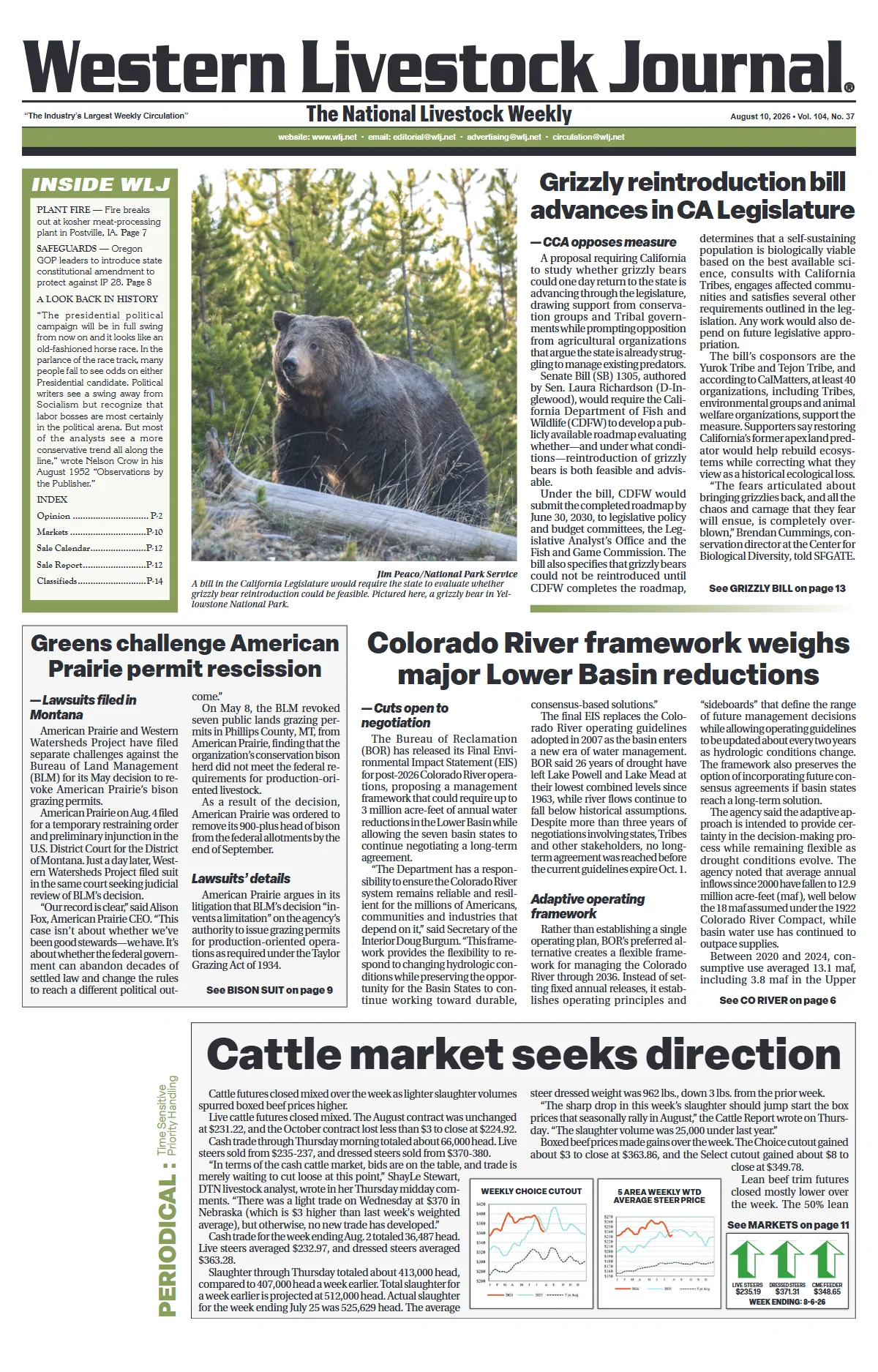
Read the latest digital edition of WLJ.

August 10, 2026