The White House’s proposed fiscal year 2027 budget outlines a broad restructuring of federal spending priorities, including reductions to the USDA budget and to rural and food programs.
At the center of the proposal is a 10% reduction in non-defense discretionary spending compared to 2026 levels, paired with targeted investments in areas such as health programs, veterans’ services and defense capacity.
USDA funding reduced
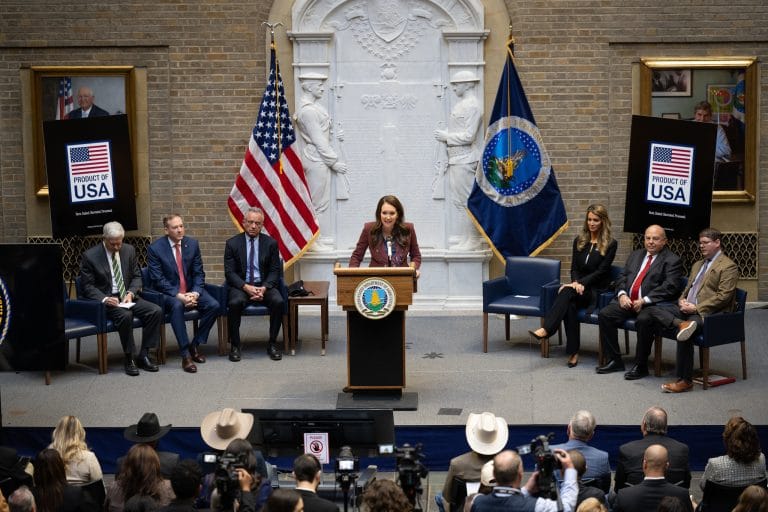
The proposed budget calls for a $4.9 billion, or 19%, reduction in USDA discretionary funding from 2026 enacted levels to $20.8 billion. The budget frames these reductions as part of a broader effort to streamline operations and refocus the agency on what it describes as core functions tied to food production and land management.
A key structural change involves reorganizing USDA operations by relocating staff from Washington, D.C., to regional hubs. The proposal includes $50 million to support this transition, with the goal of placing agency personnel closer to agricultural producers and rural communities.
The budget also prioritizes forest management and wildfire response. It supports expanded domestic timber production and calls for consolidating federal wildfire responsibilities into a unified U.S. Wildland Fire Service.
Several USDA programs would see reductions or elimination under the proposal, particularly those categorized as duplicative, non-core or inefficient.
Funding for the National Institute of Food and Agriculture formula grants would be reduced by $510 million, with research funding shifting toward competitive grants. The Rural Business Service would be eliminated, with the proposal stating that similar services are already provided through the Small Business Administration. The Agricultural Marketing Service would see a $61 million reduction, with the budget indicating that industry-funded initiatives could replace certain federal marketing efforts.
International food aid programs would also be scaled back. The McGovern-Dole Food for Education Program would be reduced by $240 million, while the Food for Peace Title II program would be eliminated.
In rural infrastructure, the budget proposes eliminating $659 million in earmarks for community facilities grants, returning the program to a loan-based model rather than grants.
DOI proposals
The Department of the Interior (DOI) would receive $15.9 billion in discretionary funding, a $2.3 billion decrease from 2026 levels.
The proposal would bring federal wildfire programs under one umbrella by creating a U.S. Wildland Fire Service within the DOI, a move aimed at improving coordination and response across agencies and with state and local partners.
It also calls for combining permitting responsibilities under the Endangered Species Act and Marine Mammal Protection Act into a single program within the U.S. Fish and Wildlife Service. The goal is to simplify the approval process and make it more consistent for land use and development.
On public lands, the budget focuses on maintaining what the federal government already manages. It points to a deferred-maintenance backlog of more than $40 billion and proposes reauthorizing the Legacy Restoration Fund at $1.9 billion per year for five years to help address it.
The plan also includes a $10 billion Presidential Capital Stewardship Program to fund infrastructure and restoration work in Washington, D.C.
Water and resource priorities include refocusing the Bureau of Reclamation on western water systems and providing $1 billion for Great Salt Lake restoration, while shifting energy policy toward expanded domestic production on federal lands.
Health, defense and veterans
The proposed budget calls for the Department of Health and Human Services to receive $111.1 billion in discretionary funding, a decrease of $15.8 billion, or 12.5%, from 2026 levels. Despite the reduction, the budget includes targeted funding for food safety, nutrition and public health initiatives.
This includes $19 million to expand access to nutrition services at health centers, $57 million for food safety and regulatory modernization efforts and $55 million for new food and infection prevention initiatives within the Centers for Disease Control and Prevention. Additional funding is proposed for telehealth and preventive care programs, including chronic care and nutrition services.
While non-defense spending is reduced, the budget proposes increases for defense and veterans programs.
The Department of War would receive $1.5 trillion in funding, representing a 44% increase compared to prior levels. The Department of Veterans Affairs would receive $144.9 billion in discretionary funding, an increase of $11.5 billion, or 9%. The proposal focuses on expanding healthcare services, improving benefits delivery and increasing support for mental health and housing programs for veterans.
The proposal now moves to Congress, where lawmakers will evaluate funding levels, program changes and broader policy priorities before final appropriations decisions are made. As with most presidential budget requests, it is widely viewed as a statement of priorities rather than a final spending plan, serving as a roadmap for Congress as they shape appropriations legislation. — Charles Wallace, WLJ contributing editor