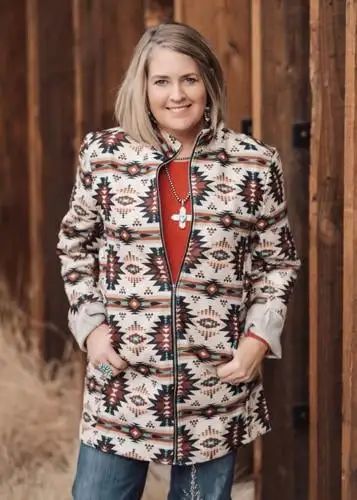
Shelby Shaw’s connection to the NILE began long before her current role as the Livestock Department manager and director of Youth Education, which includes overseeing the renowned Merit Heifer Program.
Although her childhood was spent around the Montana racetrack circuit, she quickly found her love for cattle through her local 4-H program. After exhibiting her first heifer at the Northern International Livestock Exposition (NILE) as a young girl, Shelby went on to become a NILE Merit Heifer Program recipient herself. She remained deeply involved over the years through scholarships, internships and ultimately, built a career with the organization.
In addition to overseeing the Merit Heifer Program, Shelby also manages the NILE livestock shows and sales, along with the internship and scholarship programs, and acts as the staff liaison to the NILE Foundation.
Today, she continues to stay involved in her family cow herd while working with youth across the country, helping provide opportunities similar to the ones that helped shape her own path in the cattle industry.
A hand into the industry
The NILE is a non-profit organization dedicated to the promotion and preservation of the livestock industry and Western way of life in Billings, MT. The NILE will be celebrating its 59th annual stock show this year in October and will feature a multitude of cattle shows and sales. In addition to the stock show, the NILE also features horse events and sales, a ranch rodeo, a trade show, youth contests and more.
The NILE Merit Heifer Program was developed in 2000 as an opportunity for youth to get a start in the beef cattle business. For the first few years, there were five heifers available annually for Montana youth, but interest grew quickly.
“The demand was so high for kids that were looking to get into the beef industry that our committee got together and really worked hard to find more donors that would be willing to work with youth interested in the beef project,” Shelby told WLJ.
The program expanded rapidly, growing from just five head in 2005 to 25 head in 2006. Today, the NILE Merit Heifer Program typically awards between 20 and 25 heifers each year through a competitive application process. Since its inception, more than 500 heifers have been placed with youth across the nation, reaching recipients in 23 states and supported by donors in 24 states. The 2026 program also marks a milestone, as it includes the first-ever recipient from Canada.
Program eligibility
Anyone can donate a heifer to the program, although Shelby emphasized the mentorship commitment.
“We are looking for donors who are willing to work with the youth,” she said. The heifer is co-owned between the recipient and NILE until the program is completed, and throughout the program, the donor serves as a mentor to the recipient.
“They can be as involved as they want, or are able to be, as long as the recipient can still get in touch with the donor to get some answers for their reports,” Shelby said. “That’s all we ask.”
Throughout the program, recipients are expected to take proper care of the heifer while staying actively engaged by completing monthly reports on specific industry topics. In total, participants complete 10 reports for NILE, in addition to taking part in monthly Zoom meetings, submitting a record book and participating in an exit interview. Full ownership of the heifer is contingent on successfully completing the required materials. The main goal is for the recipient to have a bred female that will go on to be a productive cow for many years.
There are no breed restrictions for donated heifers, which results in a wide array of breeds available in the program. Past placements have included a variety of breeds, from Angus to Wagyu, Shelby said.
Applicants may indicate their breed preferences during the application process, and the committee does its best to match recipients with their preferred breed and a local donor.
“It is not guaranteed, but we do try to get them the breed that they are most interested in, or at least their secondary breed,” Shelby said. “And from there we pair them with a donor that is somewhat geographically close to them.”
Donated heifers are required to be weaned and current on vaccinations at the time of placement. From that point forward, NILE helps oversee the ownership process while encouraging continued mentorship between donors and recipients. Donors can provide breeding recommendations, or recipients can take advantage of semen donated by a program sponsor to AI their heifer.
After graduating from the program, recipients have the opportunity to return to NILE to exhibit in the Progeny Pen Parade with the original female alongside her progeny, highlighting the progress they have made in building their own herd.
Application process details
Although the application process may appear daunting upon first glance, Shelby encourages applicants that the payoff is well worth it.
Any 4-H or FFA member between the ages of 12 and 16 years old as of June 30 is eligible to apply for the NILE Merit Heifer Program. Applicants are not required to reside in Montana, and prior experience or cattle ownership is not necessary.
The application process includes several components. It begins with a general questionnaire where applicants can describe their backgrounds and industry involvement. Applicants also submit a one-page personal essay explaining why they are deserving of a heifer and how receiving a heifer would fit into their future goals. In addition, six references are required, including three letters of recommendation and three additional contacts.
Finally, applicants must submit a 3-to-5-minute YouTube video. This portion of the application process gives applicants an opportunity to set themselves apart from the others. The video should include a personal introduction, a tour of their facilities, an overview of current 4-H and FFA projects, and a discussion of their goals and objectives.
“Through a video, the committee is able to get to know the applicant in a way that they may not be able to get to know somebody else,” Shelby said. “I encourage applicants to take a little extra time and figure out ways that they can be unique yet still be themselves.”
That opportunity to showcase individuality is just one piece of Shelby’s broader advice to prospective applicants. She also encourages applicants to begin their application early to avoid being overwhelmed.
“If they start early getting those recommendation letters, working on the application itself and then doing a couple different takes of their video and practice what they’re going to say, the process will be a lot smoother for them,” Shelby advised.
Applications for the 2027 NILE Merit Heifer Program should be submitted no later than June 30 at the online portal found at tinyurl.com/yfwuu68y.
Selected recipients are typically notified around Labor Day. While those chosen for the upcoming cycle are not required to be present at the 2026 NILE, they are expected to attend the 2027 NILE the following October with their bred heifer.
Any questions can be directed to Shelby at 406-256-2499 or shelby@thenile.org. Those interested in donating a heifer for the 2027 NILE Merit Heifer Program may also reach out to Shelby for more details.
Supporters are also encouraged to mark their calendars for May 1 for the 2026 NILE Foundation’s Stetsons & Stilettos scholarship fundraiser event. The night features live and silent auctions, live music and dancing at the Swift River Ranch. All proceeds will benefit the Foundation and support youth education and scholarships. More information can be found at nile.org. — Anna Miller Fortozo, WLJ managing editor