The Jan. 1 Oklahoma beef cow inventory was 1.966 million head, up 0.4% year over year. Oklahoma was one of three of the top 10 beef cow states to have an increase in the beef cow herd last year, with the others being North Dakota and Florida. Oklahoma is the No. 2 beef cow state (after Texas) and has been second consistently for the past 12 years ahead of No. 3 Missouri.
As of Jan. 1, the Oklahoma beef cow herd was 8.9% larger than the Missouri beef cow herd and has averaged 4.2% larger since 2015. In the previous dozen years, from 2003-14, Oklahoma and Missouri were alternately the second and third largest beef cow states with Oklahoma averaging 98% of the level of Missouri beef cow herd.
The Oklahoma beef cow herd has averaged 1.99 million head for the past 25 years, with a low of 1.69 million head in 2013 and a high of 2.17 million head in 2021.
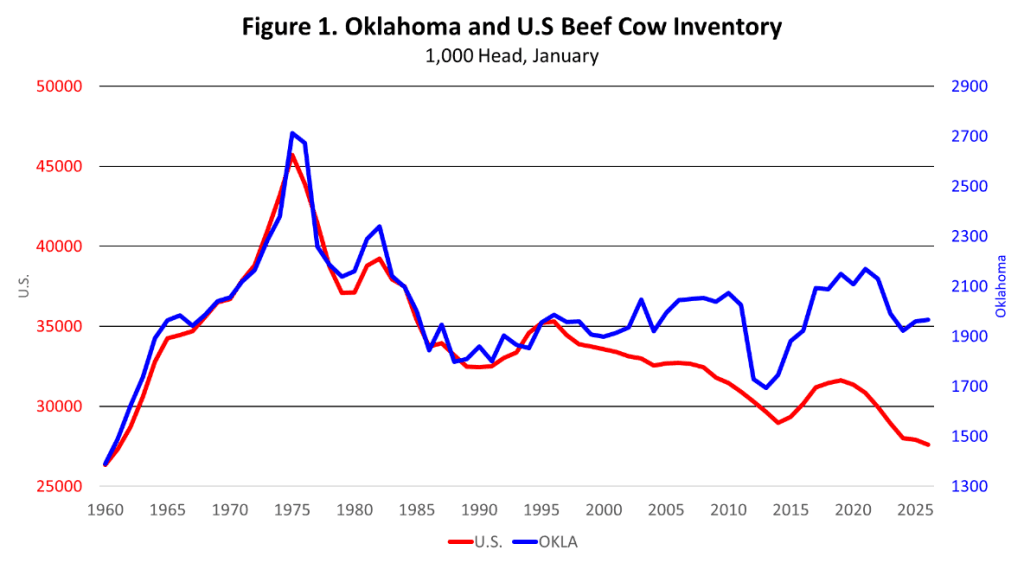
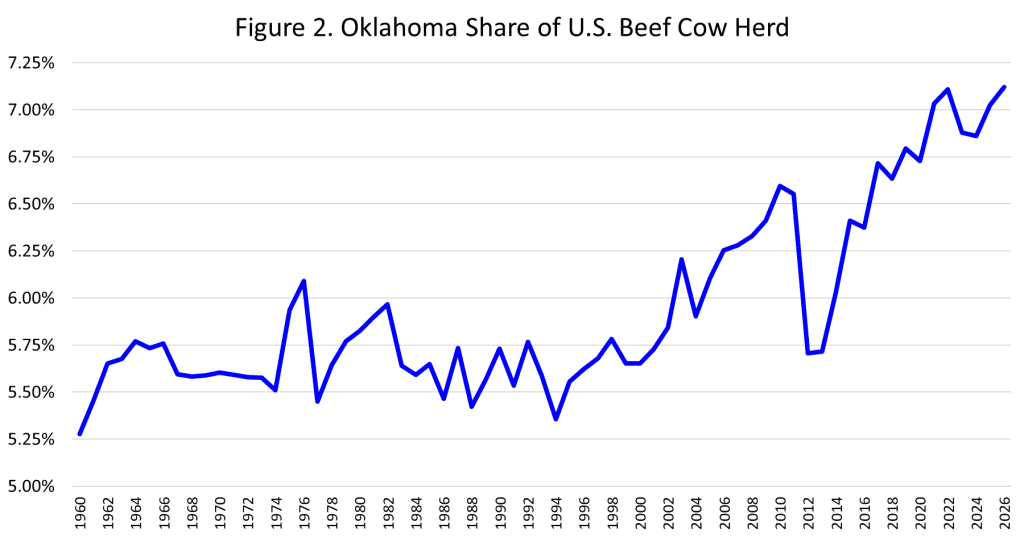
The Oklahoma beef cow herd has been growing relative to the national herd for more than 25 years (Figure 1). Oklahoma currently represents 7.1% of the national beef cow herd (Figure 2) and has averaged 6.5% for the past 25 years. From the 1960s through the 1990s, Oklahoma averaged 5.7% of the national beef cow herd.
The impacts of drought are also very evident in Figure 1. From 2010-13, the Oklahoma beef cow herd decreased by 18.3%. The Oklahoma beef cow herd began recovering in 2014, one year ahead of the cyclical low in total beef cow inventories. From 2021-24, the Oklahoma beef cow herd decreased 11% before increasing in 2025 and 2026, while the U.S. total beef cow inventory continued to decline. — Derrell S. Peel, Oklahoma State University Extension livestock marketing specialist