

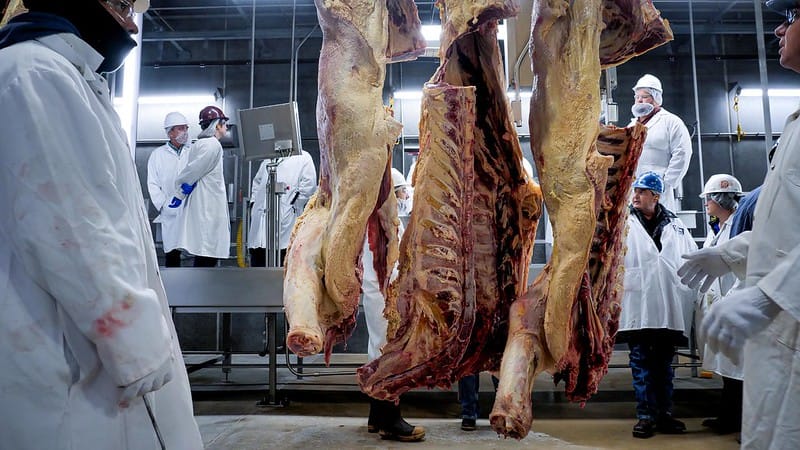
Observations on the increase in cow mature body weight and in relation to increasing carcass weights have been discussed over the past few weeks. This week, we will look at the effects of other cow herd and pre-finishing factors that impact the recent increases in carcass weight.
We compiled a dataset from calf carcass outcomes connected to mature cow bodyweight (n = 4,917 records) from cow herds in Texas, Oklahoma and Louisiana to look at cow herd management’s effect on hot carcass weight of their offspring. In this analysis, steer and heifer calves were from fall- and spring-calving herds and were finished either directly after weaning as calf-feds or as yearlings following pasture-based backgrounding systems.

The data showed that for every 100-pound increase in cow mature bodyweight, carcass-adjusted calf final birthweight increased by 28 lbs. and hot carcass weight increased by 18 lbs. The efficiency of carcass per 100 lbs. of cow weight declined by 4.1% (Table 1) as cow mature weight increases. Fall-born calves had a 35-lb. lower hot carcass weight than spring-born calves, heifers had a 53-lb. reduced hot carcass weight than steers, and calf-feds had a 53-lb. lower hot carcass weight than yearlings.
We calculated the impact of feeding calves for longer days on feed, similar to current feeding practices, resulting in higher fat composition of cattle at slaughter. At 28% fat, we consider cattle to be at a low Choice quality grade; increasing to 32%, 36% and 38% improves the quality grade potential and increases hot carcass weight by 87 lbs., 185 lbs. and 247 lbs., respectively.
This analysis suggests that the majority of the increase in hot carcass weight observed in the last two years is likely from feeding cattle to higher fat endpoints with longer days on feed. Also, it seems logical that it is more biologically efficient to feed yearlings following a stocker grazing program out of lighter birthweight cows than feeding calves out of heavier dams directly after weaning.
To highlight this, we created two scenarios with spring-born steer calves. In scenario one, we used 1,200-lb. birthweight cows (average of our dataset) with calves fed as yearlings to 32% body fat. In scenario two, we used 1,500-lb. dams with calf-fed steers finished to 32% body fat. Even though the cows were 300 lbs. lighter, feeding the offspring of the lighter birthweight cows in scenario one as yearlings offset any advantage production advantage of the larger cows.
Increasing mature cow size increases absolute calf and carcass weights but reduces efficiency when expressed relative to cow maintenance requirements. These results suggest that increasing cow mature weight is the least efficient path to heavier carcasses. Instead, matching cow size and calving season to the production environment improves system productivity and resilience.
Efficiency of the entire beef production system will be optimized by matching cow size and calving seasons to ranch environmental conditions, increasing productivity of heifers to match steers and utilizing pasture-based stocker/backgrounding programs pre-finishing. — Paul Beck, Oklahoma State University Extension beef cattle nutrition specialist



1 Comment