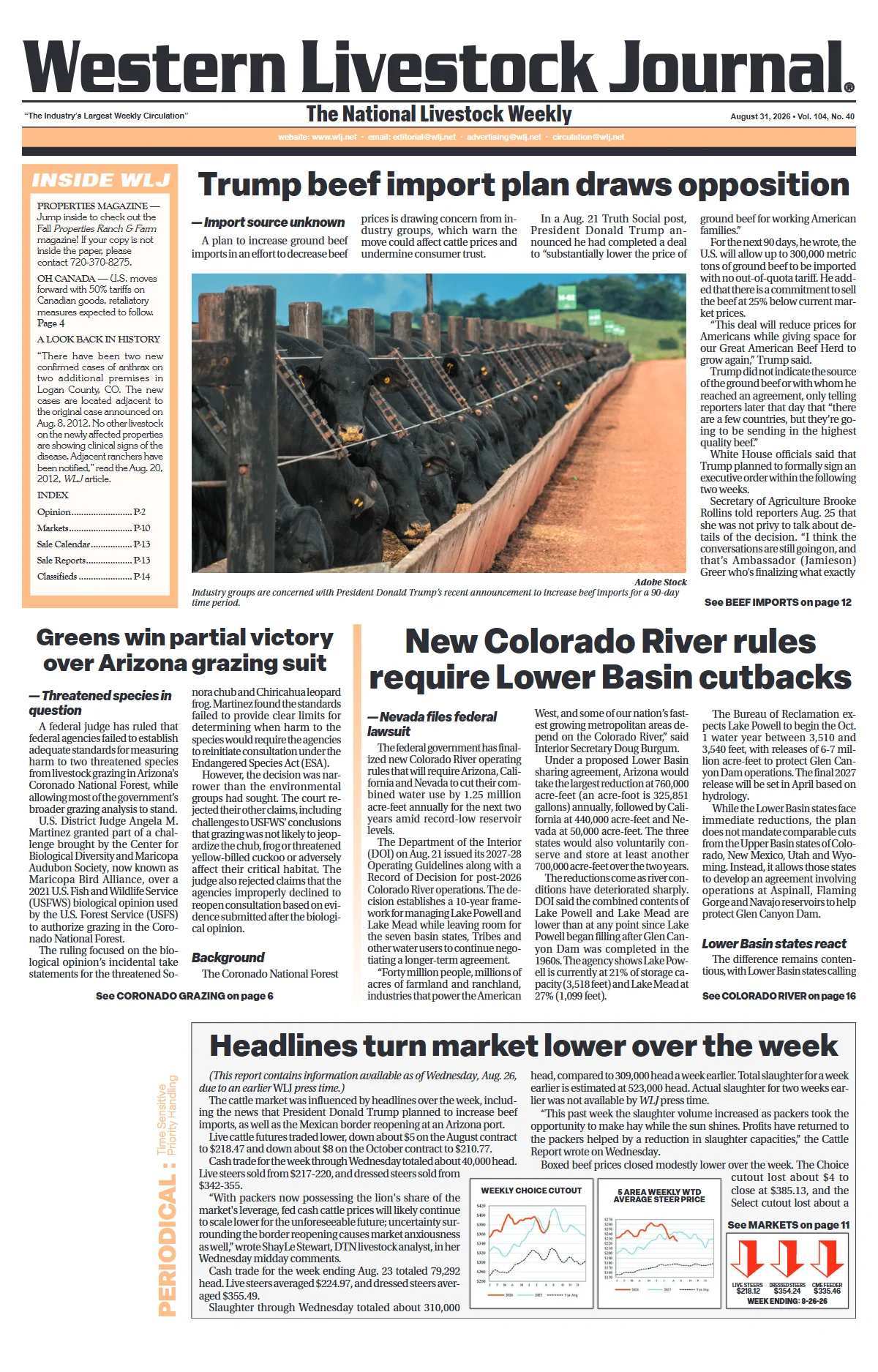
Speculation that the Trump administration plans to expand beef imports from Argentina sparked sharp backlash from cattle ranchers and sent cattle markets tumbling.
On Oct. 23, White House officials said the Trump administration plans to raise the Argentina beef import quota to 80,000 metric tons in an attempt to help lower beef prices for consumers, though talks are still ongoing and that number is not final.
The prospect first surfaced a few days earlier, when President Donald Trump told reporters at the White House that the price of beef is “higher than we want it, and that’s going to be coming down pretty soon, too. We did something.” The announcement came shortly after Trump met with Argentina President Javier Milei, moving forward on a $20 billion bailout deal for Argentina.
Two days later, when questioned about how U.S. farmers might feel about Argentina benefitting more than the U.S. from a proposed deal, Trump said Argentina is “fighting for its life” and nothing is benefiting Argentina. “If I can help them survive in a free world—I happen to like the president of Argentina … but don’t make it sound like they’re doing great, they are dying.”
He added, “We would buy some beef from Argentina. If we do that, that will bring our beef prices down.”
Under current beef import quota rules, Argentina is able to ship up to 20,000 metric tons of beef a year to the U.S. at a lower tariff rate before being subject to a 26.4% tariff. Raising the quota to 80,000 metric tons effectively quadruples the amount of beef that can enter the U.S. under a low tariff rate.
USDA Secretary Brooke Rollins said in a Fox Business interview on Oct. 23 that, “Currently, Americans consume 12 million metric tons of beef. Ten million, we produce in this country. Two million, we import. Out of 12 million, [the Argentine quota] would be 20,000 every quarter. This is not a massive influx in the millions of tons I think that some have thought of beef from Argentina.”
In response to rancher outcry, Trump posted on his social media platform Truth Social, “The Cattle Ranchers, who I love, don’t understand that the only reason they are doing so well, for the first time in decades, is because I put Tariffs on cattle coming into the United States, including a 50% Tariff on Brazil. If it weren’t for me, they would be doing just as they’ve done for the past 20 years — Terrible!”
Trump added, “It would be nice if they would understand that, but they also have to get their prices down, because the consumer is a very big factor in my thinking, also!”
Cattle markets fell sharply on Oct. 17 after Trump first spoke of a potential trade deal but then found steadier footing to begin the the week of Oct. 20. The markets plummeted again following Trump’s Wednesday social media post.
Industry pushback
Ranching groups across the industry immediately pushed back against Trump’s announcement, calling the plan misguided.
“The National Cattlemen’s Beef Association (NCBA) and its members cannot stand behind the President while he undercuts the future of family farmers and ranchers by importing Argentinian beef in an attempt to influence prices,” said NCBA CEO Colin Woodall in a statement. “It is imperative that President Trump and Secretary of Agriculture Brooke Rollins let the cattle markets work.”
Ranchers-Cattlemen Action Legal Fund, USA (R-CALF) said the announcement and the resulting market impacts couldn’t have come at a worse time. “Many producers are getting ready to sell this year’s production, meaning they will receive less for their cattle, and that will threaten their ability to remain economically viable, particularly as they face increased input costs in their operations,” said R-CALF CEO Bill Bullard in a statement.
The U.S. Cattlemen’s Association (USCA) said government intervention is not needed in an industry that is already correcting in response to years of market pressure.
“Increasing imports under current rules ultimately benefits foreign suppliers and multinational packers, while putting U.S. ranchers on the losing end and depriving American consumers of honest transparency at the meat counter,” said USCA President Justin Tupper.
NCBA encouraged beef producers to reach out to Congress and tell lawmakers to focus on investing in American famers and ranchers and not import more Argentina beef. To access the form to submit a comment, visit tinyurl.com/yc7deb56.
USDA plan
In the midst of the Trump administration’s controversial plan to import more foreign beef, USDA released a 13-plan outlining a set of actions the department intended to take to “strengthen the beef industry” and support ranchers and consumers.
The plan outlines three prongs: protecting and improving the business of ranching; expanding processing, consumer transparency and market access; and building demand alongside domestic supply.
The 13-page plan includes some actions that have been in the works already, such as voluntary “Product of USA” labels only applying to meat products born, raised and slaughtered in the U.S. The rule was finalized in 2024 and is set to go into effect in 2026. The plan also calls for more funding for the Meat and Poultry Processing Expansion Program, which provides grants of up to $2 million for small meat processors. The program has gone through three rounds of funding so far.
Also included in the plan is reviewing public lands grazing allotments and expanding grazing on vacant allotments, looking at new “standards of evidence” for rancher compensation for wildlife predations, making risk protection tools more affordable, and expanding beef demand and beef’s role in the American diet.
Argentina beef rankings
Argentina is ranked as the sixth largest beef-producing country in the world, and the fifth largest beef-exporting country, according to Dr. Derrell Peel, Oklahoma State University Extension livestock marketing specialist. Argentine beef production is about 27% of total U.S. beef production, and the country accounts for about 6% of global beef exports. Argentina ranks ninth for beef imports in the U.S., accounting for about 2.1% of total U.S. beef imports in 2025. Imports of Argentine beef are up 41.7% year over year through July, Peel said.
He noted that it’s unclear how much capacity there is to actually increase beef exports from Argentina. Domestic beef consumption in the country accounts for about 70-75% of total beef production. If the U.S. were to double imports over 2024 levels, it would likely be at the expense of domestic consumption or other Argentine beef export markets, Peel said, and the increase in imports would have a negligible impact on the total supply of beef in the U.S. market.
“In fact, if the U.S. took all of the projected 2025 Argentine beef exports (not likely), it would represent less than 2.5 percent of the total U.S. beef supply,” Peel said.
Argentine experts shared Peel’s sentiments about beef export capacity. Javier Preciado Patiño, former Argentina undersecretary of agricultural markets and director of RIA Consultores, told United Press International, “We are the world’s top consumers of beef. There’s not much room to export more.” He continued that consumers in Argentina are willing to pay high prices for beef, which makes it more profitable to sell domestically than abroad. Without a significant boost in cattle production, the country does not have enough premium beef to export without cutting into domestic supplies. — Anna Miller Fortozo, WLJ managing editor