A new voluntary wildlife conservation program could benefit Montana ranchers and five species of birds. The program, in conjunction with the U.S. Fish and Wildlife Service (USFWS) and The Nature Conservancy, would prevent enrolled landowners from being subjected to additional regulations should one of the covered birds require protection under the Endangered Species Act.
The proposal has been published in the Federal Register and is open for public comment until Oct. 25.
Participating landowners would receive regulatory certainty for the next 20 years through a Programmatic Candidate Conservation Agreement with Assurances (CCAA), a proactive conservation mechanism available under the Endangered Species Act, designed to benefit species at risk of needing federal protection.
In a press release announcing the comment period, USFWS said, “The proposed CCAA is part of a broader effort to expand wildlife conservation opportunities, preclude the need to list species, and strengthen public/private partnerships.”
How it works
Landowners work with the organizations to determine which conservation measures can be applied on their property for the duration of the 20-year agreement. Then, in the event any of the five covered species were to require protection under the Endangered Species Act while the CCAA is in place, The Nature Conservancy would provide landowners with a permit allowing incidental take (harm, harassment or death) of any of the species as a side effect of general activities.
In the event of a listing, no additional conservation measures or land and water use restrictions would be required by participating landowners during the agreement.
Birds covered in the CCAA include:
• Sprague’s pipit;
• McCown’s longspur;
• Chestnut-collared longspur;
• Baird’s sparrow; and
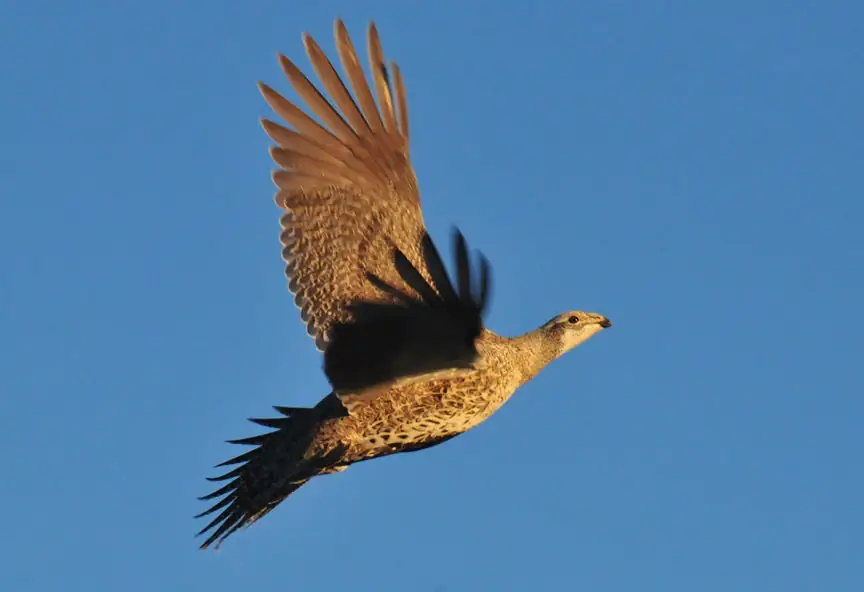
• Greater sage-grouse.
Asked if this was a new or unique program, Brian Martin, Montana grasslands conservation director for The Nature Conservancy, told WLJ TNC has a long history of working with USFWS in Montana on conservation projects, but this is the first time they have entered into a CCAA-related effort. Martin said the USFWS approached TNC in part because it has a good working relationships with landowners in some of the key habitats for these species. “TNC was interested in this opportunity because we believe we can help deliver conservation or recognize the conservation efforts of private landowners in an effective way,” Martin explained.
If the Enhancement of Survival Permit Application, submitted by USFWS, moves forward, as explained in the Federal Register notice, enrolled landowners would implement conservation measures that avoid, minimize, and mitigate impacts to the covered species and their habitats from ongoing grazing and range management activities on enrolled lands. “The Service (USFWS) would issue a permit to TNC, which would administer the CCAA and enroll participants.”
The CCAA would encompass non-federal lands within the range of covered species.
As for the birds’range, Martin said the four grassland songbirds all occupy native grasslands in eastern Montana. They are most common and abundant on the Hi-Line, an area in northern Montana, especially where there are larger areas of grassland.
He noted that the birds vary in their habitat needs and said there is some overlap, but it would not be likely to find Baird’s sparrow and McCown’s longspur in the same location. “Because of their differences, it is important that native grasslands be diverse in their composition and structure. That requires a variety of grazing management regimes that leave anywhere from a lot of residual grass after grazing to very little,” explained Martin.
Sage-grouse, Martin said, require big sagebrush for a portion of their lifecycle and occur in sagebrush grasslands across a large portion of the state. There is some overlap between sage-grouse and the grassland songbirds, but generally the songbirds require grasslands with little shrub cover.
USFWS noted that working Montana rangelands play a critical role in maintaining the interconnected web of sagebrush and grassland habitats that many of America’s plants and animals rely upon. Loss and degradation of these systems due to development and other factors has led to declines in wildlife populations, making grassland birds one of America’s fastest declining groups of species.
Martin also commented on the lost habitat and decline in bird numbers, saying, “Declines have been largely attributed to land conversion. Research has demonstrated that managed grazing is positive for these species.”
Martin further explained that as a voluntary program, landowners can enroll any or all of their land that qualifies, and can opt out at any time during the 20-year period. “It is designed to recognize the positive management of landowners and also offers some management assistance if it is requested. It provides regulatory protection should any of the species be listed so that a ranch operation would not face new requirements of management. It also provides important information if a species is proposed for listing, since it serves as evidence of positive, proactive management that is already in place.
Martin added, “The end goal of the program is to recognize and document the good efforts of landowners and improve habitat where there is a need and interest. In the end, we want to have strong populations of these species, so that there is not a need to list any of them, and at the same time retain profitable ranch operations that are providing the habitat.”
Privately owned lands in Montana provide the large, intact habitats that the five bird species need to survive. Approximately 66 percent of sagebrush and 63 percent of grassland habitats in Montana are privately owned, and 56 percent of Montana’s known and active greater sage-grouse leks are found on private rangelands.
The draft CCAA, its associated draft Environmental Assessment and the Federal Register notice are available online at http://tinyurl.com/MT-CCAA-Birds.
Members of the public are invited to provide their input until the comment period closes on Oct. 25, 2017. Please keep in mind that all comments become part of the public record associated with this action; use care in providing addresses, phone numbers, email addresses or other personally identifiable information.
Comments may be submitted via the following methods:
• Email—MT_CCAA@fws.gov. Include “MT CCAA” in the subject line;
• Fax—406-449-5339, Attn: MT CCAA;
• U.S. Mail or hand delivery to Office Supervisor, Montana Ecological Services Field Office, U.S. Fish and Wildlife Service, 585 Shepard Way, Suite 1, Helena, MT 59601.
More information on the proposed Programmatic CCAA and EA is available through the Montana Ecological Services Field Office at 406-449-5225.
Jennifer Strickland, public affairs specialist, USFW Mountain-Prairie Region, told WLJ none of the five birds currently have status/protection under the Endangered Species Act, “However, all five species are listed as ‘Species of Concern’ by Montana Fish, Wildlife & Parks, which essentially means they could use some help.” She went on, “In the Service we often refer to species like this as ‘at-risk.’ CCAAs are tools that allow the U.S. Fish and Wildlife Service to work with a variety of partners to proactively conserve species at risk in a manner that could contribute to precluding the need to list them in the future.” — Rae Price, WLJ editor