Mycoplasma bovis (M. bovis) is a devastating and often overlooked pathogen that affects cattle and bison. In cattle, it can cause mastitis, arthritis in calves and adults, pneumonia in calves and infections that may cause late-term abortions. Not all infected animals get sick, however. Many of them shed this bacterium without signs.
Dr. Chris Chase, Department of Veterinary and Biomedical Sciences professor, South Dakota State University, said we don’t completely understand how this bacterium can evade the immune system or be unresponsive to antibiotics.
“In pigs, Mycoplasma hyopneumoniae presents a different picture than Mycoplasma bovis; it causes pneumonia that isn’t quite as chronic and doesn’t form abscesses in the lungs like we see in cattle. It took researchers 20 years to learn enough about the disease in pigs to develop a vaccine, with many people working on it. We don’t have as much research on Mycoplasma bovis in cattle,” he said.
Dr. Jennifer Davies, faculty of Veterinary Medicine, University of Calgary, is a pathologist and director of the diagnostic lab at the university. “This disease manifests in different ways. It can affect all age groups, in both beef and dairy. In the feedlot, it is economically devastating, causing chronic disease that is poorly responsive to antibiotic therapy—with significant animal health and welfare consequences.” Nearly half the animals infected with M. bovis in the feedlot either die or are in the chronic pen and then euthanized.
Some may respond to treatment and go back to their home pen after extensive and costly antibiotic therapy but never do as well, with significantly reduced weight gains. There’s a lot of loss associated with this disease in the feedlot.
It can also play a role in pneumonia in young calves. “If they are consuming milk from a cow with mastitis caused by M. bovis, this can lead to middle ear infection, with or without pneumonia,” Davies said.
Ear infection may make the calf dull, and the ear and eyelid on that side may droop. “A tilted head is a typical sign of ear infection rather than pneumonia, but they can go hand in hand. The calf may have one or the other, or both together,” she explains.
In dairy cattle, M. bovis is a significant player in mastitis. This could also occur in beef cows but not as often.
Most of the cases she sees, however, are respiratory disease. “It is one of many agents; a number of viruses and bacteria play a role, leading to pneumonia in the feedlot. This bacterium is different from some of the other bacterial agents that cause bovine respiratory disease (BRD). It is the smallest living organism that can replicate.
“Along with their tiny size, these bacteria lost much of their genetic material as they evolved. They can’t produce the products they need to survive on their own and are dependent on a host. The good news is that they don’t survive very well in the environment. They survive best on mucous membranes of cattle, particularly in the nasal cavities,” she explained.
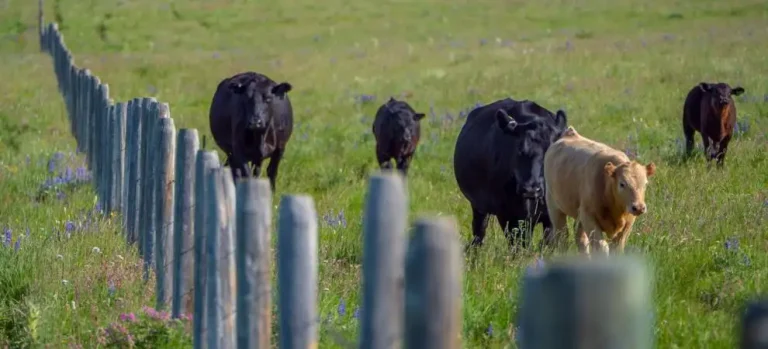
These bacteria are mainly spread from one animal to another by direct contact, though they may live long enough on feed or in water to be transmitted. In a cow-calf operation, this infection only comes into the herd with an infected animal, so a closed herd is the best prevention—unless cattle have fence line contact with other animals.
“It always comes in with cattle, rather than from the environment. Many cattle have this organism living in their nasal cavity, with no clinical signs of disease. These asymptomatic carriers may bring it into a herd,” said Davies. It can spread to susceptive animals—vulnerable if their own immune system is compromised.
As long as it stays in the nasal cavity, it doesn’t do much harm, though it might be transmitted to other animals. If it gets into the lungs, however, that’s where damage is done. The lungs are generally protected by several defenses, including tiny hair-like cilia that line the airways, moving in waves to keep pushing any foreign material up out of those airways to be coughed out or swallowed.
The respiratory system is bombarded by pathogens with every breath. “But as long as there aren’t too many bacteria in the nasal cavity, the lung defenses can handle this,” she said.
“Two things can happen with M. bovis. One, the calf is stressed. In the feedlot, stress is generally transport and commingling. Stress decreases the immune system’s defenses within the nasal cavity; bacteria can go wild and proliferate. Now the calf has an overwhelming number of bacteria that can be inhaled into the lungs and overwhelm even a normal lung’s defense mechanisms,” she explained.
“Even more significantly, usually the calf has another lung infection, lowering the defense mechanisms even more. Usually a host of pathogens are interacting and result in pneumonia,” she said.
The body reacts, trying to clear them out. “The immune system mounts a defense, which includes an inflammatory reaction. This inflammation in the lungs is what we call pneumonia,” she explains.
“Inflammation does more damage than the organism does, and the animal starts showing signs of BRD—fever, dull, not eating or drinking as much. There may be a cough and/or nasal discharge; the animal breathes faster and with more difficulty.”
M. bovis is extremely good at evading the immune system. “As a result, the body cannot clear the infection. Coupled with the fact that this organism is not responsive to most antibiotics, it goes into chronic pneumonia.”
These organisms then get into the bloodstream from the lungs and go to many places in the body, often ending up in large joints like the stifle. “The animal gets arthritis when these bacteria set up shop in joints. Inflammatory reaction in the joint often includes the tendons and tissue around the joint. This results in severe and chronic lameness, which also does not respond to treatment very well,” said Davies.
“In feedlot animals, the infection spreads to the joints in about half the cases. A common presentation is an animal with chronic pneumonia and chronic lameness. Neither are responding to antibiotics, and it becomes an animal welfare issue. The animal is euthanized at that point, and samples sent to the lab for a diagnosis,” she said.
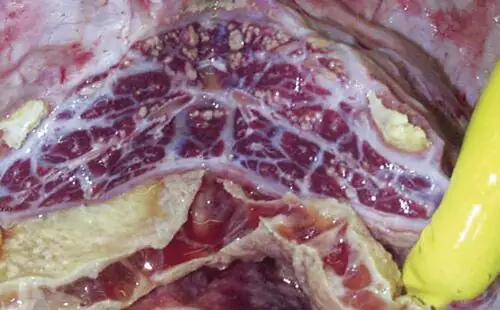
Prevention is the key, rather than trying to rely on treatment. “The time that antimicrobials are most likely to work is if we can diagnose the disease early. By the time it becomes chronic, the damage is done. When I see them in the laboratory, up to 80 percent of the lung tissue has been destroyed. There is no coming back from that,” Davies said.
There is no way antibiotics can get into that dead tissue with no blood supply. “This is part of the reason antibiotics don’t work; the lungs can’t heal that amount of tissue damage.
Diagnosis in the live animal is challenging, however, because normal-looking animals may have M. bovis in the nasal cavity and even in the lung but don’t have the disease. Just finding the organism is not enough. “That animal could be a healthy, asymptomatic carrier. In the feedlot, diagnosis doesn’t occur until necropsy after the animal has died or been euthanized.”
There are some vaccines available, but they are not very effective. Chase said there are multiple strains of these bacteria. Researchers figured out a way to grow the Mycoplasma bacterium that causes disease in pigs and get the right antigen and make it do what they need it to do for a vaccine, but no one has been able to do that yet with M. bovis. — Heather Smith Thomas, WLJ correspondent