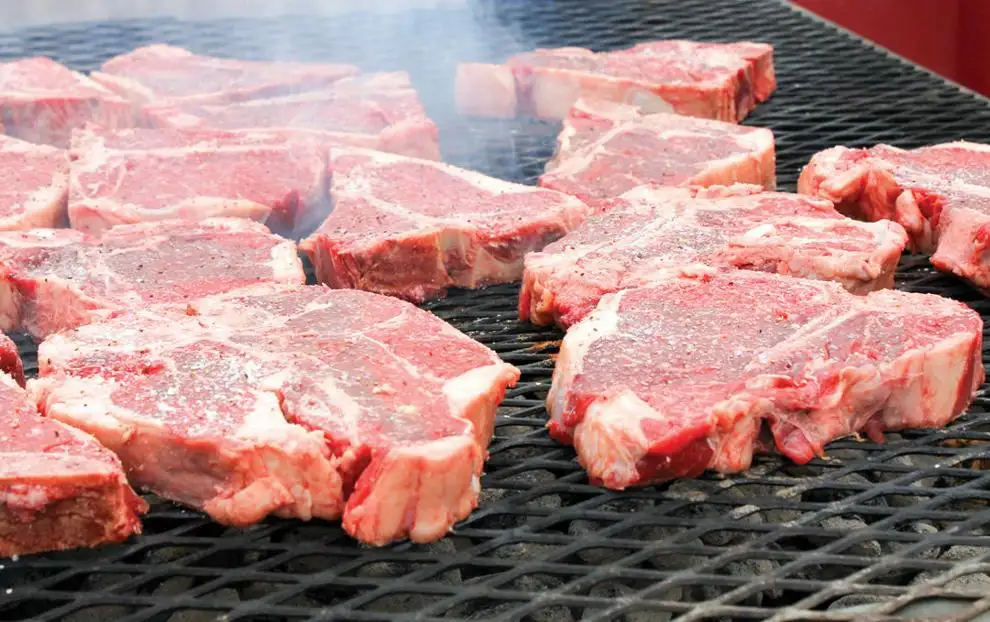
Beef demand at retail has been surprisingly strong this year despite record- or near-record high prices. But the start of the grilling season at the beginning of May had shown that Americans are trading down in their protein purchases because of the high price of beef.
The Memorial Day holiday long weekend is now well behind the market and it appears that beef retail demand was softer than expected. Packers will be hoping that June produces stronger results and that the holiday-shortened production will boost boxed beef cutout values and help fed beef processors to keep reducing their losses. Those losses the week before last were $295.56 per head, according to HedgersEdge.com.
Packers continue to struggle to buy live cattle at lower prices. The week ended May 24 saw the five-area steer prices average $260.49/cwt live or $410.24/cwt dressed. These were down $0.36/cwt and $0.83/cwt, respectively, from the prior week. Trade the week before only began on the Friday and revealed somewhat lower prices in all regions. However, packers made little headway in raising boxed beef cutout prices, so their margins remained close to $3,000 per head in the red.
Meanwhile, fed cattle graded a record high percentage of Prime and Choice for the 12th week in a row. For the week ended May 16, cattle graded 15.42% Prime and 73.20% Choice. Carcass weights remain at record levels for this time of year. Carcass weights also remain record high for this time of the year.
The expected production cuts of the holiday week may finally allow cutout values to gain traction and to advance prices, says Bob Wilson, HedgersEdge.com. But early reads and descriptors for retail activity over the Memorial Day weekend came in as “OK” and “adequate,” hardly the exceptional readings that were hoped for or needed. The other reports that came in saw lower-priced items move better, as consumers dumbed down celebration items from steaks to hamburgers, from burgers to hotdogs and from beef to chicken wings, he says. The expectations remain that beef cutout values will be able to advance in the near-term. The Father’s Day grilling weekend is only a couple of weeks away and the 250th anniversary of the July 4 Independence Day holiday follows quickly from there, he says.
An analysis of the May Cattle on Feed report makes one hard-pressed to see the report as anything but negative, Wilson says. The growing concern of reduced marketing levels (down 630,000 head for the year and 888,000 head under the five-year average) is compounded in looking ahead, as this month has one less marketing day than last May. Declining marketing levels are one thing with smaller on feed totals and quite another when on feed numbers are increasing, says Wilson.
Thenumber of cattle on feed, particularly those on feed 150 days or more, remains higher than a year ago, mainly because marketings remain well above last year. Through the first four months of the year, marketings were 630,000 head less than in 2025 and 888,000 head less than the five-year average. The last time monthly marketings exceeded the five-year average was January 2025, Wilson says.
Front-end cattle supplies of 150-plus days on feed project to remain above the prior-year levels into the end of the year, Wilson says. The total on June 1 was an estimated 3.437 million head, which would be up 14% on June 1 last year. This supply does not project to drop below 3.25 million head through the end of the year. May 1 posted the level of cattle on feed of more than 180 days as record large for any month in any year. The average number of days on feed is back above 200, he says.
The CME Feeder Cattle Index price continues to hover near the all-time high prices posted in April, Wilson says. From the COVID-19 low in the spring of 2020, the advance has measured a staggering 330%. Despite border closures caused by the specter of New World screwworm to the South and reduced numbers from the North (a result of tariff impacts), the U.S. feeder cattle and calf supply outside feedyards posted higher levels. The April 1 totals were 416,000 head above April 2025 and higher than April 2024. It was the first year-on-year gain during April since 2020.
Regarding cattle prices, USDA’s Economic Research Service (ERS) says prices in 2027 are expected to be modestly higher than the records currently forecast for 2026. This is based on a smaller anticipated calf crop in 2026 and more heifers retained for breeding to further tighten supplies available for placement in feedlots and for slaughter in 2027. ERS’ forecast for feeder steers weighing 750-800 pounds at the Oklahoma City National Stockyards is $382/cwt, a 1% increase from 2026. Its forecast for slaughter steer prices in the five-area marketing region is $253.75/cwt, a 2% year-over-year increase, ERS says. — Steve Kay, WLJ columnist
(Steve Kay is editor/publisher of Cattle Buyers Weekly, an industry newsletter published at P.O. Box 2533, Petaluma, CA, 94953; 707-765-1725. Kay’s Korner appears exclusively in WLJ.)