The latest USDA Cattle on Feed report showed an Oct. 1 feedlot inventory of 11.6 million head, unchanged from one year ago. For the last 13 months, monthly feedlot inventories have averaged 100.7% of the prior year. Feedlots have remarkably been able to hold feedlot inventories steady despite declining feeder cattle supplies.
Among major feedlot states, Texas was down year over year at 99% of last year, Kansas was 95% of last year, while Nebraska was 102% of one year ago and Colorado was 101% of last year. The Oklahoma feedlot inventory was 119% of one year ago and was the highest level since 2012.
September feedlot placements were 98% of last year. Total feedlot placements from January to September are down 1.9% year over year. Feedlot marketings in September were 102% of last year. Total feedlot marketings in the first nine months of 2024 have been 0.7% lower compared to last year. The decrease in feedlot marketings matches the decrease of 0.7% in fed steer and heifer slaughter for the first 41 weeks of the year.
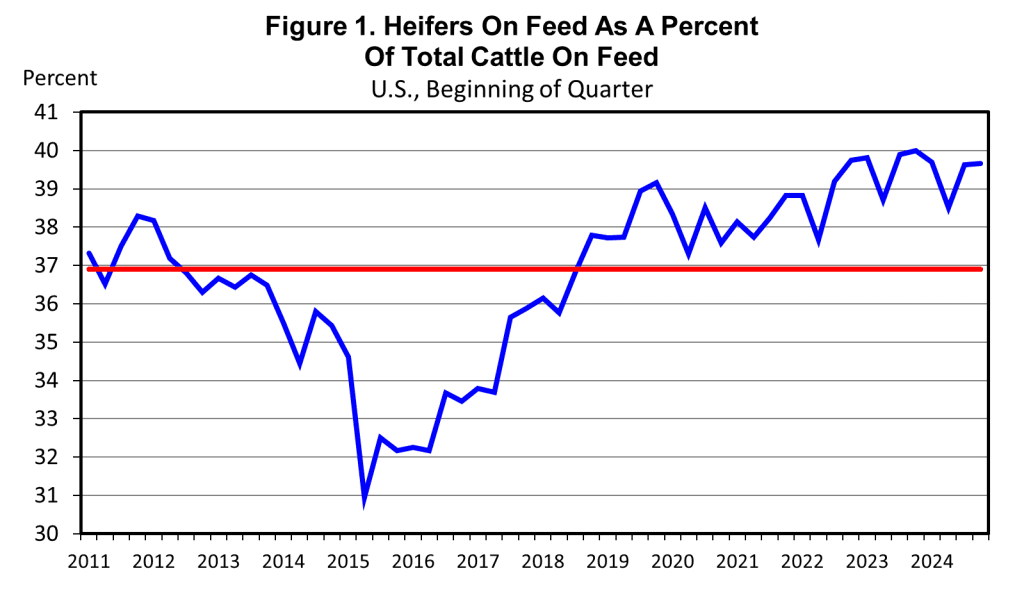
The quarterly inventory of heifers on feed was 4.6 million head, down 0.9% year over year. Heifers made up 39.7% of the total feedlot inventory on October 1, up slightly from the 39.6% in July. Heifers have averaged 39.5% of total feedlot inventories for the past 10 quarters, since July 2022 and have been above the 15-year average of 36.9% since October 2018 (Figure 1).
Continued large inventories of heifers in feedlots confirms that little or no heifer retention is starting in 2024. Heifer slaughter is down 1.7% year over year thus far in 2024. Heifer slaughter would have to drop significantly more if heifers were being retained for breeding. In the most recent beef herd expansion, heifer slaughter decreased an average of just over 10% each year in 2014 and 2015.
Reemerging drought is changing the timing of feeder cattle marketing again in Oklahoma. September feedlot placements were down 2% year over year but were likely somewhat higher than otherwise due to a fall run of calves that started earlier than usual. In Oklahoma, September combined feeder auction totals were up 7.5% year over year.
The next Cattle on Feed report in November may show an even bigger impact as the Oklahoma feeder auction total for October is 32% higher year over year. However, feeder auction totals are expected to drop sharply late in the year after the early calf marketing run is exhausted. The timing of calf marketing can be changed but the supply of feeder cattle is not larger.
Maintaining feedlot inventories for the past year has masked the ever-tightening supply of feeder cattle in the country. The feeder cattle supply is an increasingly hollow ball that will implode at some point. — Derrell S. Peel, Oklahoma State University Extension livestock marketing specialist