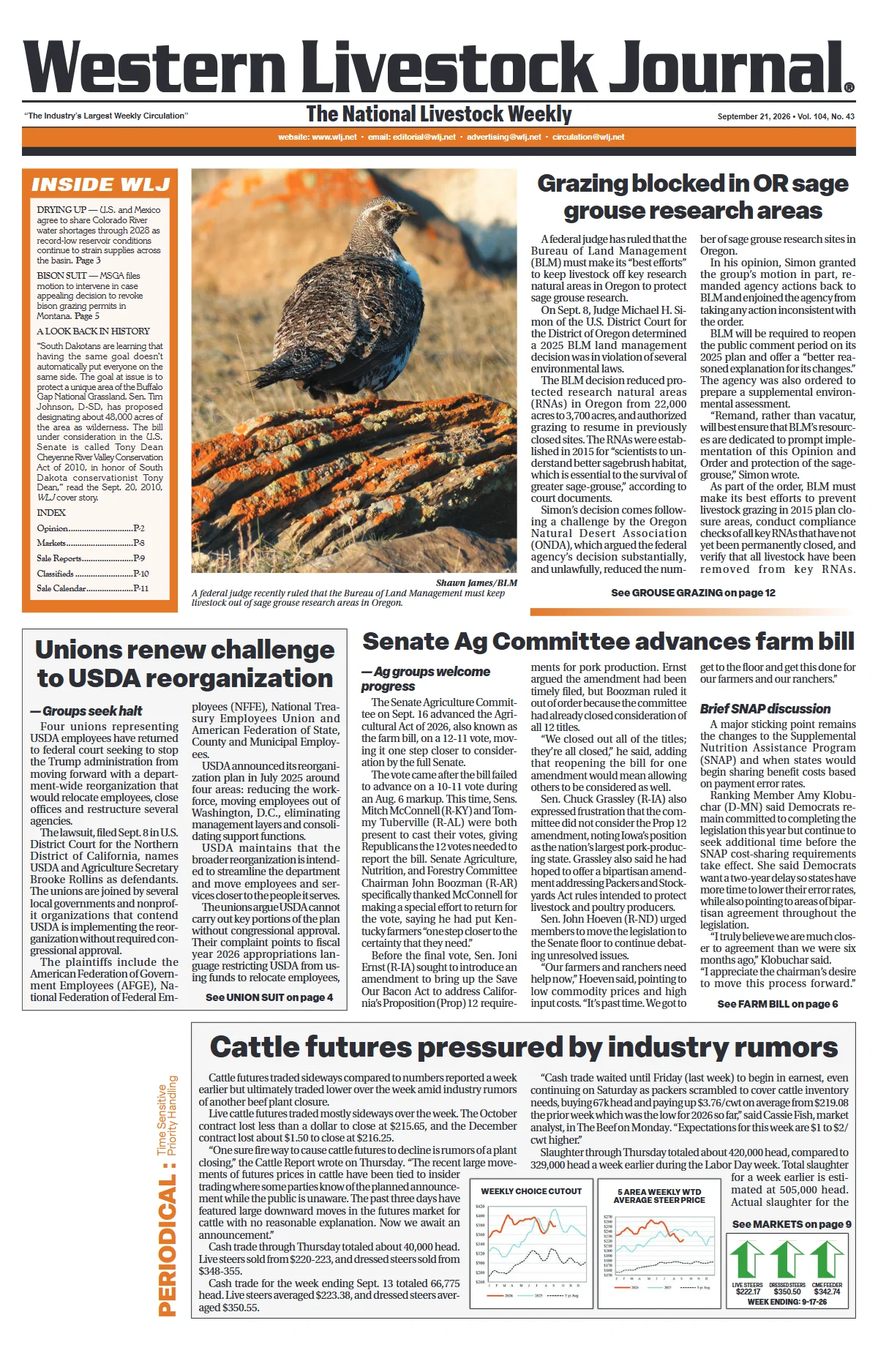
A federal judge has ruled that the Bureau of Land Management (BLM) must make its “best efforts” to keep livestock off key research natural areas in Oregon to protect sage grouse research.
On Sept. 8, Judge Michael H. Simon of the U.S. District Court for the District of Oregon determined a 2025 BLM land management decision was in violation of several environmental laws.
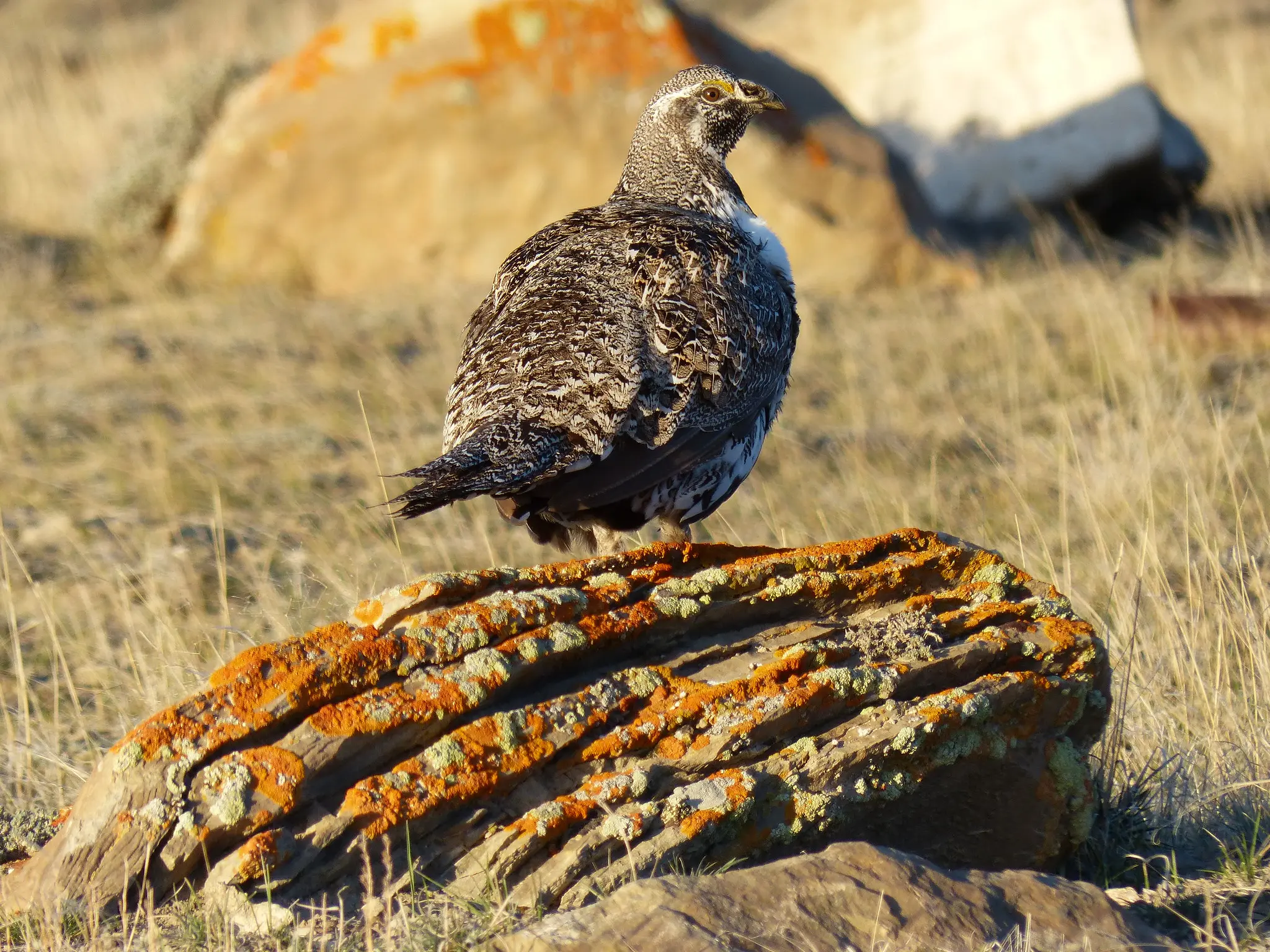
The BLM decision reduced protected research natural areas (RNAs) in Oregon from 22,000 acres to 3,700 acres, and authorized grazing to resume in previously closed sites. The RNAs were established in 2015 for “scientists to understand better sagebrush habitat, which is essential to the survival of greater sage-grouse,” according to court documents.
Simon’s decision comes following a challenge by the Oregon Natural Desert Association (ONDA), which argued the federal agency’s decision substantially, and unlawfully, reduced the number of sage grouse research sites in Oregon.
In his opinion, Simon granted the group’s motion in part, remanded agency actions back to BLM and enjoined the agency from taking any action inconsistent with the order.
BLM will be required to reopen the public comment period on its 2025 plan and offer a “better reasoned explanation for its changes.” The agency was also ordered to prepare a supplemental environmental assessment.
“Remand, rather than vacatur, will best ensure that BLM’s resources are dedicated to prompt implementation of this Opinion and Order and protection of the sage-grouse,” Simon wrote.
As part of the order, BLM must make its best efforts to prevent livestock grazing in 2015 plan closure areas, conduct compliance checks of all key RNAs that have not yet been permanently closed, and verify that all livestock have been removed from key RNAs.
Lawsuit, order details
ONDA and two other environmental groups first sued the BLM in 2019, arguing that the agency continued to delay action on its 2015 sage grouse conservation plan. The 2015 plan created 15 key RNAs for sage grouse habitat and greater sage-grouse research that closed nearly 22,000 acres to grazing.
BLM failed to keep the protected areas free of livestock, and the ONDA won a 2022 order requiring compliance.
When BLM completed a 2025 plan that reduced protected acreage to just 3,700 acres, the group sued again in March 2025. ONDA asserted that the BLM’s 2025 land management plan and 2024 environmental study were in violation of the Federal Land Policy and Management Act (FLPMA), the National Environmental Policy Act (NEPA) and the Administrative Procedure Act (APA).
In April 2025, Simon again sided with ONDA, finding BLM likely in violation of NEPA and FLPMA, and halted grazing on the 22,000 acres.
Earlier this spring, Simon heard arguments over the 2025 land plan but did not make a ruling until his Sept. 8 order.
ONDA argued that BLM violated two FLPMA mandates, but the court only agreed with one. The court found BLM in violation by failing to discuss the impacts of grazing on the wilderness characteristics of the wilderness study areas within the key RNAs. Simon did not find BLM in violation of a second mandate that requires the agency to manage public lands in accordance with land use plans.
Simon also found BLM in violation of NEPA by not discussing its changes to definitions for “relatively unaltered,” “key research natural areas,” and “baseline reference area” in the 2025 plan. In addition, the agency violated NEPA by failing to allow additional public comment on those changes, he wrote.
Finally, Simon found BLM in violation of APA by changing the number of minimum acres necessary to research sage grouse without explaining its decision. While the agency gave sufficient reason to explain reducing the number of ungrazed acres from the 2015 plan, it did not give good reason for every change, Simon said.
“BLM never acknowledges its previous descriptions of the baseline as ungrazed, nor do its studies in the 2025 ROD and (Approved Resource Management Plan Amendment) explain whether there is a difference between an ungrazed baseline and a grazed baseline,” Simon wrote. “This is the kind of unexplained inconsistency that renders the agency’s decision arbitrary and capricious.” — Anna Miller Fortozo, WLJ managing editor