
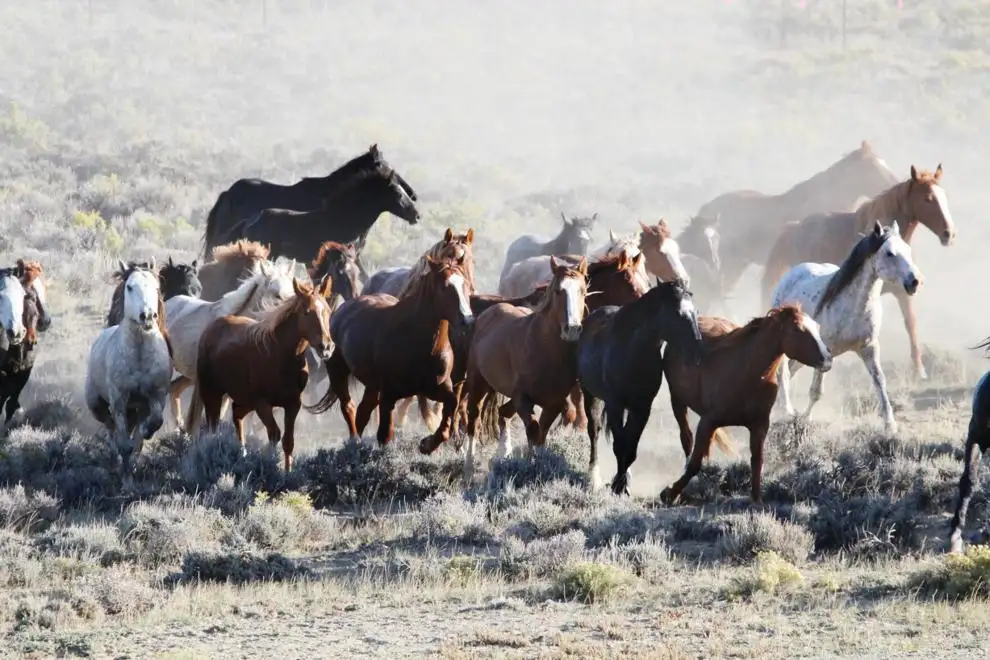
The Bureau of Land Management’s (BLM) contentious plans to remove all free-roaming horses from vast reaches of southwest Wyoming’s “checkerboard” region could begin as soon as this summer, although a legal appeal to stop roundups remains in limbo.
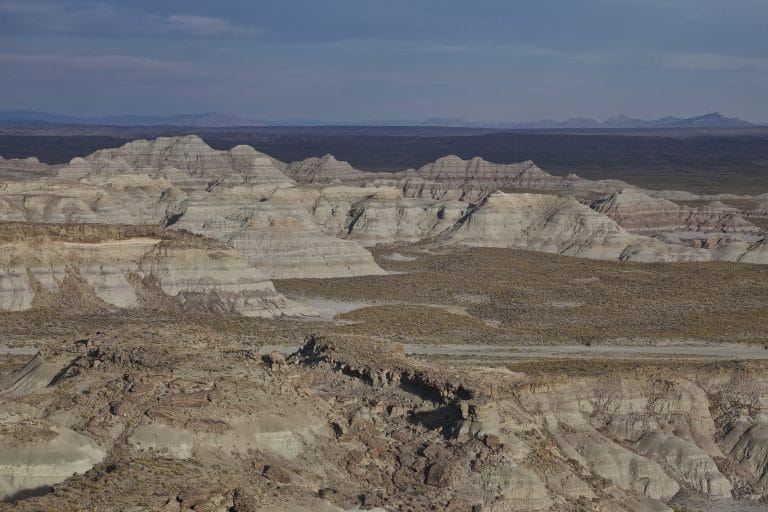
On March 31, the federal agency released a 47-page environmental assessment outlining plans to gather and permanently remove several thousand wild horses from 2,105 square miles—an area nearly the size of Delaware—managed by BLM’s Rock Springs and Rawlins field offices. Horses would come off an additional 1,124 square miles of private land within the checkerboard. A public review period is underway with comments due by April 30. If the BLM greenlights the roundups, they could begin within the next three months and continue for a couple of years, possibly longer.
First to go would be the estimated 1,125 free-roaming horses in the Salt Wells Creek herd and 736 animals in the northwestern portion of Adobe Town, according to BLM Rock Springs Field Office Manager Kimberlee Foster. Then in 2026, horse-removal crews would move on to eliminating an estimated 894 horses in the Great Divide Basin herd.
“Additional gathers may be needed in future years to remove all wild horses to get to the zero-population goal, as some may be missed during the scheduled gathers,” Foster told WyoFile in response to emailed questions.
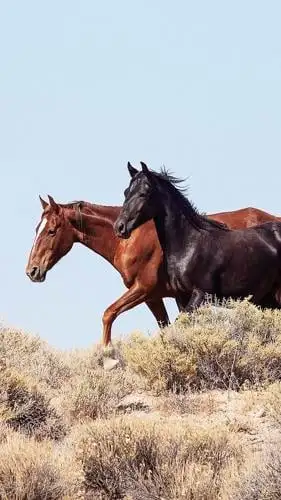
Free-roaming horses, a nonnative species that faces scant predation, increase in population by about 20% annually. Reproduction, combined with missed animals during surveys, make estimating precise herd numbers difficult. The expectation is that 3,371 wild horses would be removed, but the ultimate number could range from 2,500 up to 5,000, according to the BLM.
The push to rid southwest Wyoming’s checkerboard region of free-roaming horses traces back 15 years. The Wild Free-Roaming Horses and Burros Act directs the BLM to “to remove stray wild horses from private lands as soon as practicable upon receipt of a written request,” the environmental assessment states. In 2010, the cattle and sheep-centric Rock Springs Grazing Association, which owns and leases about 1.1 million acres of private land in the checkerboard, revoked consent to allow horses to roam on its property.
There’s been a legal battle ever since. Lawsuits from both the Rock Springs Grazing Association and wild horse advocacy groups have targeted the BLM’s planned actions, but U.S. District Court of Wyoming Judge Kelly Rankin, a Biden appointee, ruled in the federal government’s favor in both lawsuits last August.
Soon thereafter, a coalition of pro-horse petitioners—the American Wild Horse Campaign, Animal Welfare Institute, Western Watersheds Project, Carol Walker, Kimerlee Curyl and Chad Hanson—appealed.
“This is just the latest lawsuit in a 12 or more year battle to save these horses,” American Wild Horse Executive Director Suzanne Roy told WyoFile. “We’ve litigated four or five times about this issue.”
Attorneys for the federal government and horse advocacy groups exchanged arguments before the 10th Circuit Court of Appeals in March. A decision is pending, but horse advocates are optimistic about their chances.
“We have prevailed in the 10th Circuit previously on this issue,” Roy said.
The BLM, she contended, has never before fully eliminated a herd of free-roaming horses without having demonstrated there are ecological reasons for doing so.
“This would be the first time in the 54-year history of the Wild Horse and Burros Act that the BLM eliminated a herd management area and eradicated entire wild horse herds—two of them—when the agency itself concedes that the area has sufficient habitat for the horses,” Roy said. “It has implications for wild horse protection across the West, because if private landowners that have land adjacent to or within herd management areas are allowed to dictate the presence of wild horses on the public land, that’s a very dangerous precedent. So we are anxiously awaiting the court’s ruling.”
Meanwhile, the BLM is staging resources necessary to move forward with its plans. The Adobe Town/Salt Wells Creek herd roundup is the largest on the BLM’s tentative wild horse and burro gather schedule for 2025. It’s scheduled to take place from July 15 through Sept. 15. In regions of the Adobe Town herd area where horses are being allowed to persist, there are related plans to remove 2,179 free-roaming horses—numbers that exceed the “appropriate management level.”
It’s unclear how or if the Trump administration’s slashing of the federal government workforce will impact the horse gather operations. Asked by WyoFile if the BLM-Wyoming’s horse and burro program is fully staffed right now, Foster, the field office manager, wrote “BLM is prepared to conduct the planned gathers with current staffing.”—Mike Koshmrl, WyoFile
Republished from WyoFile.




3 Comments