For ranchers balancing forage production, herd performance and rising input costs, the challenge is no longer just managing land. It is also managing information.
Envu is building tools to address that shift by pairing its herbicide portfolio with digital systems that support decision-making. At the center is RangeView, a satellite-based platform that connects pasture conditions, grazing management and herd performance.
Envu, formed in 2022 but backed by more than two decades of experience in range and pasture solutions, has steadily expanded beyond chemistry alone. While products like Rejuvra and Invora herbicides remain core to its offering, the company’s broader strategy now focuses on helping ranchers understand how those tools translate into on-the-ground returns.
“We’ve been in the range and pasture business for over 20 years,” Justin Hossfeld, Envu range and pasture specialist, told WLJ. “But now we’re focused on expanding not just our portfolio, but the decision-making tools that go along with it.”
From treatment to management
RangeView was developed after Envu observed how herbicide use changed forage conditions. As invasive species were reduced, forage increased. That shift required changes in stocking rates and grazing plans.
“That changed their stocking rate. It changed how they utilized their ground,” Hossfeld said. “RangeView was built to help them visualize that and manage it.”
Using satellite imagery and geospatial analysis through a partnership with Satelytics, RangeView allows ranchers to monitor invasive species pressure, track herbicide applications and assess pasture productivity over time. The platform also integrates normalized difference vegetation index data, giving users a real-time look at forage conditions across their operation.
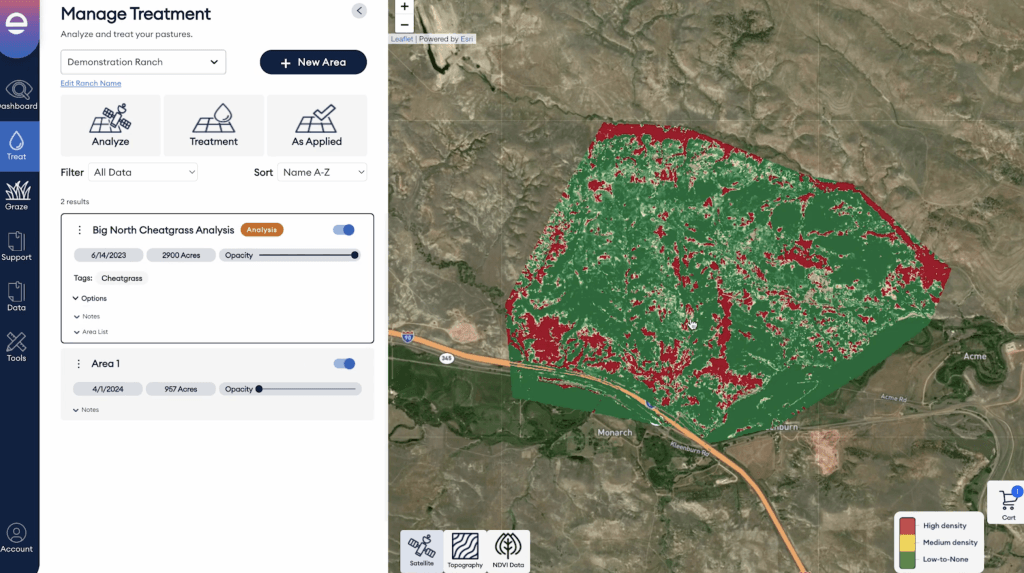
That level of visibility is increasingly important as producers look to stretch limited labor and maximize efficiency. Rather than spending hours driving pasture to pasture, RangeView consolidates that information into a single dashboard.
“In about 30 minutes, you can look at your whole ranch—water levels, cattle location, herd health—and move on to other work,” Hossfeld said.
RangeView includes tools for rotational grazing planning. Ranchers can monitor pasture use, track utilization rates and plan moves based on forage conditions.
Hossfeld said that by optimizing rotation, ranchers can improve forage recovery, reduce overgrazing and increase overall productivity. Envu estimates that better grazing management alone can increase stocking rates by 10-20% without requiring additional land or infrastructure.
To help quantify those benefits, Envu introduced in July 2025 a Return on Investment Calculator designed to work alongside RangeView. The tool allows ranchers to estimate savings tied to increased forage production, reduced feed costs and lower labor inputs.
Through the use of Envu’s suite of herbicides, such as Rejuvra and Invora, Envu estimates that improved forage conditions can reduce feed costs by $50-100 per head and cut labor costs by $15-25 per head, depending on the operation. When combined with RangeView’s planning tools, those gains become easier to track and manage over time.
Integration with CERES TAG
A recent update to RangeView includes integration with CERES TAG. The system adds livestock data to pasture information. Tags collect data on movement, grazing activity, rest patterns and breeding cycles.
That integration allows ranchers to move beyond estimating forage use to actually measuring it.
“The tag can show how much forage they graze, when they’re eating, when they’re drinking and even when they’re cycling,” Hossfeld said.

The system operates entirely via satellite, eliminating the need for cellular coverage or additional infrastructure. Ranchers can access it through a phone, tablet, or desktop, making it adaptable across a range of operations. Real-time alerts further enhance that capability, providing immediate notifications if an animal stops moving, leaves a designated boundary, or shows signs of calving, reducing uncertainty and risk.
Flexible adoption
RangeView is structured as a modular system. Ranchers can select features based on their operation. Options include grazing management, invasive species tracking and herd monitoring.
“It’s kind of a cafeteria-style approach,” Hossfeld said. “You can start with what makes sense for your operation and build from there.”
The platform also offers a free entry point, allowing users to map their ranch, explore satellite data and evaluate features before committing to a subscription.
As margins in the cattle industry improve, Hossfeld said now is a logical time for producers to consider investing in technology that can enhance efficiency and long-term profitability.
“There’s a lot of technology out there,” he said. “Don’t be afraid of it. The key is finding what’s meaningful for your operation and putting it to work.” — Charles Wallace, WLJ contributing editor