Gene editing has the potential to immensely improve the quality and quantity of beef produced around the world. However, before the word “Frankenstein” comes to mind, remember the vast majority of edits up for consideration utilize naturally-occurring bovine genes. These could also be established in a population with natural breeding methods through backcrossing to introduce the gene into a breed or a composite.
However, doing it the way that it has always been done—through backcrossing—takes a tremendous amount of time and greatly dilutes selection pressure for a broad range of other favorable traits.
A quick example is the slick hair gene, a mutation common in Bos taurus Caribbean breeds, which greatly improves an animal’s heat tolerance. To introduce the gene into a breed with an open herd book—like Simmental, Gelbvieh, Shorthorn or Red Angus—you can cross one of these mainstream breeds with a Caribbean breed, such as Senepol, that carries the slick hair mutation.
By breeding the first generation back to the breed you want to introduce the gene into for three more generations, a producer can achieve production of a purebred with the slick gene. Along the way, a producer will likely have lost a lot of ground on a number of other traits compared to the general population of the breed. This is due to the necessary pressure to select cattle that have a random chance of inheriting the slick gene each generation—with a 50% probability every generation.
In breeds with closed herd books—like Angus and Hereford—the only option to introduce a novel trait, such as the slick hair gene, into the genome is through gene editing.
Traits under consideration
Most traits considered for gene editing are impacted by single genes, so the intentional gene alteration of the genome has a direct impact on the expression of the phenotype. These are simple traits, such as the polled gene being inserted into the otherwise genetically superior but horned Holsteins. Anyone who has mechanically dehorned cattle knows what a positive stride forward that would be for animal welfare to not have to dehorn Holsteins.
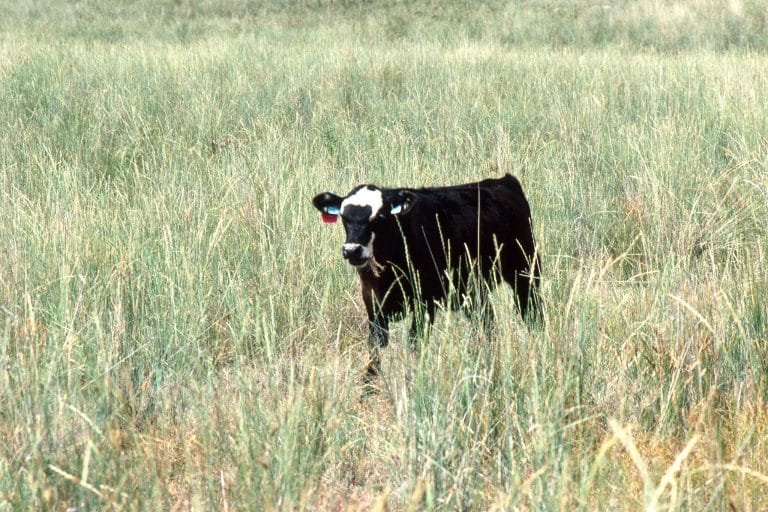
[inline_image file=”dbaa949480696d76ce66263b9868b124.jpg” caption=”A genome-edited calf for the polled trait. Courtesy of University of California, Davis.”]
Other examples of genes considered for editing include a dominant red gene found in some red Holsteins, which could make a highly desirable animal with black Angus heritage produce all red calves, making them eligible for registration at the Red Angus Association of America. In a lean meat market, a myostatin gene, which is the mutation for “double muscling,” might be desirable.
Many people feel that gene editing holds the biggest potential for modifying traits that affect fitness and eliminating mutations that cause genetic defects. In the swine industry, researchers are working to develop hogs resistant to porcine reproductive and respiratory syndrome, which has been a scourge to the species. In cattle, several mutations for the genetic defect that causes early embryonic death are known to occur in both the beef and dairy populations.
Making strides forward
Former longtime USDA researcher and current CEO of Acceligen Dr. Tad Sonstegard sees gene editing as another tool to advance the rate of selection for superior animals. He told WLJ he doesn’t see it replacing traditional selection tools of individual merit and objective genetic predictions calculated from large data sets. Rather, he sees it as a “top dressing” to add a desirable novel gene or remove a genetic defect from an otherwise genetically superior animal.
[inline_image file=”28a2829ebef1710fafe2c4bea56ebd3d.jpg” caption=”Dr. Tad Sonstegard”]
Combining all of these tools is becoming known in the industry as “precision breeding,” and it holds great promise to improve the sustainability of the cattle industry, the well-being of the animals in the system, and the quantity and quality of the beef supplied to consumers.
The technology used for gene editing today is CRISPR-Cas. In simple terms, CRISPR tags a specific region of DNA with a mirror strand of RNA, which provides a target so that an enzyme (Cas) cleaves the DNA in the correct place to either edit a gene, insert a new gene or correct a harmful version of a gene, such as a lethal recessive genetic defect.
Dr. Alison Van Eenennaam is the animal biotechnology and genomics Extension specialist at the University of California (UC), Davis, and she has become a reliable source of information on the subject of genome editing for both agriculture producers and the consuming public.
Some recent news in the cattle industry occurred in March 2022, when Acceligen received approval from the Food and Drug Administration (FDA) to intentionally genetically alter two animals to include the slick gene. Since the gene was a within-species edit, it was able to follow the “low-risk” path for FDA approval, which is still extremely rigorous. Although risk assessment is determined on a case-by-case basis, when considering cross-species editing or human therapeutics, the approval path is expected to become even more rigorous.
[inline_image file=”672b98b7cda5b69b852f24619373b9b2.jpg” caption=”Dr. Alison Van Eenennaam”]
The low-risk determination has three main categories it examines: safety to animals, safety to consumers and safety to the environment. This involved teams of scientists that examined the molecular biology and bioinformatics, including unintended editions or alteration of the DNA; surveillance and compliance; target animal safety; human food safety; environmental risks; and agriculture food ingredients.
Dr. Alison Van Eenennaam is the animal biotechnology and genomics Extension specialist at the University of California (UC), Davis, and she has become a reliable source of information on the subject of genome editing for both agriculture producers and the consuming public.
In response to the FDA’s approval of the slick hair gene editIn response to this decision, Van Eenennaam released a blog post titled “DNA is NOT a drug. And regulating genome edited research animals as a drug is unworkable.” The opening paragraph makes her thinking clear: “Investigational research animals that have been genome edited CANNOT enter the food supply in the United States, irrespective of the edits they carry, unless the researcher that has produced that animal has submitted an FDA Investigational New Animal Drug (INAD), and additionally has obtained a food use authorization which requires a TON of paperwork and also data collection. PERIOD.”
One of the points she makes is that the ratio of risks, benefits and costs is not in balance when FDA treats gene editing as a drug and utilizes the INAD system to evaluate a gene edit. However, Van Eenennaam emphasizes the cost and time needed to gain approval: “I should mention that there are also fees associated with all of this. As an academic institution, UC Davis is eligible for a fee waiver, however the Animal Drug User Product and Sponsor (ADUFA) Fees are substantial (see Table 1).
[inline_image file=”f252ecaa07b3462adbf07f917658c34f.png” caption=”Table 1. The U.S. Food and Drug Administration’s (FDA) 2022 Animal Drug User Fee Act product and sponsor fees. Courtesy of FDA.”]
“And while these fees might be quite reasonable for an actual new animal chemical drug evaluation, it becomes hard to wrap your head around a half million-dollar fee to get a single nucleotide polymorphism approved, when nature has made literally millions of unregulated SNPs in cattle genomes.”
Benefits for breeds
Dr. Mark Allan of Allan Genetic Solutions sees gene editing as a powerful methodology to add already-existing and safe versions of bovine genes into cattle populations where the mutation does not exist. The breed association model of having a closed herd book makes it the only path for many breeds. Additionally, gene edits will allow for the adaptation of certain breeds that currently are unable to thrive in certain environments.
[inline_image file=”b6858160aee8ef7059c82b04a60d268f.jpg” caption=”Dr. Mark Allan”]
Allan points out that many of the Bos taurus breeds are unable to express their genetic potential in many tropical and subtropical regions of the world. This is due to their inability to adapt to extreme temperatures. Editing the genes of elite Bos taurus animals for coat color, i.e., black to red, with the addition of the slick hair allele has the potential to create a major increase in the production of red meat and meat quality in many regions.
Allan says the discovery and technical advancements of key enzymes over the last decade have allowed today’s enhanced precision in targeted gene editing. Think of these enzymes as molecular scissors that can be used to either correct a harmful version of a gene or convert it to an advantageous version of a gene.
Gene editing technology is already routinely used in plants, and experimentation with commercial traits is becoming more common in intensely-managed species like poultry and swine. The economics are simply better when an edited gene can be passed to billions of plants, millions of poultry and hundreds of thousands of pigs.
However, when a bull with high genetic value across a broad range of traits may only pass the gene to thousands of progeny, the FDA approval model could slow the implementation of the technology and the positive impact gene editing could have on the cattle industry.
Of course, everyone wants to ensure that animals that result from gene editing are safe and that there are no unintended consequences. Therefore, it behooves the industry to work with the federal government to continuously improve the process for approving genome edits, particularly when done within a species.