“It is often believed today that successful breeders have some mysterious method of which others are ignorant. Instead, the principles of the successful breeder have been exceedingly simple. The difficulty lies not so much in knowing the principles as in applying them,” according to Sewell Wright, a livestock geneticist in 1920.
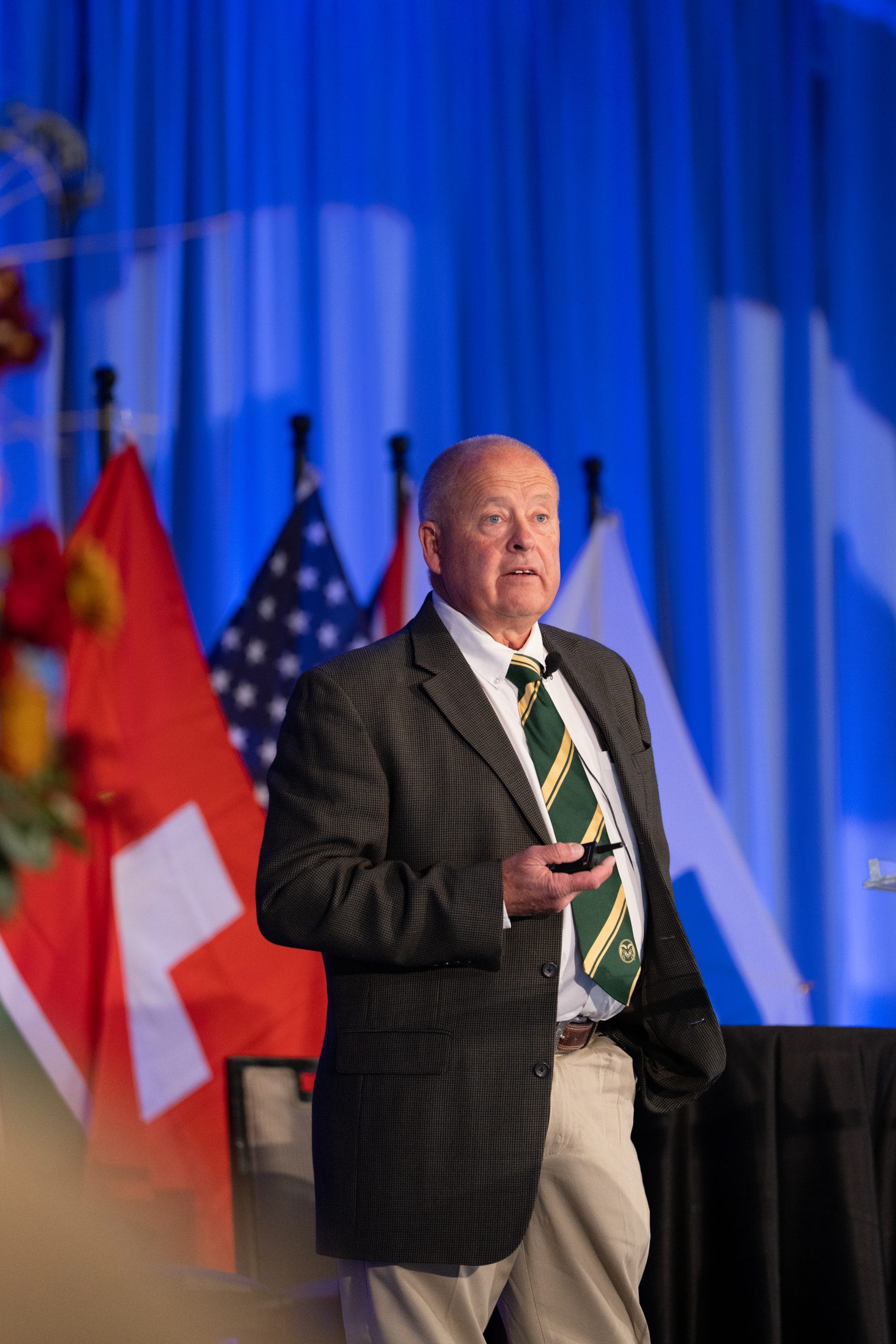
Tom Field, the Paul Engler Chair of Agribusiness Entrepreneurship at the University of Nebraska-Lincoln, shared Wright’s quote and the context for it during the opening session of the American Hereford Association (AHA) Educational Forum, held in conjunction with the 19th World Hereford Conference in Kansas City, MO. Field set the stage for sharing current AHA research results, advancements in genetic prediction and more.
AHA members have always valued objective, collaborative research as essential requirements for breed improvement. Insights shared during the Forum helped participants connect current and previous Hereford research and how each step in the deliberate journey paved the way to current possibilities.
For instance, Mark Enns, the John E. Rouse Chair in animal breeding at Colorado State University (CSU) shared details about the school’s collaborative research project with AgNext and the AHA. It’s designed to estimate in-breed heritabilities and evaluate genetic and phenotypic correlations among three environmental sustainability traits—dry matter intake, methane emission rate and blood urea nitrogen—and growth and carcass traits.
Based on results so far, Enns explained, “There are genetic differences within the AHA population for both methane emissions and blood urea nitrogen concentration. If selection pressure is applied, we will see genetic change in those traits.”
Shane Bedwell, AHA chief operations officer and director of breed improvement, also shared plans for ongoing research aimed at better understanding bovine congestive heart failure (BCHF) in late-day feedlot cattle and how Hereford genetics reduce the risk.
All of this represents the leading edge of exploring necessary new frontiers, but Bedwell reminded the Educational Forum that it is possible because of the thoughtful, deliberate way AHA leadership has addressed the need for the continuous collection of accurate phenotypic data over time, as well as genotypic data these days.
The AHA was an early adopter of whole-herd reporting, for example. It remains one of only two breeds in the U.S. which requires whole-herd reporting for data to be included in the breed’s genetic evaluation.
Hereford is the only breed in the U.S. with a genetic proving program—the National Reference Sire Program (NRSP)—designed to compare the genetic merit of young Hereford sires in real-world, commercial beef cattle production. The mainstay NRSP test herd at Olsen Ranches, Harrisburg, NE, is the reason the breed has such an enviable amount of individual animal dry matter feed intake and carcass data to use in its genetic evaluation for the benefit of all users of Hereford genetics. Incidentally, this is how and where data is also collected for methane emissions, nitrogen excretion and individual animal water intake. The Olsen herd also provides an extraordinary amount of BCHF data.
More than 400 Hereford sires have been tested through the NRSP since its inception in 1999. Those sires influence 7% of the more than 2 million AHA performance pedigrees.
“The National Reference Sire Program is simply unrivaled in the data collected and the resource it provides as a major breed improvement tool,” Bedwell said. — Wes Ishmael, Hereford World executive editor