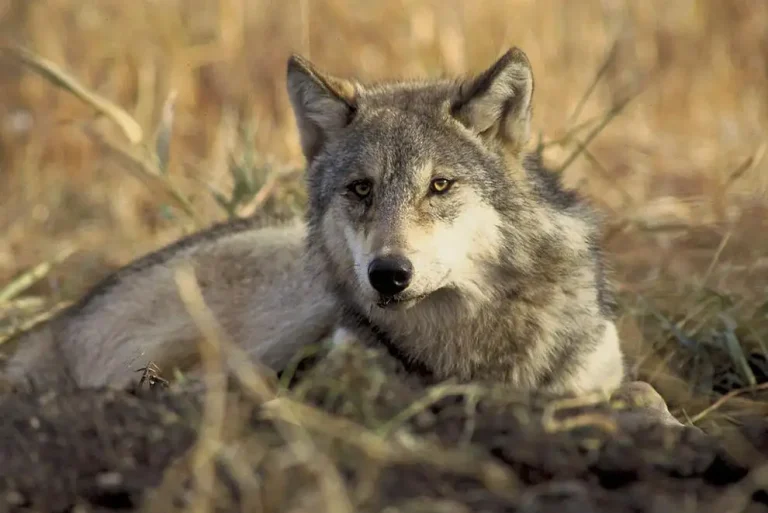
The California Department of Fish and Wildlife (CDFW) has confirmed the presence of a second pack of gray wolves in Northern California. In early May, partner biologists from the U.S. Forest Service (USFS) found evidence of recent wolf presence in the Lassen National Forest. CDFW biologists began surveying the area and planning a capture operation to collar one of the animals. On June 30, after 12 days of trapping attempts, a 75-pound adult female gray wolf was captured in Lassen County.
The wolf was examined, fitted with a tracking collar and released. During the exam wildlife biologists collected genetic and biological samples. “The anesthesia and collaring process went smoothly and the wolf was in excellent condition,” said CDFW’s Senior Wildlife Veterinarian, Dr. Deana Clifford. “Furthermore, our physical examination indicated that she had given birth to pups this spring.”
The following day, July 1, CDFW biologists returned to the field for a routine follow-up check on the female. They encountered tracks of what appeared to be wolf pups, and then found that a nearby trail camera operated by USFS had captured photos of the female with three pups.
CDFW said in a news release that during summer and fall 2016, remote trail cameras captured images of two wolves traveling together in Lassen County. There was no evidence they had pro duced pups at that time. While the female’s origins remain unknown, genetic samples obtained from scat indicated the male wolf originated from Oregon’s Rogue Pack. The famous wolf OR7 is the Rogue Pack’s breeding male.
These wolves, named the Lassen Pack by the USFS employee who first detected their location, are the second pack of gray wolves known in California since their disappearance from the area in the 1920s, according to CDFW. The first confirmed breeding pair in California produced five pups in eastern Siskiyou County in 2015, and are known as the Shasta Pack. The current status of the Shasta Pack is unknown, although one of the 2015 pups was detected in northwestern Nevada in November 2016, CDFW said.
The Lassen female is the first wolf residing in California to be radio-collared; though wolves radio-collared by the Oregon Department of Fish and Wildlife have previously ventured into California, such as OR-7 and OR-25; those wolves have ultimately returned to Oregon.
The tracking collar will collect data relative to her activity patterns, survival, reproduction and prey preferences. The Lassen Pack regularly traverses both public and private lands, including industrial timberlands, and the collar may also help to minimize wolflivestock conflicts by providing information about the pack’s location relative to livestock and ranch lands. While most of the pack’s known activity to date has been in western Lassen County, some tracks have also been confirmed in Plumas County, CDFW said in its release.
WLJ reached out to CDFW to ask how information about wolf activity will be relayed to livestock producers, but as of press time had not received a response.
Kirk Wilbur, director of government affairs at the California Cattlemen’s Association (CCA), told WLJ that CDFW reached out to CCA before publicizing the collaring and discovery of the three wolf pups for which he is appreciative. As for notification of livestock producers regarding wolf activity, Wilbur said that he doesn’t yet have those specific details as most of his discussions with CDFW have been mostly “big picture.” He added that it appears producer notification will be somewhat “generalized” so as to not disclose wolves’ precise location.