Cull beef cows make up about 10% of the U.S. beef supply and provide 15-20% of the gross revenue of typical cow-calf operations. Effective marketing of cull cows can have a large impact on the profitability of cow-calf operations. Cull cow pricing is determined by live animal grading and cull cows are priced based on their body condition score (BCS), dressing percentage and expected lean meat yield.
Cull cows are sorted into four primary carcass grades: Breaking utility cows are 75-80% lean and generally are a BCS 7 or greater and have the greatest dressing yield at 52-55%; Boning utility cows are intermediate fleshed with a BCS of 5.5-6.6 and commonly have a dressing percentage of 50%; lean cows are thinner with 85-90% lean with a BCS of 4.5-5 and 48-49% dressing percentage; light/Canner cows are the leanest with a BCS lower than 4.5 and a 48% dressing percentage.
Breakers are the most valuable with a $3-5/cwt premium over Boning utility cows and over $10/cwt premium over lean and light cows.
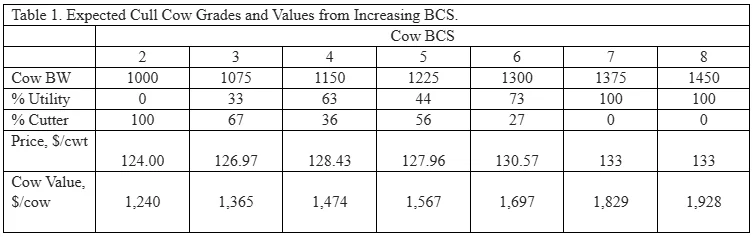
Beef cutout research indicated that cows in BCS 4 were 64% in the Boning or Breaking utility grade while cows in BCS 6 and 7 were 73% and 100% Boning or Breaking utility. So, condition of cows at market has a large impact on returns for cull cows.
The included table shows the value of cull cows using current cull cow prices, expected weight changes between BCS and the expected cull cow grades. The example uses a cow bodyweight of 1,225 lbs. at a BCS of 5 and adjusted live weight by 75 lbs. for each BCS change. Prices for Boning and Breaking utility were $133/cwt and for lean/cutting were $124/cwt.
Increasing BCS 4 to BCS 8 at marketing increased cull cow value by over $450, while increasing BCS from an extremely thin BCS of 2 to BCS 8 increases cow value by nearly $700. This increase in value comes from both added body weight and increasing market price through increased quality.
About 60% of cull beef cows are marketed in the utility grade with 20-25% in the USDA Cutter grade and 5-15% in the Canner grade. Feeding thin cows to higher BCS before marketing can make a large difference in their value. When we consider that the prices of cull cows typically hit their lowest point in the fall, substantial gains can be made by feeding cows to heavier weights and marketing in a higher market. — Paul Beck, Oklahoma State University beef cattle nutrition specialist