Across international markets Red Angus breeders are faced with a powerful shift in buyer expectations. Questions once centered on phenotype and performance now increasingly include: Can you prove what you claim about your cattle? As traceability, verified genetics and data-backed assurance rise to the forefront of global beef trade, proof has become the new passport.
At the Red Angus Association of America (RAAA), our mission is to provide innovative programs and services that advance the quality, reliability and value of Red Angus and Red Angus-influenced cattle, with a clear focus on breeders and their commercial cattle customers. We believe that practical tools—not just policy—are what truly drive profitability, credibility and genetic progress.
“Increasing consumer demand for high-quality beef products requires breeders and their associations to push the limits on genetic and phenotypic selection tools, while also providing a view into the animal’s origin and how it was raised,” said Greg Ruehle, executive vice president of the RAAA.
That philosophy guides how we evaluate Red Angus today. The breed must stand on three legs that support one another: cows that fit the environment, genetics and research that keep improving those cows, and verification platforms that allow buyers to trust what they are buying. When those pieces come together, Red Angus is well-positioned to help rebuild the U.S. cow herd from its lowest level since the 1940s while meeting higher expectations for verified, high-quality beef.
Females that can rebuild the future
As producers weigh how to rebuild, they’re more selective than ever about the kind of cows they want to put back into their pastures. Red Angus females bring a combination of traits that fits a wide range of environments and management styles.
They have proven their ability to efficiently regain body condition after calving, before rebreeding and after weaning. That helps support longevity and productivity in the cow herd. Moderate mature size and a red hide make Red Angus cows more efficient and less susceptible to heat stress. Strong maternal traits, paired with a reputation for docility and ease of handling, make them practical cows for ranch families and their labor forces.
Demand for Red Angus bulls reflects those advantages. Commercial producers are looking for sires that moderate frame, add fertility and longevity, and sire feeder cattle that convert efficiently and hang a high-quality carcass. Red Angus genetics have shown the ability to help moderate carcass size, improve conversion of dry matter to edible beef products and excel in both quality and cutability characteristics. Early work in beef-on-dairy systems indicates that Red Angus sires can also enhance carcass quality and yield in beef x dairy crosses, adding another outlet for the breed’s value proposition.
These breed strengths set the stage. The next step is to support them with data and research so that breeders and commercial customers are making decisions on more than instinct alone.
Red Angus is more than a hide color. It’s a set of genetics managed and improved through a significant investment in evaluation, research and data systems.
Ongoing work with partners such as the Agricultural Research Service and the National Institute of Food and Agriculture helps reduce costs, manage risk and improve yield and quality across the beef supply chain. Studies on traits such as hair shedding and environmental adaptability illustrate how Red Angus can be selected for long-term cow efficiency in challenging climates. That work reflects a broader mindset. We want to know how Red Angus cattle perform from the pasture to the rail and use that information to guide the next round of genetic improvement.
By pairing these tools with a growing emphasis on supply-chain data, Red Angus is building a framework where live-animal traits and carcass outcomes are part of a continuous improvement loop. This emphasis on measurable performance underpins everything from bull selection to how calves are marketed. It also leads naturally to the question of how to document those cattle in a way that travels with them.
Angus Access
For 30 years, Red Angus producers have marketed verified calves that carry more than a color-based claim. In 1995, RAAA launched the Feeder Calf Certification Program, the beef industry’s first USDA Process Verified genetic, age and source program, to ensure Red Angus-sired calves could access the same value premiums as black-hided cattle.
Today that program operates under the Angus Access brand. The name makes clear what these cattle deliver: Angus-quality beef from red-hided cattle, backed by documentation.
The numbers reflect the impact. In the most recent fiscal year, producers enrolled more than 114,000 head through Angus Access and more than 17,000 head through its sister program, Allied Access. Since 1995, total enrollments across all Process Verified Programs have passed 3.6 million head. Each calf enrolled in the Angus Access program is traceable to at least 50% registered Angus bloodlines, source verified to the ranch of origin and group age verified under USDA Process Verified standards.
Jaclyn Wilson, a Red Angus producer in Nebraska, captured the essence of that advantage when she noted that once the hide is off, no one is sorting carcasses by color—they simply see Angus beef. Angus Access helps ensure the paperwork behind that carcass matches the quality on the rail.
This focus on verification naturally leads to a conversation about identification. To keep that documentation intact from ranch to rail, the tag itself has had to evolve.
A universal language of cattle identity
Markets that rely on documented value now expect calves to arrive already equipped for electronic data capture. Rather than explaining what electronic identification is, the more important point for Red Angus is how it is being used.
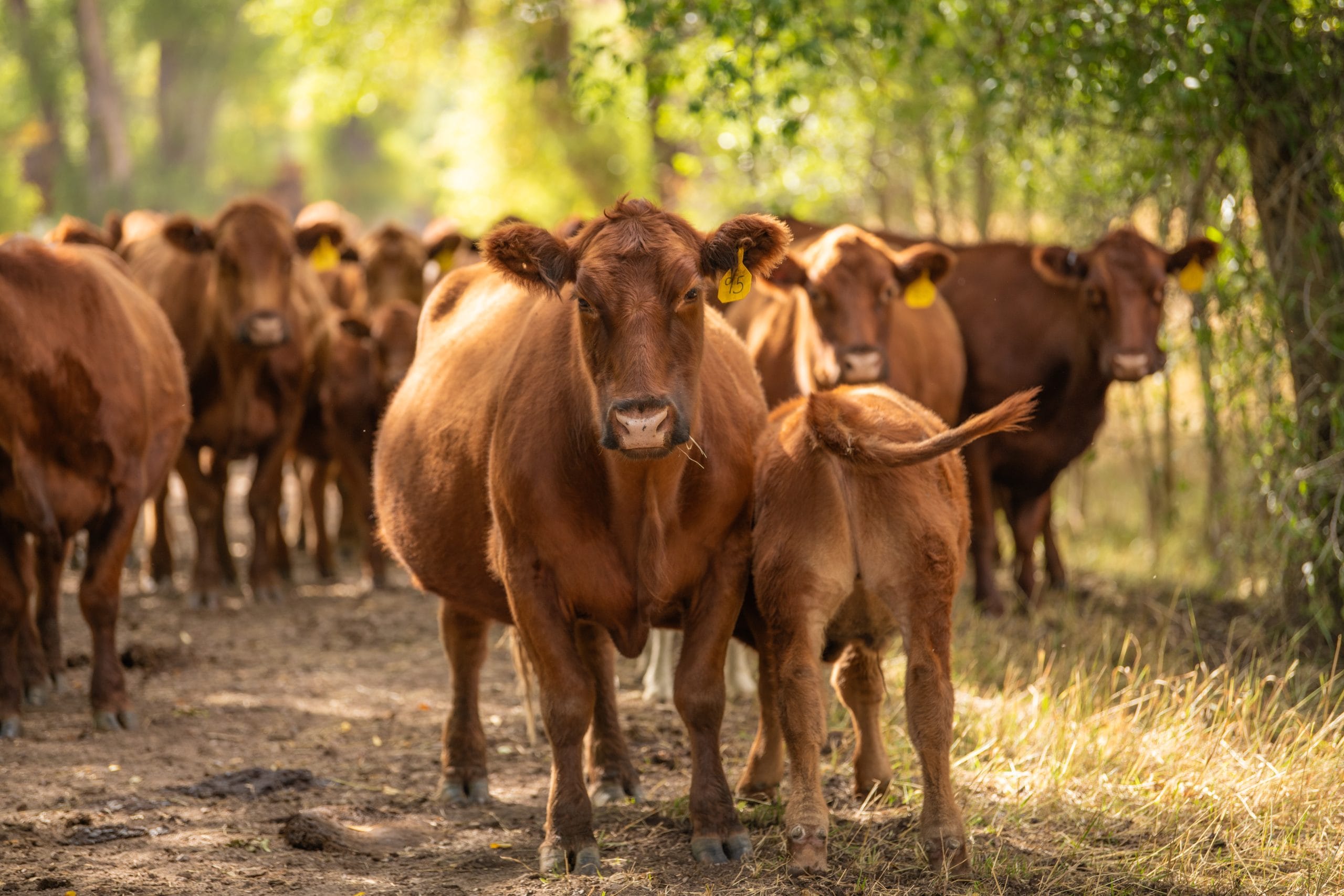
By modernizing its Process Verified Program, RAAA is setting a clear requirement that, beginning in 2026, animals enrolled in Angus Access carry 840-series electronic identification (EID) tags.
This requirement strengthens the data chain supporting Angus Access. It allows identity, management information and carcass outcomes to stay tied to the same animal from enrollment through harvest. It also aligns the program with value-based marketing and export channels that expect documented identity and origin.
RAAA is working with technology providers on a ledger-based system that can return more carcass information to the ranch. The goal is straightforward. Ranchers who invest in Red Angus genetics should have access to performance and carcass data from the cattle they breed and raise. That feedback creates an ecosystem of verified genetics and sustained herd improvement that helps meet evolving consumer and retailer expectations for transparent, high-quality beef.
With these systems in place, the “passport” for Red Angus beef is not just a figure of speech. It is a combination of genetics, documentation and electronic identity that can be read and trusted at each step of the supply chain.
Technology only matters when it works at the chute. For many Red Angus breeders and their customers, Angus Access and EID have become tools that do more than verify cattle—they help tell a clearer genetic and management story, build trust with repeat buyers and make Red Angus cattle easier to market.
California Red Angus producer Celeste Settrini described the program this way: “Red Angus value-added programs have absolutely enhanced the sale of our calves. The paperwork and verification tell buyers exactly what they’re getting and reflect the work our family puts into doing things right. That transparency keeps repeat buyers coming back year after year.”
For Wyoming producers Brad and Tammie Neville, EID tagging has created both immediate and long-term advantages—from retaining lifetime identification at vaccination to improving efficiency and accuracy in the feedyard.
Their experience echoes comments from many Angus Access users: when cattle arrive with a recognized program tag and a scannable ID, they’re simply easier to buy, manage and place in premium programs.
RAAA continues to invest in tools that elevate Red Angus genetics, not through theory but through practical, data-enabled systems that support producers and buyers. The breed’s strengths in maternal function, efficiency and carcass merit, combined with research, genetic evaluation and verification programs, position Red Angus to help rebuild the cow herd and meet rising expectations for transparent, high-quality beef.
In an era where the story behind the beef is nearly as important as the beef itself, the long-term winners will be producers who can prove what they already do well. For Red Angus breeders, Angus Access and EIDs are helping them do exactly that—setting the breed up not just to compete, but to lead. — Maclaine Shults-Mauney, RAAA editor and written content specialist