Calving difficulty is a major issue for beef producers and is a primary problem that comes to mind when we are calving out first-calf heifers. Difficulty during calving reduces calf vigor and sucking behavior. This in turn reduces colostrum intake and passive immune transfer resulting in increased calf death loss of four to eight times greater than in uncomplicated births.
Calving difficulty also has large impacts on the cow, reducing the cow’s milk production and subsequent reproduction performance and increases the potential of losing the cow.
The factors that affect calving difficulty include:
• Calf birth weight, which is related to the length of gestation and the sex of the calf.
• Body condition of the cow at calving. Cows can be too thin or too fat.
• Inadequacies in heifer development that lead to calving heifers that are too small.
• Pelvic area of the cow. The size of the birth canal limits the size of the calf that can be delivered.
• Abnormal presentation of the calf at birth.
The biggest cause of calving difficulty is a large calf at birth combined with cows with small birth canals. Pelvic area affects calving difficulty, independent of cow weight. Heifer weight and age and external dimensions of width of hooks and length of rump are not always good indicators of pelvic area or predictors of calving difficulty, so pelvic measurements are a good tool to cull heifer with a higher potential for calving difficulty.
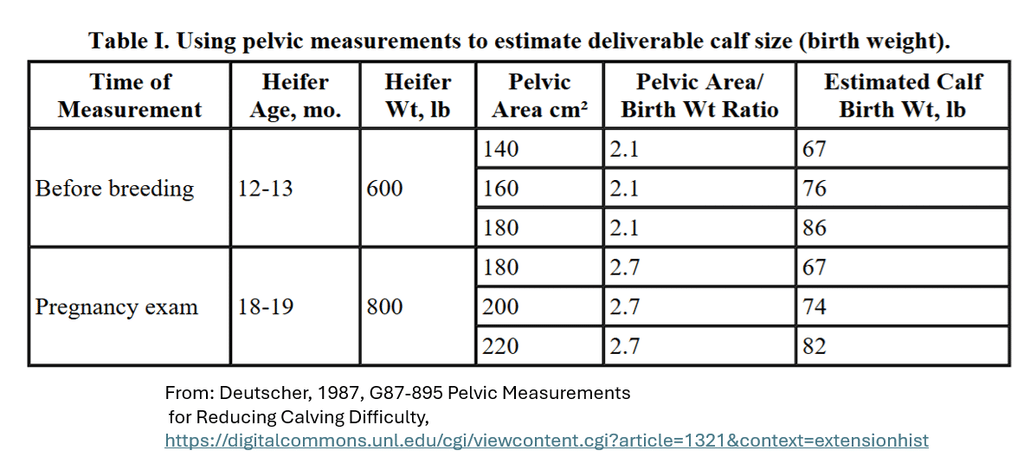
Based on research from the University of Nebraska, pelvic measurements obtained before breeding of a heifer at 12 months of age can be divided by a factor or 2.1 to estimate the calf birth weight the heifer can deliver as a 2-year old at calving without substantial difficulty (Table1).
For instance, a 600-pound heifer with a 160 cm2 pelvic area is expected to be able to deliver a 76-lb. calf when she calves as a 2-year-old (160/2.1 = 76-lb. calf).
Pelvic area increases with the growth of the heifer. Pelvic area can also be measured during pregnancy checks. For an 18-month-old heifer, we use a factor of 2.7.
So, an 800-lb. heifer with a pelvic area of 205 cm2 at 18 months of age would be expected to deliver the 76-lb. calf as a 2-year old (205/2.7 = 76 pound calf).
The included table from Deutscher’s 1987 University of Nebraska factsheet shows the pelvic area/birth weight ratios for differing heifer weights and ages to determine the calf birth weight she should be able to deliver.
Pelvic area is only part of the equation, to reduce calving difficulty in heifers we need to:
• Use proven calving ease bulls to breed heifers.
• Grow and develop heifers to targeted weights before calving.
• Calve heifers at a minimum body condition score of 5.
• Measure pelvic area and cull heifers with abnormally small pelvic areas. — Paul Beck, Oklahoma State University Extension beef cattle specialist