There was little fanfare over a pair of water regulations put into practice by the president last week. In a few small ways, these items that could benefit Western ag water users and ranchers.
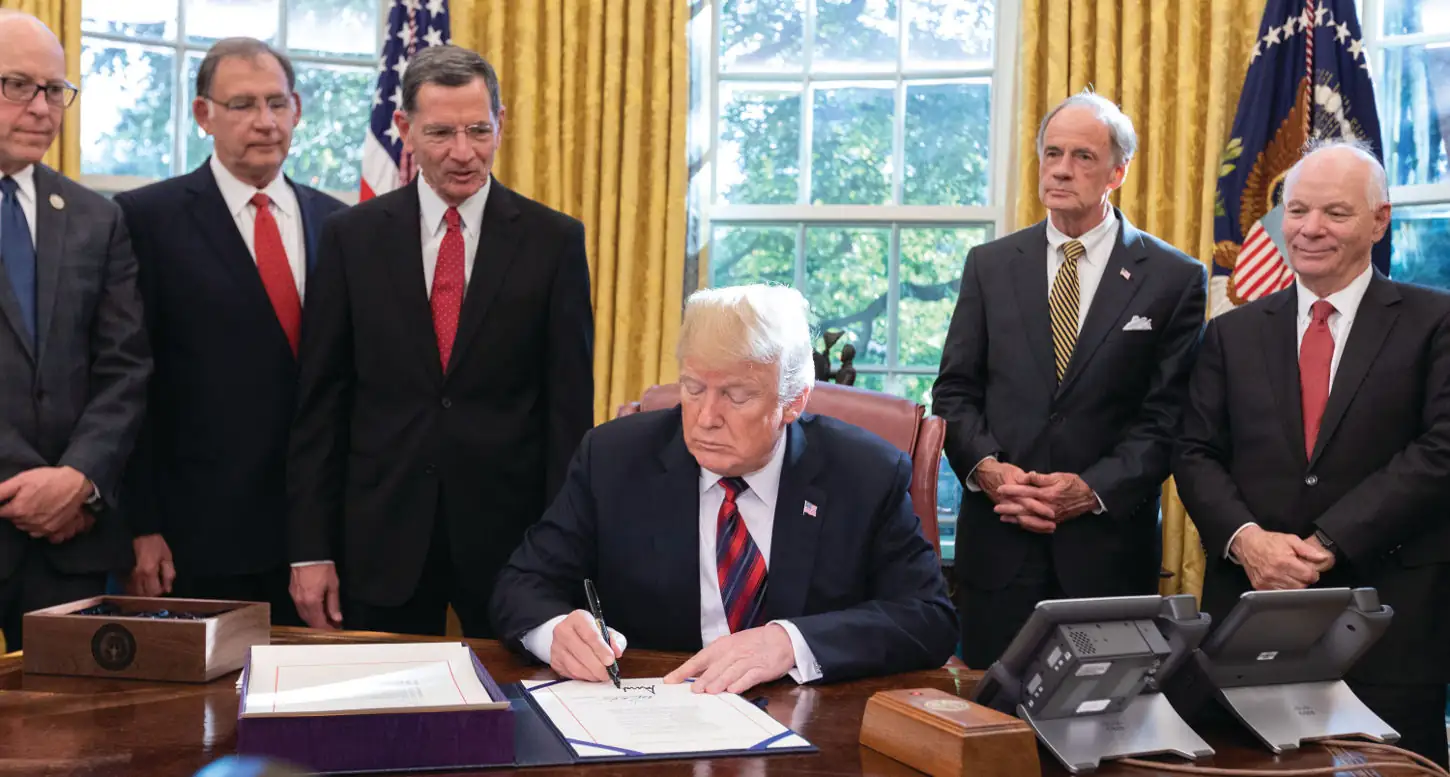
On Friday, Oct. 19, he signed a presidential memorandum to improve infrastructure for and regulations of “Water in the West.” A few days later, on Tuesday, Oct. 23, he signed “America’s Water Infrastructure Act” into law.
Western water memo
The “Presidential Memorandum Promoting the Reliable Supply and Delivery of Water in the West,” signed by the president Oct. 19, takes aim at an issue near and dear to Western ranching hearts—water regulation.
Blaming “decades of uncoordinated, piecemeal regulatory actions,” the memo directs the Secretaries of the Interior and Commerce departments to “work together to minimize unnecessary regulatory burdens and foster more efficient decision-making.”
Specifically, the secretaries are directed to:
• Identify major water infrastructure projects in California that fall under their joint responsibility under either the Endangered Species Act (ESA) and/or the National Environmental Policy Act (NEPA);
• Jointly designate one person to coordinate the projects’ compliance responsibilities under ESA and/or NEPA;
• Develop a timeline for completing those compliance responsibilities within 40 days of the memo being published in the Federal Register (approximately mid-December; the memo had not been published in the Federal Register as of press time);
• Pay special attention to and make specified reports on the progression and biological assessments of the Central Valley Project in Arizona and the California State Water Project in California;
• Complete the ongoing joint consultation for the Klamath Irrigation Project by August 2019;
• Update on the progress of covered projects monthly;
• (Secretary of the Interior) Direct underling bureaus to “promote the expanded use of technology” related to water and power deliveries, including desalination, recycled water, and water management, among others;
• Consider locally-developed plans related to hydroelectric project licensing; and
• Develop a schedule to complete the Columbia River System Operations Environmental Impact Statement and the associated Biological Opinion (due by 2020) within 60 days of the memo’s publishing in the Federal Register (approx. early 2019).
During the signing, Trump called the memo “vital to improve access to water in the American West.”
“For decades, burdensome federal regulations have made it extremely difficult and expensive to build and maintain federal water projects,” he told the press and attendant state representatives present at the signing.
“So today, I’m directing Secretary [Ryan] Zinke and Secretary Wilbur Ross to streamline approvals for federal water infrastructure and to eliminate all unnecessary burdens, significantly speeding up the environmental review and approval process. We will have it done very, very quickly.”
California’s Rep. Jeff Denham (R-10), who attended the signing, equated less water with fewer jobs and a weaker agricultural economy. Rep. Tom McClintock (R-CA-04) echoed this, describing the memo and recent water bills including S.3021 as moving “us back toward an era of abundance.”
“Droughts are nature’s fault; they happen. But water shortages are our fault; that’s a choice that we made a generation ago when we began imposing laws that have made the development of our water resources cost-prohibitive,” McClintock said.
Water Infrastructure Act
As mentioned, Trump also signed S.3021—America’s Water Infrastructure Act—into law on Tuesday, Oct. 23. The expansive, 332-page bill was first passed unanimously by the Senate in early September, and then later passed the House, which passed it with amendments. The amended version was passed by the Senate on a 99-1 vote.
Scott Yager, chief environmental counsel at National Cattlemen’s Beef Association, said that S.3021 was one of a reoccurring class of legislation that often brings regulatory relief to ranchers with the 2016 analog having been very beneficial. This year’s water bill was more standard infrastructure and infrastructure funding issues rather than issues that more immediately touch ranching and agriculture.
“There’s nothing in the water bill for WOTUS,” Yager explained, referring to the Waters of the U.S. rule currently under scrutiny across the country.
“We have a WOTUS rider in the House farm bill. We had one in the House appropriation bill for both the Army Corps [of Engineers] and [the Environmental Protection Agency], but that got stripped out in the final bill. But we’re going to keep pushing for Congress to repeal it and hopefully we can get that farm bill provision across the line.”
Among the many topics covered in the bill—see more details below—the Klamath Basin got specific attention (Section 4308). Specifically, the bill amends the Klamath Basin Water Supply Enhancement Act of 2000 by adding a section dealing with power and water management. Part of that involves funding for drought-related reimbursements to area irrigators.
Rep. Greg Walden (R-OR-02), who was present for the signing, called this good news for Klamath Basin farmers and ranchers.
“Authorizing $10 million annually for four years to the Bureau of Reclamation will assist with groundwater pumping and other drought relief measures for basin farmers that we secured in law earlier this year. This will ensure needed relief makes it to irrigators who suffered added costs and losses this water year and will help ensure we are prepared if our farmers are hit again in a future drought year.”
Elsewhere in S.3021’s section on the Klamath Basin, it specified that the use of federal funds for “the physical deconstruction of the Iron Gate, Copco 1, Copco 2, or John C. Boyle Dam located on the Klamath River in the States of California and Oregon,” is not authorized.
“Our policy supports keeping those dams in place,” Yager told WLJ, acknowledging the complicated and ongoing nature of the Klamath Basin water use discussion and uncertainty about the extent that the section might positively impact area ranchers.
The bill addresses numerous other specific water management and water resource development issues. Those most likely of agricultural interest include:
• Section 1101—Requires that Congress “consider a water resources development bill” at least once every two years given the importance of water resources to the nation, its people, and the economy.
• Section 1132—Increases a few Army Corps of Engineers’ budget line items for the rehabilitation of dams from $10 million to $40 million.
• Section 1301—Seeks to deauthorize up to $4 billion in current water resource development projects that are “no longer viable” for several mostly economic reasons. It additionally seeks to codify “an expedited and definitive process for Congress to deauthorize water resource development projects that are no longer viable.”
• Section 1305—Authorizes “a non-federal interest” to construct a new levee adjoining the existing levee within the project to reduce flooding damage in the Yuba River Basin in California.
• Section 4307—Allows for take of depredating birds, such as ravens and vultures, that would otherwise be protected under the Migratory Birds Act and directs the Department of the Interior to use the most expedited process in issuing take permits. Depredation of newborn baby calves by certain raptors and ravens is a growing issue in parts of the Southern Plains and the South. — Kerry Halladay, WLJ editor