Turk Stovall, owner of Stovall Ranches, is a fifth-generation Montana rancher whose family moved to the state on the Bozeman Trail in the 1800s. The ranch was originally located east of Livingston, MT, and the family worked with the U.S. government to raise beef cattle to help feed the Crow Tribe. Today, the ranch still operates on the Crow Reservation, located south of Billings, MT. The farm crisis of the 1980s forced the Stovalls to sell a lot of their land holdings, but they were fortunate to regain the land and rebuild the ranch, Turk told WLJ.
Turk went to Montana State University and returned to the ranch upon graduation, where he had a hard time working with his father because Turk was “the smartest 22-year-old on the planet.” He attended graduate school at Oklahoma State University and majored in ruminant nutrition and meat science. After graduating, Turk went to work for Certified Angus Beef as an assistant director of supply. Turk then transitioned to North Platte Livestock Feeders in Nebraska, where he worked in procurement and marketing. Turk said they were a 100% cash market at the time and wanted to get into branded beef programs, but it was also when the “cow that stole Christmas” occurred.
“I really enjoyed my time in North Platte and made some really good relationships that actually stemmed from Certified Angus Beef, just from trying to coordinate Angus cattle through the beef supply chain,” Turk said.
As his father started to get ill, Turk received a call from ORIgen Inc. to work in Montana. Turk worked up the ranks at ORIgen to become the general manager and CEO while working with his father on supplying branded beef programs by sourcing genetics from Montana cattle. Turk and his father purchased the Leachman Cattle Company operation in 2009, which came with a small feedyard, and Turk said they have grown the operation to a 10,000-head operation.
“That’s been a really great tool for us; to be able to bring in our cattle and to put them into marketing groups, or make better decisions for us to say what should stay here, as well as a nice collecting area for us to buy grass calves to go out to our other ranches,” Turk said.
After his father passed away, Turk transitioned away from ORIgen and back to Stovall Ranches.
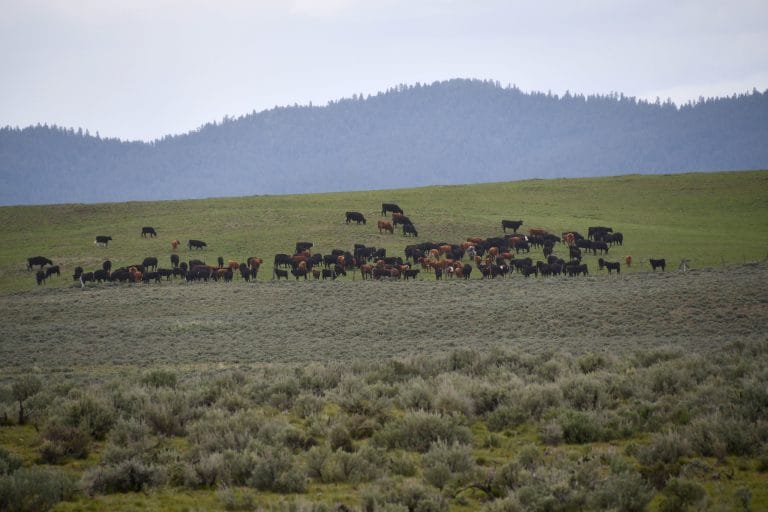
Turk said the business model at Stovall Ranches is diverse, and they run a cow-calf segment of 2,500-3,000 head of mother Angus cows in what Turk calls an “Angus-Angus” herd with good maternal quality and close to 9,000 grass yearlings. Turk said carcass traits are essential, and they calve later and ultrasound all their bred cattle. Based on the ultrasound results, Turk will either keep those females on the ranch or allow someone to buy the bred cattle.
Turk has also begun to breed Angus cattle to Wagyu cattle, incorporating another breed known for substantial marbling, which he said has been interesting coming from an Angus background. The program is part of Mishima Reserve, a specialty beef program where cattle are at least 50% Wagyu genetics, raised without hormones and antibiotics.
Seeing the need to be able to source and supply cattle into branded programs, Turk was looking at areas to build a feedyard, either in-state or out-of-state. A chance encounter at one of his children’s wrestling matches led to a conversation to purchase an existing feedlot, a 25,000-head capacity now called Yellowstone Cattle Feeders LLC. Through his contacts at North Platte and Certified Angus Beef, Turk has been able to reconnect industry relationships to benefit the Montana region. Turk teamed up with Tim Sheehy and Greg Putnam on the purchase, and Turk said their working relationship has been a learning experience for both sides. Tim and Greg are both first-generation ranchers, and Turk has spent a lifetime in the industry.
Greg and Tim are both Navy SEALs, and Turk said when you share something with a Navy SEAL, they “listen at a level not every American listens to.” It is like going into battle with whiteboards and well-thought-out contingency plans, Turk said.
“We want to be the best, and we want to be a place where quality is thought of in everything we do,” Turk said. “When you are going to go into a battle in Afghanistan, the amount of training that those guys do, you just shake your head and say, ‘Man, I’m really happy those guys are on our team.’ When you try to take those same philosophies and bring them into our industry, there are just some great discussions of ‘Why do we do it that way?’ and ‘How can we make it better?’”
Turk said it is about sitting down and discussing how they can bring new markets and services to Montana ranchers without going out of state. Yellowstone Cattle Feeders LLC aims to finish more cattle at the feedlot, working with the meat packing companies and branded programs in the state and bringing commercial cattle feeding operation efficiencies to them.
When Turk isn’t taking care of the ranch or the feedlot, he is working as the second vice president of the Montana Stockgrowers Association and representing Montana on the Cattlemen’s Beef Board. After becoming a Montana Stockgrowers board member, Turk was enlightened by how many issues were going on in the state. Turk said he ran for the officer position because he felt like there were some things he could help with, and the issues facing farmers and ranchers are something he felt he could make a difference in.
“When every minute of the day is slammed, can I justify more time doing this or not?” Turk asked. “Sometimes I feel like I can’t afford not to do it. I think there are some critical moments in time right now in our industry that we really need to take pretty darn seriously.”
Turk noted the Montana Stockgrowers’ lawsuit regarding the Bureau of Land Management’s decision related to American Prairie bison grazing, stating it is a problem for central Montana and the entire western U.S. that grazes on public lands.
“This is a national issue, and we need to all get on board and protect not only our Montana ranchers but also our American ranchers because these public lands are very important, and the Taylor Grazing Act was put together for a reason,” Turk said.
Turk continued that the issues affect not only ranches but rural communities. He realizes there are misconceptions about agriculture, with some outside groups saying ranchers are unsustainable. It’s certainly not the case, and Turk posed the question as to why ranchers would want to hurt the livestock and environment—their livelihoods.
Turk said he wants to contribute to the industry and the next generation. “Looking at my kids— what is their future going to look like? We need to take it seriously,” Turk said. “Is there really enough margin in our business to keep not only our current ranchers in business, but is it attractive enough for the next generation to even say, ‘I want to do this?’ I don’t know if we know the answer, but the answer needs to be found.”
Turk continued that we might have differing views on policies, but the industry has to agree on how we will keep the next generation in ranching. Otherwise, Turk said it will be consolidation and corporations running the business—and he doesn’t think anybody wants that. The industry needs to sit down together and find a solution, Turk said.
However, Turk is optimistic about the future of the industry, and while there are high hay prices and drought, Turk said the industry will pull out of it, and there will be better times and more opportunities going forward. — Charles Wallace, WLJ editor