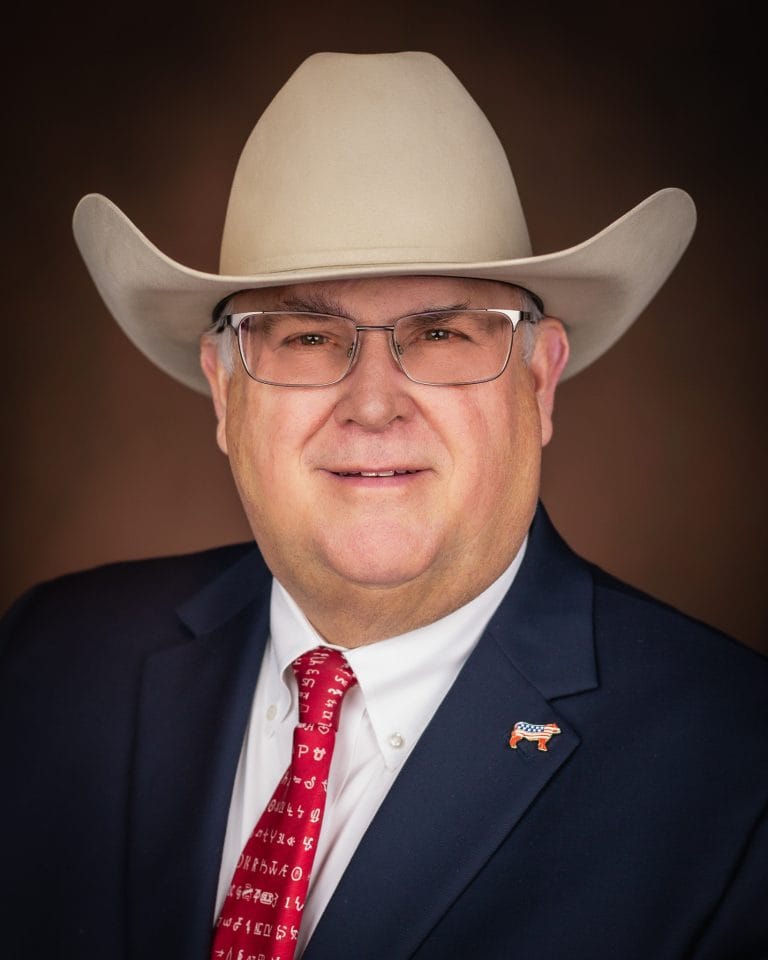
Rowdy Barry, famed bullfighter, well-known cowboy artist, and successful rancher and prebiotic supplement sales representative, has been “infatuated with bulls from an early age,” as he told WLJ. The Kennewick, WA-based cowboy grew up on a number of different ranches, showing and rodeoing his way through his younger years. Although he always thought he wanted to be a bull rider, he was tall and lean and “got on a few bulls, but didn’t ride very many of them,” he said with a laugh.
Growing up, he always enjoyed watching professional bullfighters, and after “one thing led to another,” Rowdy worked his way to an incredibly successful bullfighting career of over 35 years. A career that, in his mind, he never worked a day in his life. “I was fortunate enough to do something I loved to do for a living, and I was able to travel North America and get paid to do it,” he said.
Rowdy started his career professionally in 1986, and in the ’90s, he was on the road for as many as 300 days a year, doing about 100-125 performances annually.
“We had a lot of different moves and things, but the thing I was known for that booked me a lot of rodeos as a young man was I would run at a bull straight on, and I’d hurdle him and jump him from tip to tip, from head to tail,” he said.
Later on in his career, he would do what was called “the walk,” where he would get up on a barrel, and as the bull would run up, Rowdy would jump on his head and right run down his back.
“That thrill of adrenaline was able to keep me booked in some very good rodeos throughout North America and for me to make it to the National Finals Rodeo (NFR) that way in the Wrangler Bullfights in ’92,” he said.
In addition to entertainment, the other value in a bullfighter is protection, Rowdy said. “Early in my career, a rodeo clown did both—comedy and saving cowboys—and some of them were better at comedy than they were at protection,” he said. “And other guys, like myself, got into the business not because of the comedy—because I felt as funny as a broken leg—but for the bulls and the adrenaline of controlling that situation.”
His job was to take the shot for the bull rider if he needed to. And to progress in the rodeo circuits and make it to the NFR for bullfighting, you are typically voted on by the bull riders—those you are trying to protect.
Rowdy recalled a tense moment in the ’90s when he was working on the bucking chute crew, picking up bucking horse flanks and helping to untie the calves. Bull rider Tuff Hedeman was riding and got hung up on his bull, unable to break his hand away. The bull kept bucking and dragging Tuff for 30-60 seconds, while a group of bullfighters rushed to get Tuff’s hand untied.
“At one point, they’re getting wiped out and winded, and I had a shot where I was able to jump up there and untie Tuff,” Rowdy said. “I was able to run my hand underneath his arm and I could see where the tail had half hitched on his thumb—a very unique freak accident,” he said.
Rowdy was able to untie the half hitch off Tuff’s thumb and get him free. At one point during the incident, Tuff did a complete 360-degree spin with his hand in the rope when the bull made one of his revolutions.
Rowdy said for really scary situations, the adrenaline usually hits afterward. “But as a bullfighter, that’s just what you do. You’ve already resigned yourself to a career that you give yourself up for somebody else. It’s preconditioned in you that you’re going to go ahead and sacrifice yourself if needed.”
Cowboy artistry
In addition to being a natural talent for bullfighting, Rowdy is also a creative and popular cowboy artist. When he was a young boy, his mom was always painting and there were usually crayons or paints in front of him—probably in an attempt to keep a rambunctious boy occupied, he suggested slyly.
“I always stuck to it,” he said. “All throughout school, I was probably off daydreaming, or someone would want me to draw a big old bull elk or a jet airplane. I was happy and obliged to do it—a lot of times I was doing that instead of taking notes in school,” he joked.
He has always been a hands-on type of guy, he said, and art gave him a vehicle out of the classroom. “I was fortunate to turn the art into a passion and into a partial living throughout my bullfighting career,” Rowdy said. “It was a release for me and something I enjoyed doing, and I was fortunate enough to take it to some shows and sell it well.”
He added that the way he saw it, being creative is a God-given gift, and he feels an obligation to share it to people in need or charity. This includes donating artwork for charitable auctions.
Rancher and representative
Throughout college and his career, Rowdy always had a string of cattle and he leased pasture where he could. After a successful bullfighting career, he was able to purchase a ranch, but after about 20 years of having the ranch, he sold most of the cattle and leased out the ranch, he said.
“I was missing my kids’ ball games and I was on the road too much with fighting bulls,” Rowdy said.
A couple of years ago, along came a friend of his who was looking for area representatives to sell products for Pro Earth Animal Health. Now Rowdy works as a rep for the company, selling CattlActive and Zesterra, all-natural supplements. In addition, he manages all of the retail stores for Oregon and Washington.
At the most recent NFR, all of the bucking stock and timed event stock received the Pro Earth liquid drench, from the time they got off the truck just prior to Thanksgiving, through the NFR events. The drench is added to the animals’ water and helps mitigate their stress.
“I could tell you that on the bucking bull and bucking horse end, the acidosis that we’d normally see in the bucking shoots—I didn’t see it this year,” Rowdy said. “I personally felt that we didn’t see as many re-rides and stalls that we have in the past.”
Whether at chuteside or on the sidelines, Rowdy said one of the best things is watching the next generation of contestants, watching young athletes achieve their dreams. “It’s fun to see that next generation,” he said. “I’ve watched these kids grow up.” — Anna Miller, WLJ managing editor