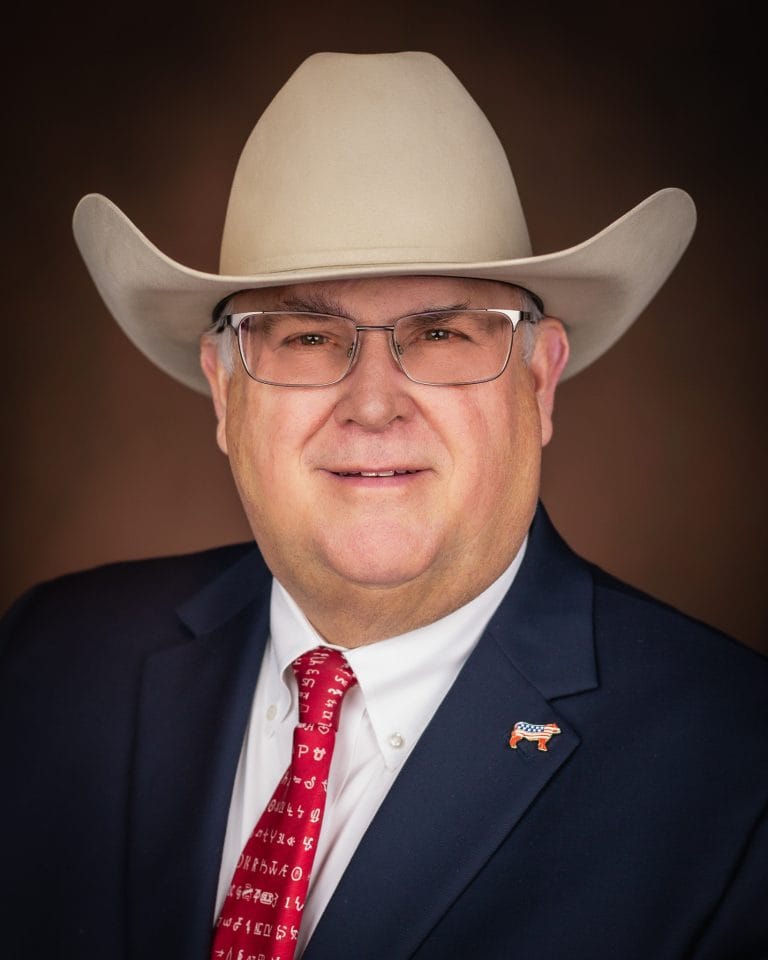
Paul Dykstra has deep roots in the cattle business, having grown up on a family cow-calf operation in Colorado. His time in the business has led him from the ranch, to working in feedyards, to holding a feedyard management position at the U.S. Meat Animal Research Center, to his current position as the director of supply management and analysis at Certified Angus Beef (CAB).
His extensive 20 years of experience at CAB have led him to interact with all players in the production chain, whether it be a seedstock producer or a packer. He shares trends in the quality beef market and the branded beef market and keeps up to date with production and price trends. Paul told WLJ his goal is to point people toward more profitable outcomes, whether it relates to feeder or seedstock cattle selection or market direction.
“A lot of that is going to point back toward high-quality carcass output balanced with a good foundation and balanced production at the ranch to the feedyard,” he said.
Paul speaks fondly of his work, saying he is blessed to interact with so many people in the business. “What makes me so happy about what I’ve been able to do with Certified Angus Beef is to be a part of the progression of the cattle business over the last 15 or 20 years,” he said. “A transformation of our product base in total U.S. beef cattle has come such a long way since the early 2000s in a very brief time. And that’s the period that I’ve been fortunate enough to be a part of. So it’s been a great ride.”
Most recently, the CAB brand has adjusted its hot carcass weight maximum to 1,100 pounds. Paul said carcass weights in the industry are not headed lower, with the exception of seasonal adjustments. In his biweekly column, CAB Insider, Paul says the adjustment means there will be a potential increase of 3-4% in carcasses accepted into the brand, and additional specifications will remain an important parameter in continuing to address optimal final product cut size. For fiscal year 2022, CAB accepted an impressive 5.78 million carcasses into the program.
By capturing more product with the hot carcass weight adjustment, there is a net benefit of a larger supply for the brand’s customers, Paul said. This includes a greater premium for licensed partners, along with cattlemen.
CAB does not own any beef cattle or products at any time and is a marketing company by definition. There are no cattlemen or feeders that are licensed to produce Certified Angus Beef—it all begins at the packing plant. The packer is the only licensed partner in the chain that actually pays the brand, which averages about 2 cents/lb. of product sales, Paul said.
“If you think about 2 cents/lb., that seems like nothing, but that totals out to a pretty good sum that gets reinvested to support marketing efforts for our brand partners,” he said.
Live cattle that are eligible for the label must be predominantly black and meet the brand’s 10 carcass specifications. From there, distributors, grocers and restaurants have the chance to be licensed with CAB, which allows the brand to track purchases and sales.
Paul said price spreads have increased significantly on the quality grade scale in recent years, all the way from Prime down to Select. “These price spreads have widened and stayed wider in the last few years, but today, they’re acutely wide,” he said. “If a feedyard is calculating a breakeven and they have any kind of confidence in a set of calves that they can achieve these higher grades, to a large extent, there’s a whole lot of margin in those Prime and premium Choice carcasses in there.” He added that he is excited about what high-quality genetics are going to be able to put on the table from a margin perspective in the near term.
Paul said it also bears repeating that cattle who get sick do not grade to the extent that cattle who have never had a bad day will. “If a feedyard doesn’t have some confidence in what the health protocols or the vaccine schedule are going to be for a set of calves, … well they don’t even want to talk about carcass quality,” he said. “We’ve got to get that first step right before we try to put icing on top of that cake.”
Paul expressed his fondness for all sectors of the industry—thanks to the people found in all of them—but admits that his upbringing on a cow-calf operation makes him biased toward the cow-calf sector.
“The reason that I have such a passion for the cow-calf business and trying to drive dollars back to that sector is that the cow-calf operator is the original price taker in our business,” he said. “They can’t demand a higher price for their product.”
He continued, “Those are the folks that I identify with, from the standpoint of trying to scratch out a living on a really big day’s work every day on sometimes pretty scarce resources and sometimes not too many allies. That’s Americana to me. And I want those folks to get paid for what they’re producing out there.”
He added that he doesn’t think anybody gains credibility or long-term success by misleading anyone, and he finds it his responsibility to speak straight to what he observes happening in the business. Sometimes this means telling a producer they shouldn’t focus as much on getting a calf into the CAB program, and they should explore other opportunities based on their circumstances, he said.
“It’s not always about winning. Sometimes it’s about helping somebody to pursue what’s in their best interest. If you’ve got a good cause behind you, then the virtues of that will come through in the long run, even if there’s ups and downs,” he finished. — Anna Miller,WLJ managing editor