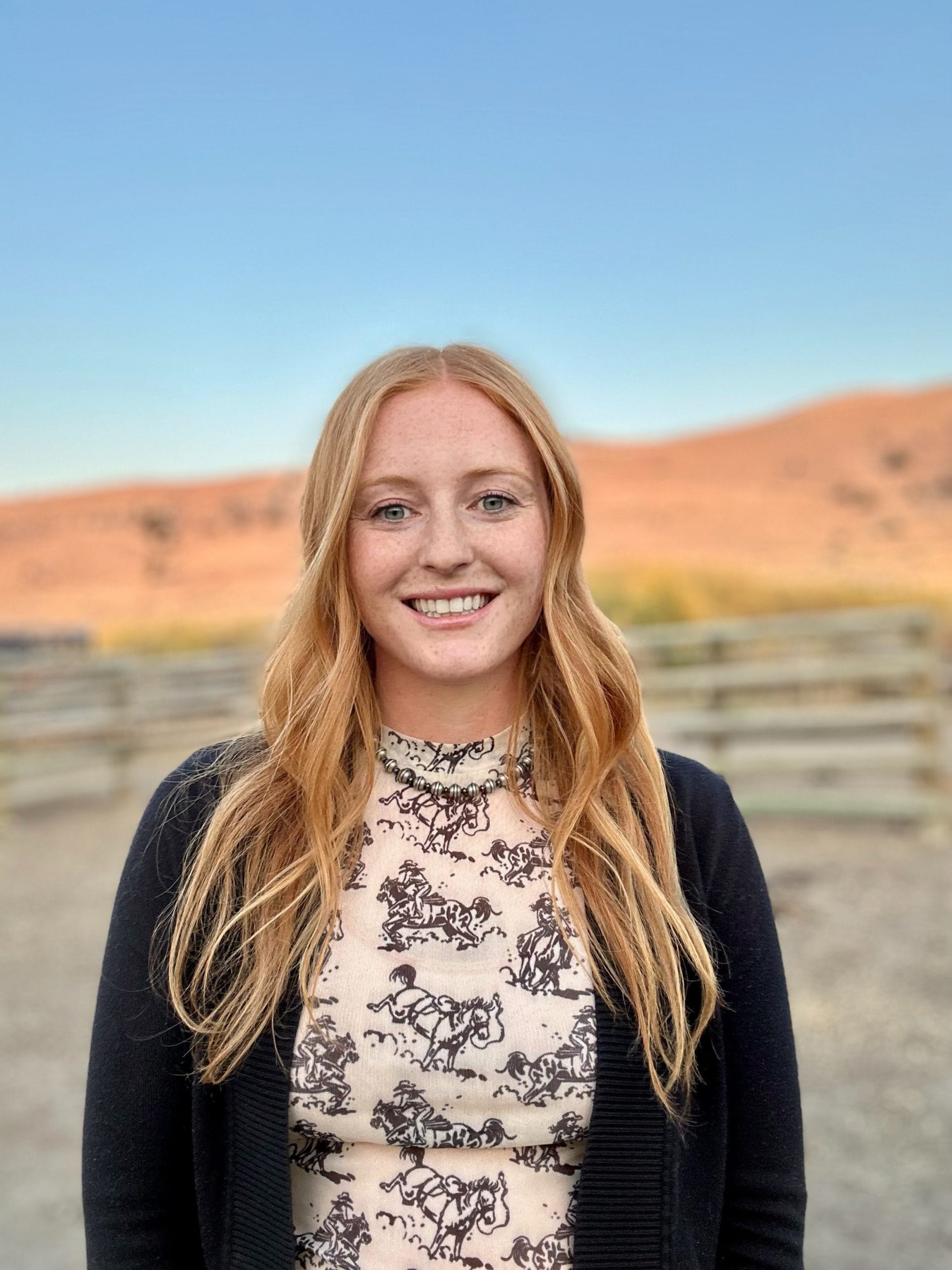
Raised in a ranching family and now working in agricultural tech, Haley Potter is helping bring modern financial tools to producers through Ambrook, a platform aimed at making farm and ranch accounting more accessible and transparent.
Haley grew up immersed in ranch life in North Dakota and now lives in Montana with her husband, Joe, and their daughters, Ruby and Annette.
“I’ve tried to get as much experience in the cattle industry as possible,” Haley told WLJ. While earning her undergraduate degree at Oklahoma State University, she worked in the campus slaughterhouse, later adding time as a veterinary technician and in feed sales before stepping into her current role with Ambrook.
She was first drawn to Ambrook for the flexibility it offered, which allowed her and Joe to continue managing a remote cow camp two hours from town, where career options were limited and often felt out of reach. In addition to the cow camp, they are also working to integrate back into the family ranch and buying and selling ranch horses.
Beyond the flexibility, the company’s mission also strongly resonated with Haley.
“The mission of Ambrook is essentially to make farmers and ranchers more resilient so that they’re able to pass on the operation to the next generation,” Haley said, “which really spoke to me because I have two young girls and I want to be able to pass that on to them.”
Co-founder Mackenzie Burnett started the company with the intention of wanting operations to be more sustainable and understand their true cost of doing business. The idea stemmed from Mackenzie working with producers to apply for grants during COVID-19 and seeing firsthand how difficult it could be for farmers or ranchers to pull profit and loss reports or balance sheets simply because of the sheer complexity of their businesses. It’s not that the producers were bad recordkeepers, Haley explained, but with most operations running several different enterprises, the level of accounting required is often greater.
“That’s where a lot of folks were getting stuck,” Haley said. “So that’s where the idea of Ambrook was born; we need to solve this problem because there isn’t really a software that can do that well and affordably right now..”
In the early days, Mackenzie and her fellow co-founders, Jeff Anders and Dan Schlosser, visited operations across the country, coding software at kitchen tables and building the company into what it is today.
“We still do ranch visits, we still go visit our customers and we still work with them side by side to make this bigger and better all the time to better solve a lot of the complexities that we see in agriculture that you don’t necessarily see in other businesses,” Haley said.
In her role in product operations on the full-service team, Haley helps customers get set up with the software and continues to offer support throughout the year.
“I also help them get into really granular conversations about, for instance, what does this piece of machinery actually cost them to run per hour?” Haley explained. “I have a set amount of customers that I help every single day, doing check-ins, reconciliation work or setting up different enterprises.”
From her own experience, Haley has seen how challenging it can be to gain a practical understanding of finances in agriculture. While her time in college provided a solid foundation in production, she said the day-to-day realities of bookkeeping on an operation were largely left unexplored. Knowing that financial strain is often at the root of why operations don’t continue from one generation to the next, Haley is motivated to help bridge that gap and make those tools more accessible to producers.
Inside Ambrook’s approach
Ambrook has grown quickly from its humble beginnings during the COVID-19 years, supporting more than 7,000 customers now compared to the handful of customers in the early days.
“If you think about a lot of accounting software today, it’s designed specifically for the accountant or someone with a high level of accounting knowledge,” Haley said. “A lot of folks in agriculture didn’t get into ranching or farming because they love bookkeeping, but they do need to know how to bookkeep to really understand where they are at.”
That’s where Ambrook was designed to be looked at by both the operator and the accountant, and to be seamless to use for either party, she added.
“I think that is something that’s been missing from other softwares and where Ambrook really shines and helps solve a problem,” Haley said.
Customers have two options to choose from when getting started with Ambrook: a self-service path or a full-service path. Regardless of the option chosen, Ambrook offers real-person support from people in agriculture who understand the complexities and intricacies of the agriculture industry.
Those who choose the self-serve path are still able to connect with a support chat to answer messages. In Haley’s role, she works on the full-service side, where she helps customers one-on-one and they are able to reach out directly to her for more tailored support. This option is helpful for customers who have more complex operations or are wanting to integrate data from other softwares.
The enterprise level of accounting offered by Ambrook is one of the main features that sets it apart from other accounting softwares, Haley said. This can be especially helpful for ranchers managing several components of a business.
“They might have a lot of irons in the fire; maybe they put up their own hay, they run cattle, own a few rentals and also have a small trucking business on the side,” Haley said as an example. “What’s hard to do in other platforms is to keep those accounted for and look at them all together, but then really dive into the question of whether one enterprise is subsidizing the other,” she said. “And we need to be able to answer those questions to keep making good financial decisions to be more profitable year after year.”
The software is also cloud-based, which makes it easy for the producer to access it on their phone.
“As we are looking at a true generation succession change in agriculture, you can have a login for the kids, one for mom and dad, maybe one for a hired hand, and they can all have different settings or privacy roles and permissions,” Haley explained.
Ambrook functions as a practical, day-to-day tool that can be used as often as an operation needs, she said. The platform can be connected directly to a user’s bank account, automatically pulling in transactions in real time to create an ongoing record of income and expenses. Users can then review and categorize those transactions in a way that aligns with their tax reporting and recordkeeping, while also generating reports throughout the year. All reports are generated in real time.
Customizable tags allow a user to break down performance across different parts of the business. This could include comparing how calves are performing at different feedlots, or tracking costs for specific projects, such as vet expenses on individual horses or annual machinery costs. The software is also able to track inventory, which could be especially helpful for businesses such as feed stores.
The platform can also simplify payment workflows, whether it’s collecting payments, depositing money or paying bills. The Ambrook Wallet feature is particularly noteworthy for producers in rural areas.
“I live nearly three hours away from my closest bank that we bank with,” Haley said. “Now I can deposit checks through Ambrook Wallet. Traditionally, a lot of times the checks were over the bank’s threshold, and I would have had to wait three to four weeks to go deposit it.”
Acknowledging user data privacy concerns, Haley said data on Ambrook is securely stored in the cloud and not sold or shared externally. If a user cancels their subscription, the data is retained for a set period before being permanently removed. She also pointed out that, compared to locally stored systems, such as QuickBooks on a computer desktop, cloud-based storage can offer added security since financial records aren’t tied to a single device and can still be accessed even if a computer is lost or damaged.
“We just want to make sure that it’s simple to get the complex answers that a lot of folks need,” Haley finished. “We want to make tax season so much easier because that can be a really stressful time. My day-to-day is genuinely trying to make this more robust and and share a lot of the feedback that I’m getting so that we are constantly improving the product for producers.” — Anna Miller Fortozo, WLJ managing editor