
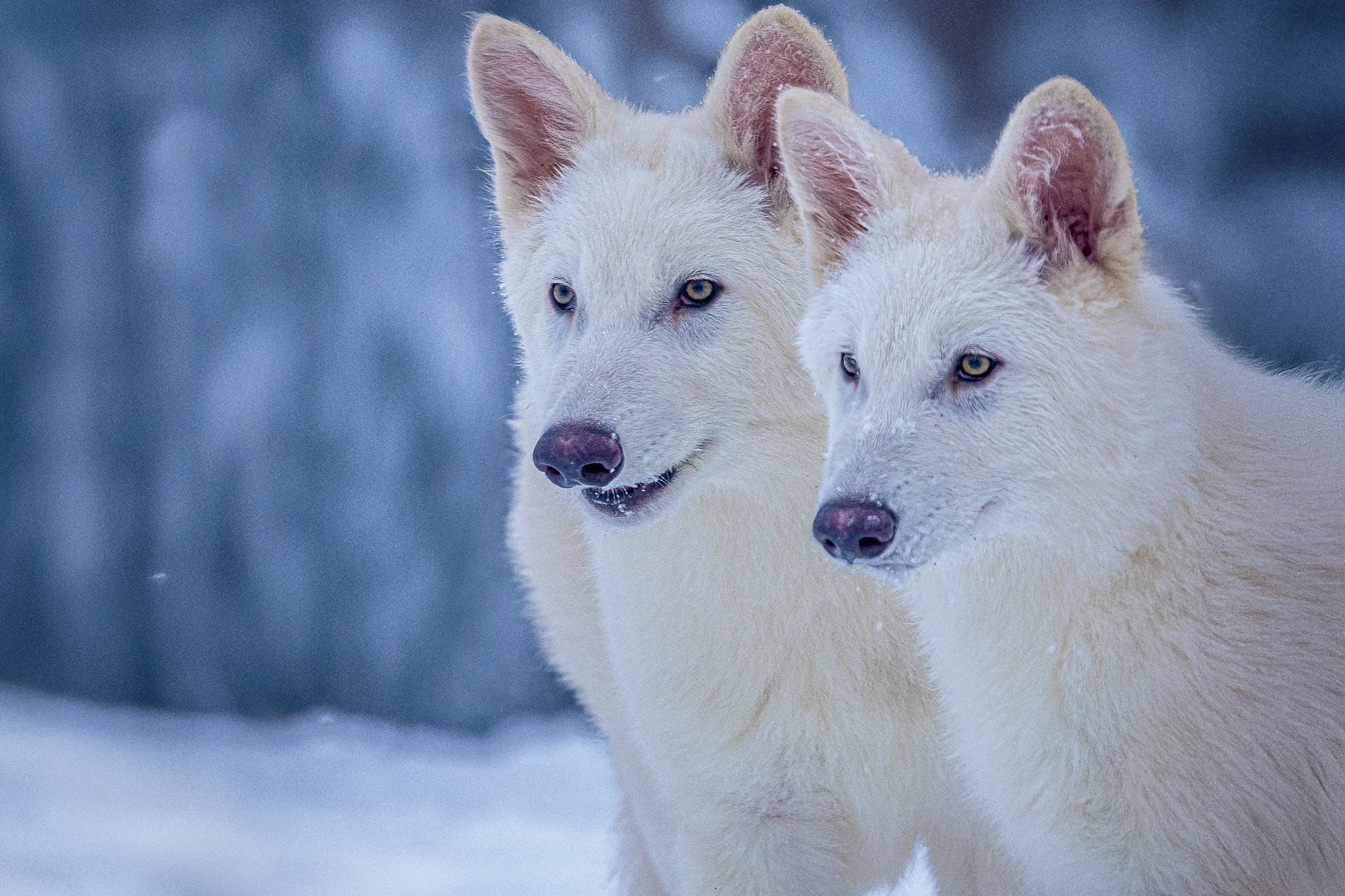
Recent news articles have described the genetic engineering of an extinct dire wolf, a process called “de-extinction.” The dire wolf was a large wolf, about 130-150 pounds, that lived in North America during the ice ages and went extinct about 10,000 years ago. The dire wolf, with the scientific name Canis dirus, is thought to have been larger with different characteristics than the modern gray wolf with the scientific name Canis lupus.
Many fossil bones of dire wolves have been recovered, especially from the Rancho La Brea Tar pits in Los Angeles. DNA information from these fossils has been used to clone dire wolf genetics into modern wolves, with claims that the dire wolf has been recreated. This isn’t exactly accurate.
Wolves with dire wolf genetics have been created by a biotech company, Colossal Bioscience in Dallas, TX, with DNA cloning methods (see the references at wlj.net). Scientists obtained DNA from dire wolf fossils and determined the DNA sequences for 14 genes. They then changed a modern wolf’s DNA to match that of the dire wolf DNA sequences by “editing” the modern wolf DNA with new technology. The edited DNA was in a modern wolf cell nucleus, which was inserted into a wolf egg cell, which was then implanted into surrogate dog mothers that gave birth to three wolf pups with the 14 dire wolf gene sequences in their DNA.
The outcome of this effort was three modern wolves with 14 dire wolf genes. It’s the same result as creating genetically modified organism (GMO) crops or transgenic goats. The difference between the wolf project and GMO is that the wolf DNA was chemically edited inside a wolf cell, while GMO crops and transgenic animals have actual foreign DNA inserted into their DNA. Regardless, these methods result in new genes in a plant or animal. The cloning process of getting the gene-edited egg into a surrogate mother is the nuclear transfer method as was done with Dolly, the first cloned sheep in 1996.
These animals created by Colossal Bioscience are not really dire wolves, they are modern gray wolves with some genes changed to the DNA sequence of dire wolves. You might consider them “genetically modified wolves,” like GMO crops in which foreign genes have been inserted. It would be like editing genes in an Angus cow to have genes for some traits like a Brahman cow. Of course, with live cattle you could just crossbreed them to get genes from one into the other, but with the extinct dire wolf this isn’t an option.
The analyses showed that dire wolves and modern wolves share more than 99% of their DNA sequences and the edited genes are thought to be responsible for the different characteristics in dire wolves and modern wolves. It’s not clear from the reports if the dire wolf genes are actually being expressed in the pups or if they will be inherited in sperm and eggs cells when the pups mature, and this will be important to verify.
Some of you are thinking, why do we need to bring back extinct wolves? There are plenty of wolves killing our livestock already. The dire wolf project is justified by preserving biodiversity, like many other environmental projects. It is a very impressive technological achievement to recreate characteristics of extinct species—the company wants to recreate woolly mammoths, too—but not very practical. But consider that the preservation of crop, livestock and wild plant and animal genetics is an important enterprise because rare varieties and breeds might have useful genetic variation in the future. The USDA has such a program in Colorado called the National Animal Germplasm Program. Whether recreating extinct animal genetics is useful remains to be seen, but it is interesting for research and museum and zoo displays.
I think it’s important to keep in mind that efforts to preserve biodiversity have resulted in misuse of the Endangered Species Act (ESA) in which every type of animal in a geographic area, like the Mexican wolf subspecies and grizzly bear populations, has been considered a species. This has expanded the federal government’s authority to local wildlife population management, which I think violates the 10th Amendment to the Constitution. Let’s hope that the government doesn’t try to use the ESA to manage extinct dire wolves, saber toothed tigers and woolly mammoths. — Dr. Matt Cronin
(Matthew Cronin is a scientist at Northwest Biology & Forestry Co. and a teaching professor at Montana State University, Bozeman. He was a research professor at the University of Alaska.)
The scientific name of dire wolf is also considered to be Aenocyon dirus Science Colossal Bioscience Game of clones: Dire wolves reborn as Colossal unleashes world’s first de-extinction Is the dire wolf back from the dead? Not exactly | Science | AAAS HomeNewsAll NewsIs the dire wolf back from the dead? Not exactly The Dire Wolf Isn’t Back—But Here’s What ‘De-Extinction’ Tech Can Actually Do | Scientific American Dire Wolves Were Not Really Wolves, New Genetic Clues Reveal The legendary dire wolf may not have been a wolf at all | Science | AAAS Dire Wolves Weren’t Actually Wolves, DNA Analysis Reveals Western Livestock Journal Wolf Articles April 2024 Resource Science: Black and gray wolves | Resource Science | wlj.net August 2023 Resource Science: Possible black wolf sighting in Arizona | Resource Science | wlj.net March 2023 Resource Science: Predicting the numbers of wolves in Colorado | Resource Science | wlj.net June 2023 Resource Science: Wolf ESA populations are too complicated | Resource Science | wlj.net March 2023 Resource Science – Wolves in Colorado: The need for management | Resource Science | wlj.net November 2023 Resource Science: Wolves in CO and Mexican wolves | Resource Science | wlj.net May 2023 Resource Science: Draft EIS for introducing wolves to CO | Resource Science | wlj.net March 2022 Resource Science: Wolves—When north meets south | Top Headlines | wlj.net April 2021 Resource Science: An assessment of wolf numbers, predation in CO | Top Headlines | wlj.net
References


1 Comment