Consilience: the linking together of principles from different disciplines especially when forming a comprehensive theory.
Politicians need to make policies considering a wide range of issues, such as the economy, immigration and the environment. Consilience, defined above and explained by the biologist E. O. Wilson, is required to do this properly. Politicians also use broad terms which can be vague. For example, there are new policies to identify and protect “old growth forests” without clear definition of what they are. All forests grow, so “old trees in forests” might be a more accurate term. The U.S. Forest Service recognized that forests in different areas have different growth rates, weather, soil, water conditions and tree species and defined old growth for different regions (see the References at wlj.net). The Endangered Species Act (ESA) is another example of vague terminology because subspecies and populations are considered “species” under the ESA.
Maintaining the economy while protecting the environment is an example of consilience and combining policies. Immigration must also be combined with these policies because immigration increases the U.S. population, population growth is the ultimate cause of environmental impacts, and population growth is considered necessary for economic growth (see the References).
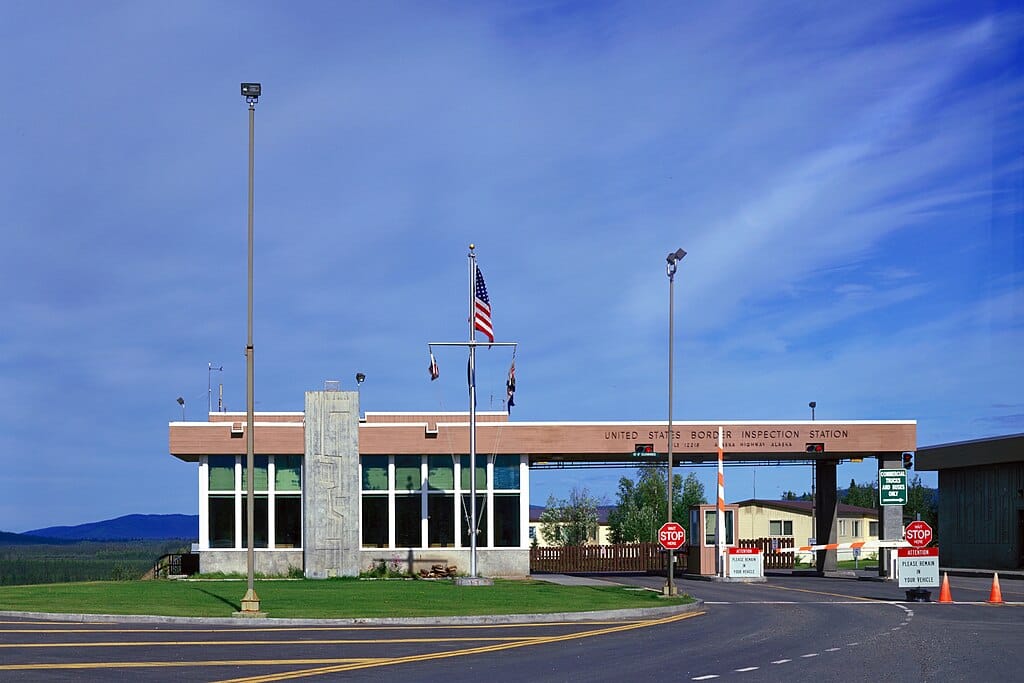
Consider that immigration increases the U.S. population. Todd Bensman of the Center for Immigration Studies reports that 7.6 million illegal immigrants were encountered by the Border Patrol since January 2021, more than 5 million were allowed to stay in the U.S. and 10 million are expected to remain in the U.S. by January 2025. Increasing populations increases demand for resources and land, with increased environmental impacts including climate change.
Immigration is advocated for economic growth. While discussing immigration reform, former president Bill Clinton recently said, “We’ve got the lowest birth rate we have had in well over a hundred years … We are not at replacement level, which means we have got to have somebody come here if we want to grow the economy.” The Penn Wharton Budget Model at the University of Pennsylvania reported U.S. population projections: “U.S. population growth is projected to decline, and the population will become much older over time. Preventing these outcomes will require faster immigration by several multiples of its current rate.”
This focus on economic growth ignores the environmental impacts of population growth. It appears we need consilience of economic, environmental and immigration policies. But first we need facts and clear terminology. Note the terms used in these quotes. Clinton refers to a lower birth rate and Penn Wharton refers to population growth declining. They don’t refer to population numbers. You might consider birth rate and growth of your livestock herd, but ultimately you aim for a number of animals that fit your range.
We need to know the number of people in the U.S. population and if it’s growing or declining for informed policy. I got the current U.S. population data from the Census Bureau. The U.S. population was 337,269,340as of Oct. 15 at 8 a.m. MDT. There is one death every 11 seconds, which is 5.5 deaths every minute or 2,866,909 deaths per year, and one birth every 9 seconds, which is 6.7 births every minute or 3,504,000 births per year. Births minus deaths (3,504,000 minus 2,866,909) is an increase of 637,091 people per year. There are more births than deaths. There is one immigrant every 28 seconds, which is 2.1 immigrants every minute, or 1,126,285 per year. The Census Bureau doesn’t say if this includes illegal immigrants. Combining the excess births and immigrants is 637,091 plus 1,126,285, which is 1,763,376 new people per year. The U.S. population is growing with or without immigrants.
The Census Bureau also reports the U.S. population gains one person every 18 seconds, which is 3.3 new people every minute or 1,752,000 people per year. This is a little less than my calculation of net birth plus immigration of 1,763,376 per year (a difference of 11,376).
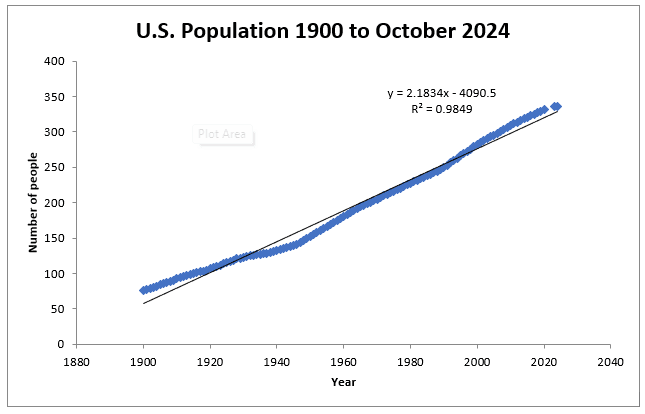
The U.S. population is increasing by about 1.76 million people per year with births and immigration. Fertility data indicate there are currently 1.62 children per woman, and this is projected to decline. But do we need more immigration as Clinton and Penn Wharton suggest, perhaps because immigration is currently an important political issue? I don’t think we need more immigration, especially illegal immigration, because it’s illegal. The U.S. population has increased at about the same rate since 1900. In my opinion, increased environmental impacts, crowding and traffic, loss of open spaces, and impacts on agricultural land is a result of increased population. The U.S. population can’t continue to increase at a high rate for only economic reasons without impacting our quality of life, environment and agricultural lands. Impacts of immigration on the U.S. population, the economy and the environment need to be assessed together. — Dr. Matt Cronin
(Matt Cronin is a biologist with Northwest Biology and Forestry Company LLC in Bozeman, MT, croninm@aol.com. He was a research professor at the University of Alaska.)
References
Consilience Definition & Meaning – Merriam-Webster
Wilson, E.O. 1998. Consilience: The Unity of Knowledge. Vintage Books, Random House, New York.
USDA Forest Service. 2023. Mature and Old-Growth Forests: Definition, Identification, and Initial Inventory on Lands Managed by the Forest Service and Bureau of Land Management Fulfillment of Executive Order 14072, Section 2(b). April 2023 FS-1215a. Mature and Old-Growth Forests: Definition, Identification, and Inventory (forestlandowners.com)
Resource Science: A new category of forests – Old growth | Resource Science | wlj.net
Bill Clinton Stumps for Harris, Calls for More Immigration Because of ‘Low Birth Rates’ (msn.com)
U.S. Demographic Projections: With and Without Immigration — Penn Wharton Budget Model (upenn.edu)
Todd Bensman. 2024. An immigration crisis beyond imagining. Imprimis, a publication of Hillsdale College, January 2024 Volume 53 Number 1).
Sept 2023. Resource Science: US population growth | Resource Science | wlj.net
May 2024, Resource Science: The US population and immigration | Resource Science | wlj.net
Population and the American Future. 1972. The Report of the Commission on Population Growth and the American Future. The New American Library Inc. New York.
Browning et al. 1972. Population and the American future: A discussion and introduction to a review symposium. Social Science Quarterly Vol. 53 No 3 December 1972 pp 445-451.
Attorney General Mark Brnovich Sues Federal Government Over Environmentally Harmful Immigration Decisions | Arizona Attorney General (azag.gov).