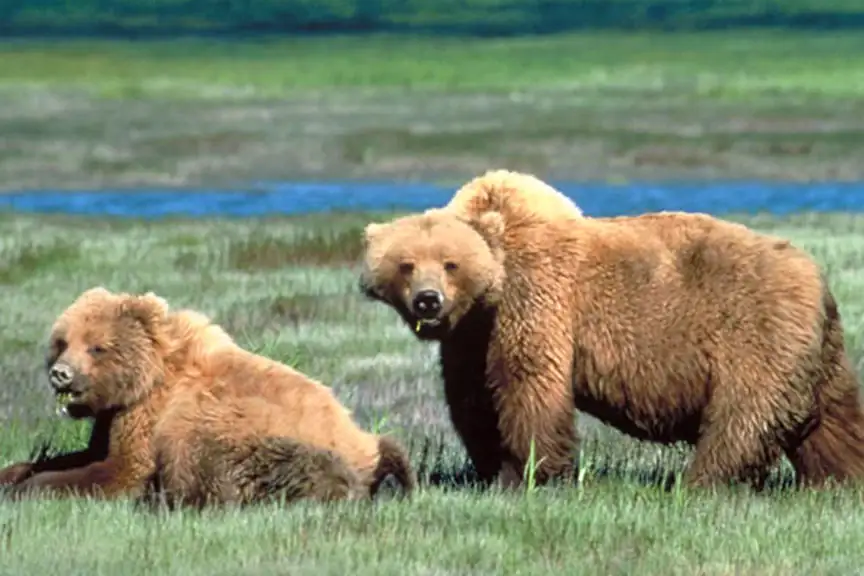
Grizzly bears and polar bears are frequently in the news. They are both considered endangered species, both are dangerous to people, and grizzlies kill livestock in the Western states.
Restoring grizzly bears in the Western states is a goal of environmental groups who have used the Endangered Species Act (ESA) to stop resource development. Polar bears have become the symbol of global warming and climate change because of concerns about loss of their sea-ice habitat, and their ESA listing also been used to stop resource development in Alaska.
Many of you are familiar with grizzlies and live in areas where they occur. Some of you might be familiar with polar bears if you’ve worked in the Alaska North Slope oil fields where they are frequently seen.
Grizzlies are common in Alaska and parts of Canada and they are also called brown bears depending where they live. The large bears of coastal areas and islands of Alaska including Kodiak Island are called brown bears, while inland populations are called grizzly bears, but they are the same species. Brown bears also occur in Europe and Asia. Polar bears in the Arctic, and black bears across the U.S., are the two other bear species in North America.
Polar bears and grizzly bears are closely-related species and may occasionally interbreed where their ranges overlap in the Arctic. However, this is rare and they are separate species. This is similar to other closely-related species such as mule deer and white-tailed deer; and wolves and coyotes.
Like wolves, the status of populations of grizzly bears listed as endangered species under the ESA in the Western states is complicated. From U.S. Fish and Wildlife Service (FWS) website, grizzly bears are listed as:
• Alaska—not listed as an endangered species in Alaska.
• Mexico—listed as an endangered subspecies (the Mexican grizzly bear), though the Mexican grizzly might be extinct.
•Yellowstone National Park—listed as a threatened distinct population segment (DPS) in and around Yellowstone National Park (called the Greater Yellowstone Ecosystem). This population was designated a DPS in 2007, delisted in 2017, and relisted by a judge in 2018. There are about 700 bears in this population.
• Contiguous 48 States—listed as a threatened DPS in the contiguous 48 states in 1975. The Yellowstone DPS was split from the Contiguous 48 States DPS in 2007. The Contiguous 48 States DPS currently consists of Recovery Zones in: The northern Rockies in Montana, called the Northern Continental Divide Ecosystem, with about 765 bears; The Selkirk Mountains of northeast Washington, northern Idaho, and adjacent British Columbia, Canada with about 70-80 bears; the Northern Cascade Mountains in north-central Washington with less than 20 bears; the Bitterroot Mountains in southwest Montana and eastern Idaho, though it is not known if there are currently any bears there, although one was seen in 2002 and tracks were seen in 2012, and it is considered as “potential habitat” and an experimental population; and the Cabinet-Yaak area of northwest Montana and northern Idaho where there are about 45 bears.
These ESA listings for grizzlies thus include one contiguous 48 States DPS with five recovery zones, the Yellowstone DPS, and the Mexican grizzly subspecies.
Websites on grizzly bears and the ESA:
- Mexican grizzly (PDF)
- National Park Service (official website)
- Fish and Wildlife Service (official website)
- The Yellowstone DPS (official website)
Websites on polar bears:
- Fish and Wildlife Service (official website)
- Fish and Wildlife Service, Alaska (PDF)
- Chukchi Sea polar bears (University of Washington article)
- Dr. Susan Crockford’s website on polar bears
The entire polar bear species was listed as a threatened species in 2008. There are a total of about 22,000 to 31,000 polar bears worldwide, distributed among 19 sub-populations around the Arctic.
Some of the sub-populations are thought to be declining, some are stable, and some are doing well including the Chukchi Sea population off northwest Alaska and northeast Siberia which has about 3,000 bears. The numbers of bears in each sub-population are uncertain because it is difficult to count them in the remote Arctic.
Polar bears’ primary food source is marine mammals, such as seals, which they hunt on the sea ice. Polar bears were determined to be threatened with extinction based on models predicting decline of sea ice due to human-caused climate change. These models use assumptions about future changes to sea ice habitat and polar bears’ response to them, which are run in computers to predict the changes of numbers and distribution of bears.
As with sage grouse, I think the polar bear ESA listing is inappropriate because it is based on predictions from models. Recall that to be listed as endangered, a species must be likely to go extinct. In my opinion, predicting extinction from models is inadequate to justify an ESA listing. Instead, scientific hypotheses could be formed, and tested with observations over time to determine the species’ status.
Those not agreeing with the polar bear ESA listing may be labeled “climate change deniers,” so it is important to clearly state that one can accept that sea ice has been declining, but this doesn’t guarantee extinction of polar bears.
Polar bears survived previous warm periods between the cold periods with major glaciers that covered much of North America, so it is reasonable to approach the issue scientifically with hypotheses, regardless of the ESA and its regulations. Because some of the polar bear sub-populations have not declined since the ESA listing in 2008, it is premature to designate them an endangered species in my opinion.
The key points regarding the bears and the ESA is that (for grizzlies) the species definition including subspecies and DPS allows the federal government to take jurisdiction of populations from the states; and (for polar bears) model predictions (instead of empirical hypothesis testing) are used to predict extinction to justify an ESA listing.
Depending on your viewpoint, the ESA listings may be justified to help the grizzly and polar bears, or they may be inappropriate because of the regulations affecting natural resources and livestock. Regardless, the science issues you can raise with your elected officials and federal agencies are:
1. Is including “subspecies and distinct population segments-DPS” as ESA species (grizzly bears) legitimate federal jurisdiction?
2. Is basing predictions of extinction on models (polar bears) legitimate as scientific justification for ESA listings?
Other concerns about the impact of ESA listings on your livestock or work in the resource industries should also be discussed with your congressional delegations and local officials. You will note a common idea in my columns: Is the science used with the ESA conclusive, or selected to achieve a policy agenda? I think Congress, other elected officials, and the federal agencies need to address this question openly and honestly. — Dr. Matthew Cronin
- Cronin, T.M. and M.A. Cronin. 2015. Biological Response to Climate Change in the Arctic Ocean: the View from the Past. Arktos: The Journal of Arctic Geosciences. Review article. DOI 10.1007/s41063-015-0019-3
- Cronin, M.A., G. Rincon, R.W. Meredith, M.D. MacNeil, A. Islas-Trejo, A. Canovas, and J.F. Medrano. 2014. Molecular phylogeny and SNP variation of polar bears (Ursus maritimus), brown bears (U. arctos) and black bears (U. americanus) derived from genome sequences. Journal of Heredity. 105:312-323.
- Cronin, M.A., M.M. McDonough, H.M. Huynh, and R.J. Baker. 2013. Genetic relationships of North American bears (Ursus) inferred from amplified fragment length polymorphisms and mitochondrial DNA sequences. Canadian Journal of Zoology 91:626-634.
- Cronin, M.A. and M.D. MacNeil. 2012. Genetic relationships of extant North American brown bears (Ursus arctos) and polar bears (U. maritimus). The Journal of Heredity103:873-881.
- Cronin, M.A., S.C. Amstrup, S. Talbot, K. Sage, and K.S. Amstrup. 2009. Genetic variation, relatedness, and effective population size of polar bears (Ursus maritimus) in the Beaufort Sea, Alaska. The Journal of Heredity 100:681-690.
- Cronin, M. A., S. C. Amstrup, and K. T. Scribner. 2006. Microsatellite DNA and mitochondrial DNA variation in polar bears in the Beaufort and Chukchi seas, Alaska. Canadian Journal of Zoology 84:655-660.
- Cronin, M.A., R. Shideler, L. Waits, and R.J. Nelson. 2005. Genetic variation and relatedness in grizzly bears (Ursus arctos) in the Prudhoe Bay region and adjacent areas in northern Alaska. Ursus 16:70-84.
- Cronin, M.A., D. Paetkau, and R. Shideler. 1999. Genetic relationships of grizzly bears (Ursus arctos) in the Prudhoe Bay region of Alaska: Inference from microsatellite DNA, mitochondrial DNA, and field observations. Journal of Heredity 90:622-628.
- Cronin, M.A., S.C. Amstrup, G.W. Garner, and E.R. Vyse. 1991. Interspecific and intraspecific mitochondrial DNA variation in North American bears (Ursus). Canadian Journal of Zoology 69:2985-2992.
(Matthew Cronin was a research professor at the University of Alaska and is now a scientist at Northwest Biology Company LLC and an affiliate professor at Montana State University. He can be reached at croninm@aol.com. Check WLJ.net for a list of reference and citations of this column.)