Straight Hereford steers produced through the American Hereford Association (AHA) National Reference Sire Program (NRSP) underscore the Hereford breed’s significant improvement in carcass quality while maintaining the breed’s maternal superiority, feed efficiency, docility and longevity.
Olsen Ranches, Harrisburg, NE, the mainstay NRSP herd, randomly mated their commercial Hereford cow herd via one-time AI to 14 different NRSP Hereford sires. The resulting 300 head of steers, born June-July 2022, were ultimately harvested in February 2024 (six weeks later than normal due to weather).
The steers graded 51.1% Prime with the remainder grading Choice, predominantly in the upper two-thirds of Choice, and posted an average yield grade of 3.6. Among other performance metrics for the pen: 4.3 pounds average daily gain, 26.2 pounds daily dry matter intake, 6:1 feed conversion, 858-pound carcass weight and 13.8 square inch ribeye.
For proper context, the Olsens employ a low-input philosophy. Calves are born June-July, weaned October-November and then roughed on winter pastures with little to no feed supplement until the feeding trial in June. Likewise, cows receive no supplement except during extreme weather conditions.
“With the Olsen herd, we have pedigree data going back to the first year. We have pedigree-identified the cow herd through multiple generations,” explains Shane Bedwell, AHA chief operations officer and director of breed improvement. “NRSP sires are randomly mated to these cows and heifers. We end up with progeny groups of 30-50 head. All of the progeny information collected flows directly into the sire’s EPD analysis.”
All NRSP steer progeny are retained through the feedlot, so data is collected from birth
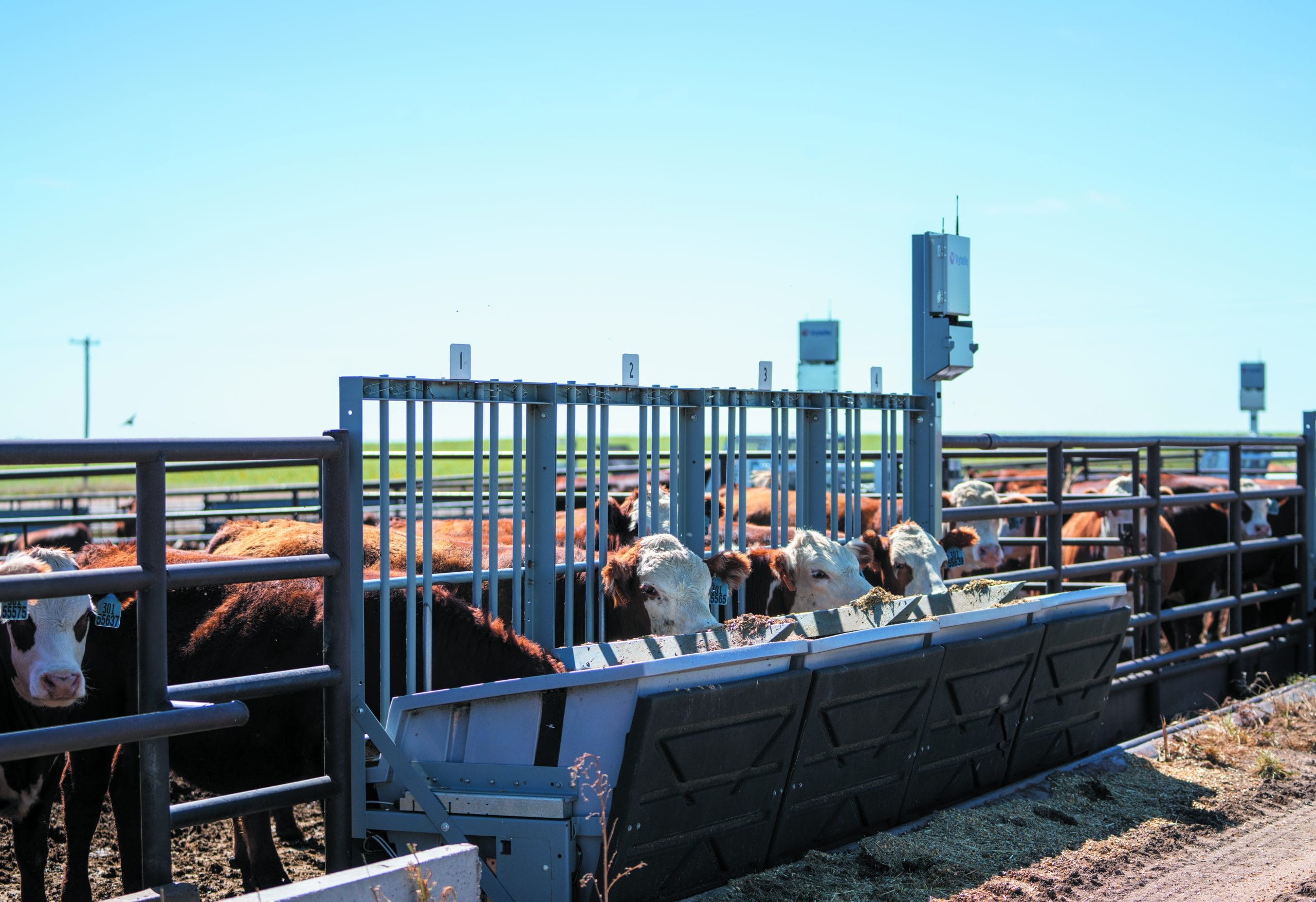
to harvest. Olsen Ranches have collected individual animal feed intake data since 2010. They began collecting individual water intake data in 2023, as well as methane and nitrogen excretion data. The latter fuel’s AHA’s pioneering research project with AgNext and Colorado State University aimed at identifying genetic differences in greenhouse gas emissions.
Embracing precision
It’s impossible to overestimate the value of the NRSP and the Olsen’s ongoing involvement when it comes to the breed’s rapid genetic progress in key traits. Credit also goes to other NRSP test herds over time, including Amana Farms in Iowa, Mershon Cattle LLC in Missouri, Simplot in Idaho and Stahly Ranch in South Dakota.
“This subset of cattle has proven invaluable to the breed in terms of genetic progress and the directions we’ve been able to go, such as the inclusion of feed intake, measuring efficiency and conversion,” Bedwell says. “It has definitely leveraged us with an unmatched data library to continue making progress.”
Of course, much of the credit for the breed’s exemplary genetic progress goes to breeders’ unwavering commitment to utilize tools offering the most accurate genetic prediction available. In other words, U.S. Hereford breeders remain willing to adopt new technology as it becomes available.
Consider AHA members increasing the use of DNA testing over time. AHA members submitted an estimated 36,874 DNA tests in fiscal year 24, a staggering 30.8% more than the previous year. Nearing the end of calendar year 2024, there were nearly 240,000 genotypes on file with the Association. — AHA