There’s no relief in sight for the drought-stricken Northern Plains.
That was one of the messages of Bryce Anderson, DTN senior ag meteorologist, in a long-range weather webinar held last Tuesday.
“This has been a tricky year. It’s been a frustrating year. I think that we’re not going to get out of it real quickly because the concern, the caution, the frustration—however you want to term it—that’s going to stay with us throughout the fall season.”
Anderson focused most of his attention on the issue of precipitation timing and this year’s short corn-growing season—see page 9—but the drought was a point of attention too.
“The drought that we have going on in the Dakotas and in Montana is probably going to stay around, I think, all the way through the winter to be honest,” he opined, adding that he thinks it is likely the drought will continue into spring of 2018.
“This is going to cause concern for a number of months yet.”
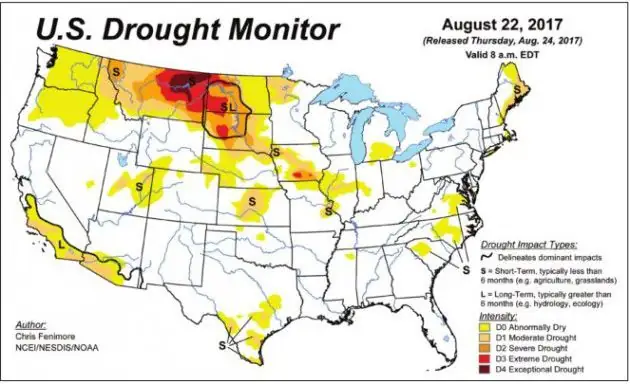
As of last week, almost all of Montana (97.2 percent), North Dakota (99.6 percent), South Dakota (88.4 percent) was in some form of drought.
According to the National Oceanic and Atmospheric Administration’s (NOAA’s) Climate Prediction Center, the drought encompassing the Dakotas and Montana is expected to remain through to the end of November at least. Worse yet, the center predicts the drought is likely to develop into western Montana and on into Idaho and Washington in that time.
“Above normal temperatures are favored to continue across much of the Northwest during the fall, and drought is therefore anticipated to expand across al ready abnormally dry portions of eastern Washington, Idaho, and western Montana,” commented NOAA forecaster, Adam Allgood, last week.
“As climatological precipitation decreases, drought persistence is favored for Montana, North Dakota, western South Dakota, and northern Minnesota.”
Anderson also noted, as can be seen in the drought map above, that drought conditions have spread into Iowa. As of last week, over 55 percent of the state was in some form of drought. A small pocket in the southcentral portion of the state was classified as D3: Extreme Drought. This patch of red only appeared two weeks ago and has grown.
“It’s the driest in Iowa since 2012 when we had the tremendous drought across the Corn Belt,” said Anderson.
NOAA’s Climate Prediction Center anticipates most of Iowa’s drought conditions will improve and possibly abate before the end of November.