What a wild ride 2025 gave us. Like a roller coaster ride that goes up but also must come down. We saw everything … literally everything. From daily record highs to extreme weather patterns and events, to political turmoil, to plant closures and everything in between … we saw the full gamut. There’s been a constant news cycle throughout the year, but that probably goes with the territory we’re in right now.
Recently, at the Missouri Governor’s Conference on Agriculture, experts like Derrell Peel of Oklahoma State University spoke about how even though prices are at records levels, fundamentally he didn’t think prices were “too high” when taken in context with input costs, inflation, interest and shelf competition. Furthermore, he indicated that continued reporting from USDA’s Cattle on Feed reports shows that heifer retention hasn’t truly started and “the tightest supplies are still ahead of us.”
All indications in the January 2026 Cattle inventory report coming in a few weeks show that we should see fundamentally a one-sided affair with production maintaining the advantage. More than likely, we will see another low point in the overall inventory, delaying expansion another term and furthering higher prices received for calves. While some people have noted they’ve kept more heifers this year, nationally, those numbers aren’t showing up in the reports.
Herd rebuilding remained a defining theme throughout the year. After years of drought and forced liquidation across nearly every major cattle producing area, many producers wanted to expand again—but rebuilding isn’t a switch easily flipped. The decision to sell heifer calves or retain gets harder when operating notes are expensive and inputs still feel inflated.
Weather stayed a wildcard and looking at snowpack levels across much of the West has a lot of people pretty uneasy right now. Some regions caught moisture and grew grass, others watched pastures burn up early or dealt with harsh winter conditions. Either way, ranchers were reminded that nature, not Washington, is the first regulator of livestock numbers.
Through all of this, the consumer has been there with full support. Per-capita consumption has continued to eek upwards thanks to popular diets, consumer approval and continued purchasing. Everything has gone up, and it seems that wages across the country haven’t truly kept up with inflation, but the portion of their budget that families are dedicating to beef as its protein source has remained, and even grown slightly over the last several years and shows the strongest beef demand in nearly four decades.
While most Americans are going to spend the week thinking of their new year’s resolutions, I’ve always felt that once the next calf crop starts hitting the ground is when the excitement for the new year actually begins. It’s the daily grind of hard work, chartered decision making and anticipatory effort in raising the next cycle of cattle that will end up supplying this country and countless others across the world. We have a lot to be thankful for and a lot to look forward to this year.
There are going to be some ups and downs, regardless of what we do. As we saw this past fall, one major headline can trip the paper market into a selloff, and a market correction will happen. However, like we saw recently, the cash market is still in the driver’s seat and should remain throughout this year. Even if the southern border opens, we shouldn’t see a huge shakeup. There are stacked cattle waiting to enter, but a wait-and-sell move makes sense as markets will adjust and stabilize. Ultimately, there isn’t need for panic.
For me, while writing this column, my mind keeps drifting to all the dispersions and liquidations that have continued. While I can’t blame people for capturing this market and retiring, it’s still somber to think about how many operations have exited the business. In the last decade, there were over 100,000 operations that exited in a down market. Today, the high market values are enticing these sales. It makes sense to see some industry groups pushing their platform focusing on this very issue. It’s a real issue, and one that isn’t going away.
This industry is built on an interesting balance of competition and camaraderie. While there are differences in everyone’s cattle, there also continues to be different belief systems. This is a good thing, in my opinion, and creates a separation from the average, which is the most important ingredient in successful marketing. Not everyone is going to agree on issues like EID, MCOOL, the checkoff and so on. However, those that are out there trying to divide the masses and silence others’ opinions are ultimately hurting the industry. It’s perfectly fine to disagree on some issues, but a disagreement doesn’t make one right and the other wrong. I hope to see this industry succeed on key issues in this coming year and make this industry enticing for the next generation to enter. I hope to see livestock production position itself for long-term success more than year-to-year success.
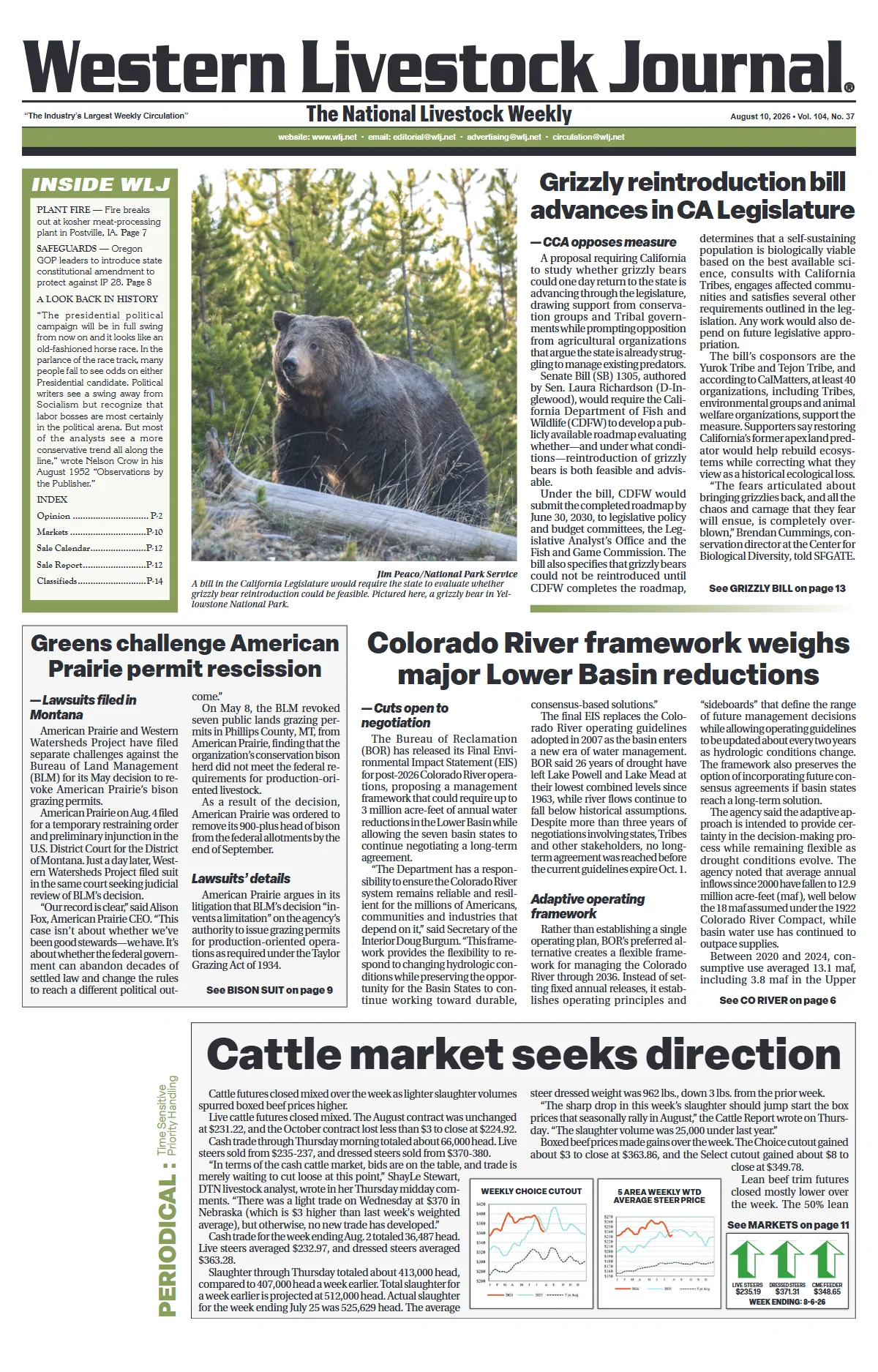
Lastly, I’m so thankful to every single reader and advertiser of Western Livestock Journal. As we enter our 104th year, this publication has seen all the ups and all the downs. It’s the readership that keeps our heartbeat going every single day. We wish you a happy new year, and continued success in all that you do! — LOGAN IPSEN