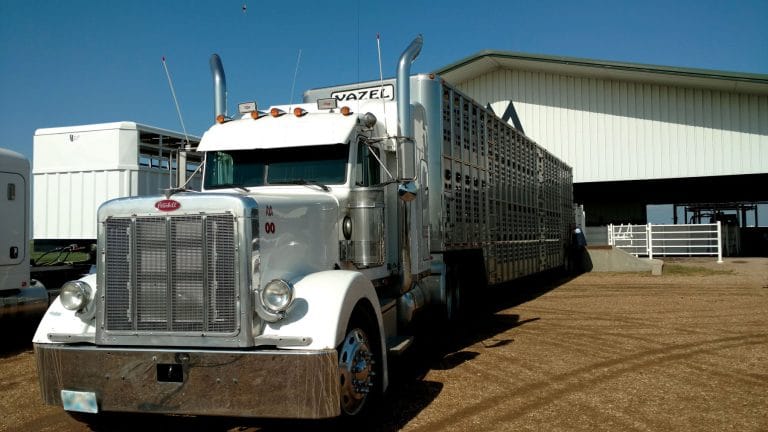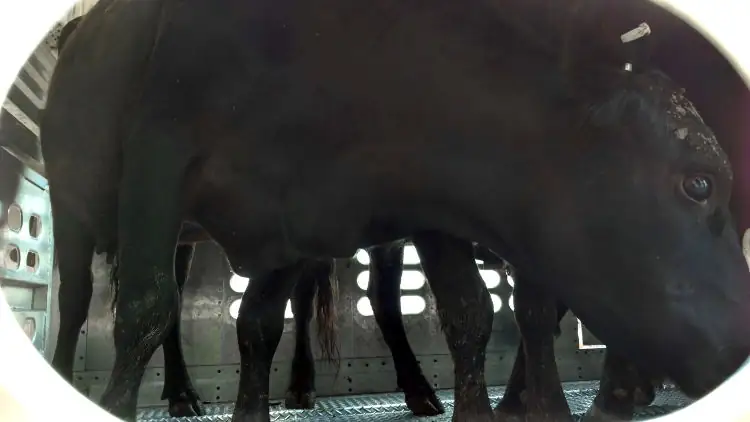
Regulations impacting truck drivers hauling agricultural commodities and livestock are experiencing a lot of moving parts as lawmakers look to create a level of flexibility that provides for driver safety, as well as the welfare of livestock during long hauls.
Some of the concern was raised with the mandated electronic logging devices (ELDs) that track hours of service (HOS) and are required in most commercial trucks as a result of the Moving Ahead for Progress in the 21st Century Act passed by Congress and signed by President Barack Obama in 2012.
The Federal Motor Carrier Safety Administration (FMCSA), a division of the U.S. Department of Transportation, explains on its website that the ELD rule is intended to help create a safer work environment for drivers, and make it easier and faster to accurately track, manage and share records of duty status data.
However, due to the unique nature of their business, agricultural commodity and livestock haulers argued that the HOS rules could negatively impact their businesses and put animals at risk of injury or additional stress. Those discussions led to temporary exemptions for compliance with the ELD rule, until June 18 for agricultural commodity haulers. Livestock and insect haulers are not required to comply with the ELD rules until Sept. 30, 2018.
As covered in the May 28 WLJ, legislation introduced in the U.S. Senate on May 23 would provide the relief livestock haulers are seeking. SB 2938, the Transporting Livestock Across America Safely Act (TLASS), would increase HOS while also maintaining mandated rest periods.
Among supporters of the measure that was introduced by Sen. Ben Sasse (R-NE) are the National Cattlemen’s Beef Association (NCBA) and the United States Cattlemen’s Association (USCA).
USCA Transportation Committee Chairman Steve Hilker issued a statement about the bill, saying, “We asked, and Congress answered. This is a historic moment for livestock and insect haulers to finally be afforded needed flexibility in the restrictive hours of service rules. We commend this bipartisan group of senators, led by Senator Sasse, for working with the industry towards a common-sense solution.”
He went on to say, “We look forward to working with the Senate—and the House—to get the Transporting Livestock Across America Safely Act across the finish line.”
NCBA’s Executive Director of Government Affairs, Allison Rivera, explained that SB 2938 does not change the mandate for the ELD, but would provide that ELD reporting follow the HOS that would be established for the livestock community.
She noted that the title of the bill is to “remind people that currently livestock haulers are hauling animals across this country very safely and we have a strong safety record.” She added, “When we talk about what’s been going on in the transportation world and the electronic logging devices and hours of service, we realize that with our safe record we still need some flexibility within the hours of service.”
Current HOS allow 11 hours of driving time and 14 hours of on-duty followed by a mandated 10-hour rest. Rivera said the new legislation would increase the current agricultural exemption on the front end of a haul from 150 to 300 air miles. What this means, she explained, is that that a trucker can leave his or her farm and drive to, for instance, a livestock market to load and be exempt from HOS if it is within the established radius. HOS for drive time would not begin until the 300-air-mile threshold is met. The trucker would also be exempt from HOS for the 150 (now) and proposed 300 air miles on the back end of the haul. Providing the same flexibility on both ends of a haul is important, Rivera explained, to allow for time loading or unloading animals.
Drive time would also be increased between 15 to 18 hours and allow a driver to take a self-imposed rest without that time being counted against on-duty time. Rivera said, “With our [livestock haulers’] strong safety record we know that our drivers are resting when they need to; they are resting according to the weather so that their animals are in a good place. So, while resting, this will not count towards on-duty time, which I think is important.”
Once animals are safely off the trailer, Rivera said the legislation would require at least a 10-hour rest. If a hauler has 18 hours of drive time the mandated rest period would be 13 hours.
“We feel like this bill takes into account the flexibility that livestock hauler need,” Rivera said.
NCBA is optimistic that the Senate bill will move, and Rivera said her association is continuing to work with the FMCSA on the HOS rules. She also noted that a bipartisan group of senators recently sent a letter to FMCSA requesting HOS flexibility for livestock haulers.
“We feel like this bill is just another part that kind of paints this whole picture and shows support from our members of Congress that we have to do something,” Rivera said.
The next step on the Senate side, according to Rivera, is to gather more cosponsors, in addition to the 16 initial cosponsors. She added that the House of Representatives is expected to have a bill with the same language sometime early in June. The effort on that side, she said is being led by Rep. Ted Yoho (R-FL-3).
Rivera emphasized the importance of agricultural producers reaching out to their members of Congress and asking them to support the TLASS. — Rae Price, WLJ editor