The battle against flies is challenging. Different flies have different habits, so a combination of tactics is most effective to control them. Stable flies breed in rotting organic matter—old hay, silage, bedding. Horn flies breed in fresh cattle manure. Horseflies/deerflies breed in wet areas/ponds, and black flies breed in flowing water, often miles away. In many beef operations, horn flies are the most irritating and costly parasite.
There are many ways to combat flies, including sanitation, physical removal of breeding sites, biological strategies like parasitic wasps and dung beetles, and chemical control with pesticides.
Sonja L. Swiger, Texas A&M University veterinary/medical Extension entomologist, says the most costly problem in cow-calf herds is horn flies, though stable flies can be an issue. “After a mild winter, stable flies emerge earlier than usual,” she said.
Texas A&M did a study many years ago and found that if you don’t clean up where you feed big bales, the area around one big round feeder produces more than a million stable flies.
In spring it helps to move feeders and spread wasted hay so it will dry. Otherwise, this material stays wet and provides breeding sites for stable flies.
If you can keep stable flies from proliferating in spring, you may not have to do much control during summer. About 10 days after a rain, however, you can expect a tremendous increase in stable flies.
“For horn flies we use integrated pest management that includes pasture rotation, leaving fresh manure behind, and not overloading any one site with larvae. You can decrease flies even more if you drag the pasture you just left, to break up manure pats so they dry out faster. If pats are still mounded up, they develop a crust and larvae continue to live inside them,” said Swiger.
The horn fly life cycle is short. “It only takes about a week from egg to adult. Rotating pastures often, getting away from that manure, can make a difference.”
Some producers try to avoid chemicals and pesticides, looking for other ways to help control these pests. “One benefit of rotation, if you can leave the pasture long enough, is dung beetles can get in there and tear down manure. They are our most beneficial insect,” Swiger said.
Some products used for parasite control (such as ivermectin) are harmful to dung beetles. “New products are coming out that are more natural/less harmful. The impact on dung beetles is minimal unless you are overusing products.”
Chemicals
“We recommend waiting as long as possible in the spring to start using a product—until after you can count 100 to 200 horn flies per animal,” said Swiger. Cattle can tolerate a few flies so we wait until control is more important.
If cattle are uncomfortable because of flies, it’s time to treat. This also ensures there are more adult flies present at the time of treatment. “Most products applied to the animal only kill adults, and you want the biggest impact for your efforts,” she said. You can knock down the population that will be laying eggs.
Horn flies spend all their time on the animal (compared with other biting flies that are only there long enough to get a blood meal) so anything you put on the animal will get to them. Just make sure you use a product that will kill them, because they quickly develop resistance.
“Unfortunately we are limited in products to rotate. We recommend rotation (to minimize resistance), such as switching between an organophosphate and a pyrethroid, but the only way we can use organophosphates is in ear tags,” said Swiger.
Ear tags are effective, but they don’t work if the population of horn flies is resistant to that product.
“When populations get really high you can’t rely on just one product. We recommend using several methods—like a pour-on as well as a feed-through, or ear tags. The tag companies recommend two tags per animal,” she said.
Feed-through products end up in manure and contain insect growth regulators; the larvae don’t mature to become flies. She advises producers to use a feed-though as well as a topical product, to hit both stages of the life cycle.
Some producers also use back-rubbers, oilers, dusters, etc. for cattle to self-treat. “Cattle can use these in a walk-through to water, for daily treatment,” said Swiger.
“Most products are not labeled for use on calves. Young calves get protection from the cow. If she’s treated, and has fewer flies, her calf won’t have as many flies.” Calves may also get some benefit from topical products on the cow, since they rub against mom while nursing. Some fly tags can be used on calves, if they are over a certain age/weight.
Fly traps
There are several kinds of fly traps, for different types of flies. “Traps work best for horse flies and deer flies, and there are some traps for stable flies (sticky traps they land on). Those flies take a blood meal and leave, whereas horn flies never leave the host,” said Swiger.
The only trap that removes horn flies is a cow vacuum—an enclosed area the cows walk through. It blows flies off the animal and sucks them into a bag. This trap is expensive, and used mainly in dairies since it must be set up where animals have to go through it.
Resistant cattle
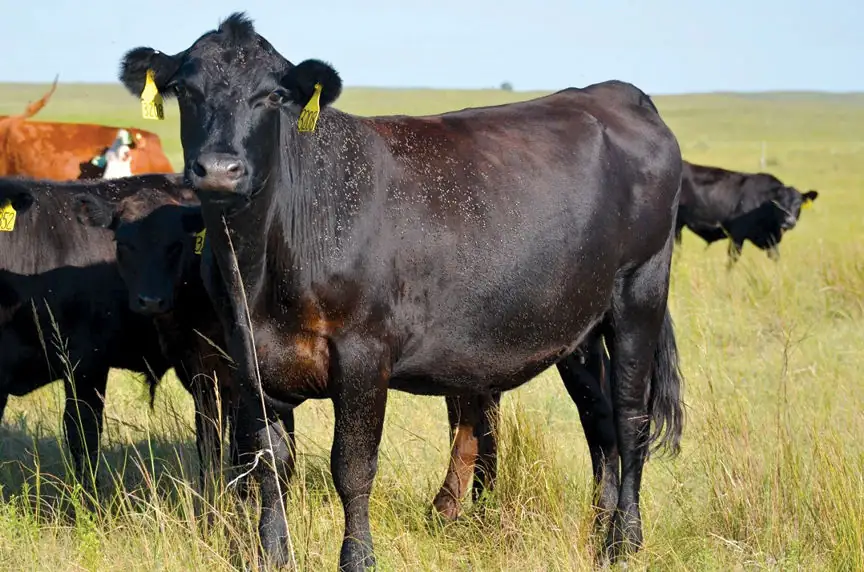
Some cattle are more attractive to flies. Some producers are selecting for fly-resistant animals, but often the cattle with the most resistance (Zebu-based breeds) don’t have the best traits for meat production. “Angus are not very resistant to flies,” said Swiger.
Bulls attract the most flies. “This seems to be due to testosterone levels, but we don’t know why. Some animals have no resistance and need more help to control their flies. Color can be a factor (more flies on dark-colored cattle) but not always.” — Heather Smith Thomas, WLJ correspondent