

Much has been said and written about rising beef prices, and especially ground beef prices, for many months. Since 2022, the year of record beef production, and the beginning of the current bull market, wholesale and retail beef prices have risen with strong beef demand and declining beef production. Choice wholesale boxed beef prices have increased by 44.1% from the 2022 average and All-Fresh Beef prices are up 29.8%. Total beef production has decreased 10.5% from the 2022 average to current levels.
Beef consists of many products, each in individual markets, and not all change at the same rate reflecting differences in supply and demand for each product. Across the range of beef products, Figure 1 shows monthly wholesale values for beef tenderloin and a representative ground beef formulation of a 7:1 mixture of 90% and 50% lean trimmings resulting in an 85% lean product. The trend lines for each price series confirm that ground beef prices have been rising faster than tenderloin (and most all other muscle cuts).
The relatively faster increase in ground beef prices is a function of demand and supply factors. In general, as beef prices increase, consumers are likely to rely even more heavily on ground beef to blunt the impact of higher beef prices, thus increasing ground beef demand relative to other beef products.
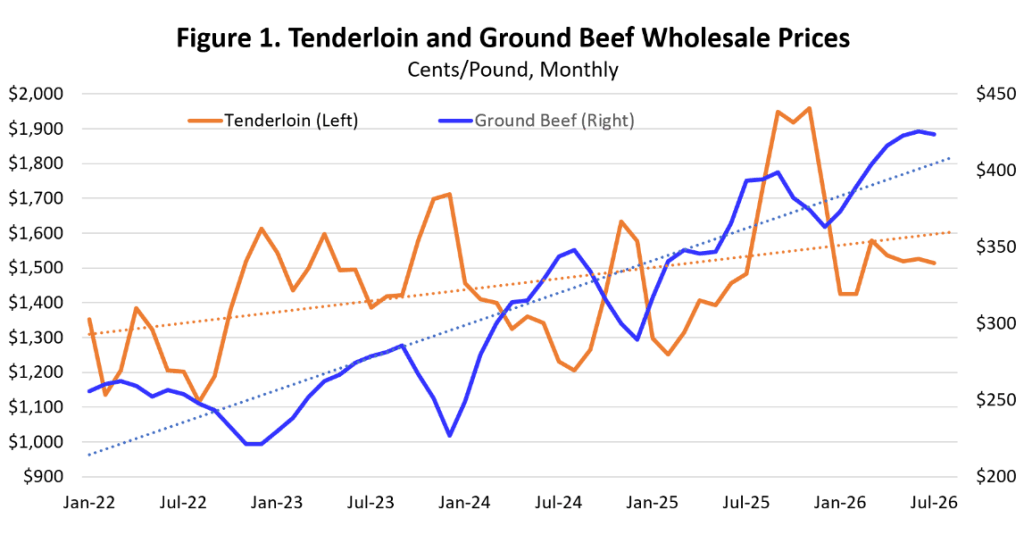
In Figure 1, wholesale beef tenderloin prices have increased an average of 26.6% since 2022 and 85% lean ground beef prices are up 60.7%. On average, prices for the highest value steak cuts including tenderloin, ribeye and strip loin wholesale prices are up 33.6%, while prices for cuts including flank steak, tri-tip, top sirloin and top round are up an average of 42.7%.
Not only is the demand for ground beef demand higher, the supply of ground beef has decreased faster than for fed beef. Ground beef relies heavily on lean processing beef from cull cow and bull slaughter.
Figure 2 shows that the supply of nonfed beef (cull cows and bulls) has decreased faster than the production of fed (steer and heifer) beef.
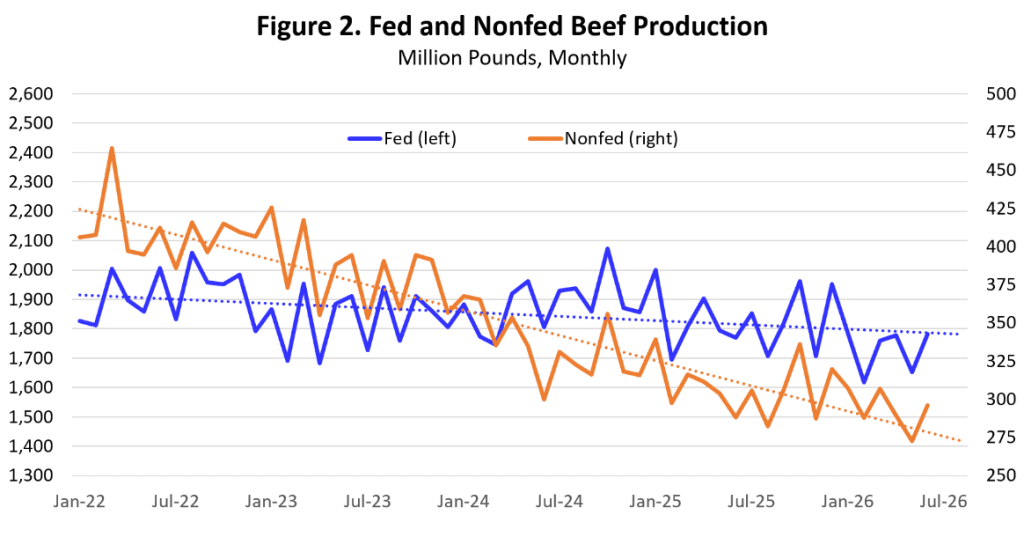
The production of nonfed beef is down more sharply than fed beef because cow slaughter has decreased 30.5% since 2022, while fed slaughter is down 12.7%. Moreover, declining fed slaughter is partially offset by a sharp increase in steer and heifer carcass weights, while cow carcass weights have increased modestly.
Going forward, nonfed beef production may decrease more slowly as the beef cow herd and cow slaughter stabilize. However, fed beef production is expected to continue decreasing with tighter fed cattle supplies expected through 2027 at least. — Derrell S. Peel, Oklahoma State University Extension livestock marketing specialist




1 Comment