Five New Mexico landowners are asking the 10th Circuit Court of Appeals to revive a federal takings lawsuit that challenges the state’s declaration of public access rights across privately owned streambeds—arguing that forcing public entry onto their land without compensation violates the U.S. Constitution.
Background
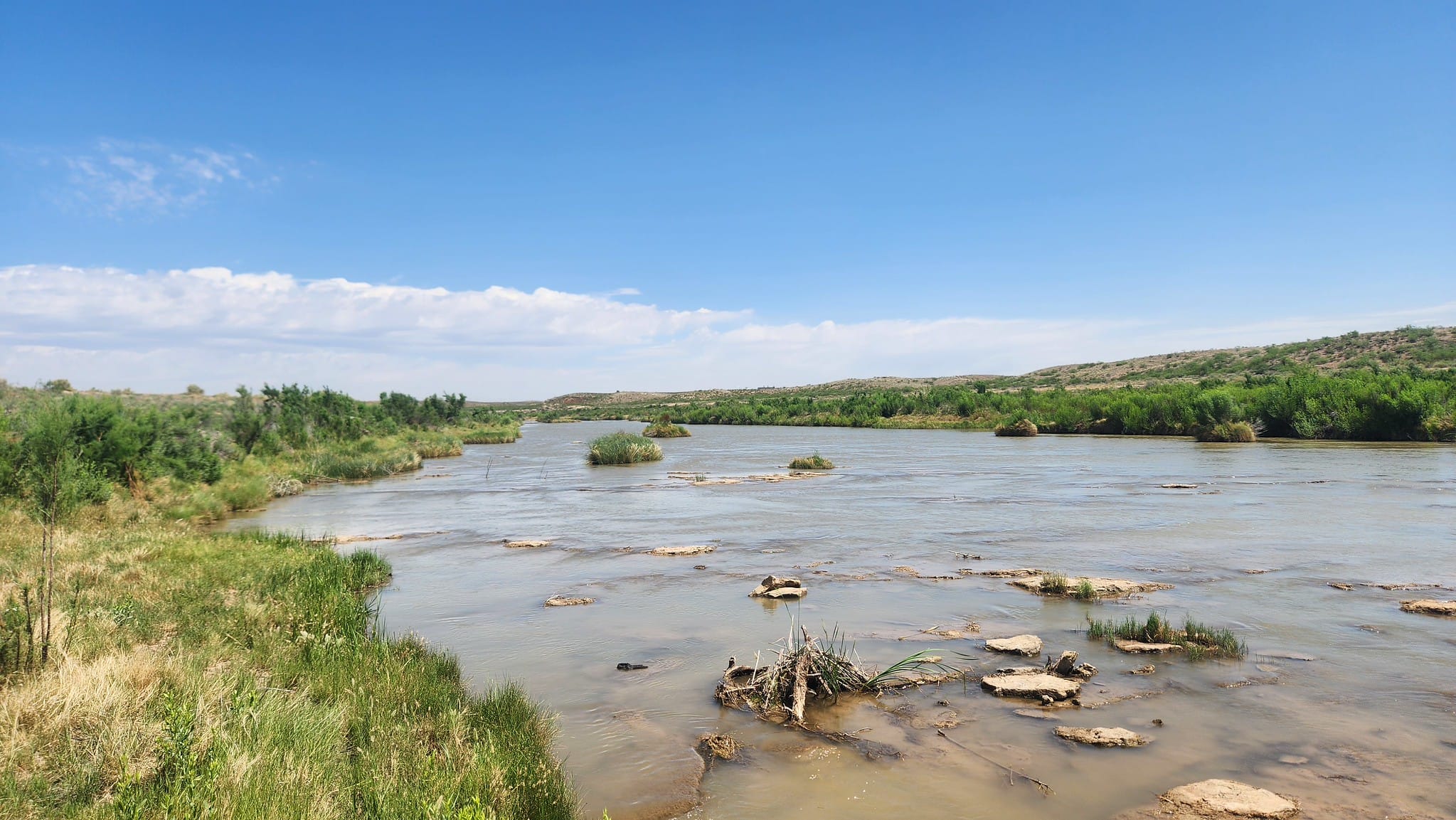
Erik Briones, Richard Jenkins and Roland Rivera own adjoining parcels along the non-navigable Pecos River in San Miguel County, while siblings Lucia and Michael Sanchez operate a family ranch along the non-navigable Rio Tusas in Rio Arriba County. Several of the properties trace their ownership back to before New Mexico achieved statehood, and the Sanchez family acquired its land in 1942.
All five landowners hold title to the streambeds beneath the rivers running through their land and, for decades, exercised what they say was a well-established right to exclude trespassers from those private streambeds.
That long-standing practice is now at the center of a federal takings lawsuit before the 10th Circuit Court of Appeals. According to the landowners’ opening brief, their legal trouble began with a 2022 New Mexico Supreme Court decision, Adobe Whitewater Club of New Mexico v. New Mexico State Game Commission. In that case, the court held that the state constitution’s public water clause guarantees members of the public the right to walk and wade across privately owned streambeds. The landowners argue that before the decision, the commission and the New Mexico Department of Game and Fish did not endorse any public right to trespass on private streambeds prior to 2022.
That legal landscape, the landowners argue, shifted abruptly after the Supreme Court ruling. The state Supreme Court invalidated the game commission’s regulation and declared that public recreational rights extend across private streambeds. According to the brief, executive officials then “immediately reversed their positions and began warning property owners not to exercise their right to exclude,” while the attorney general launched an enforcement campaign to “ensure public access to rivers and streams in New Mexico.”
In June 2024, the five landowners sued Attorney General Raul Torrez, the members of the commission and the director of the Department of Game and Fish in federal court. They alleged that enforcing the court decision without compensation amounted to an unconstitutional taking of their right to exclude the public from their private streambeds. Rather than seeking damages, they requested injunctive and declaratory relief to block further enforcement.
The U.S. District Court for the District of New Mexico dismissed the case in January 2025, holding that the landowners lacked standing and that sovereign immunity barred their claims. The landowners appealed the decision.
Oral arguments
The 10th Circuit heard oral arguments on Jan. 23, focusing on whether forcing public access onto private streambeds constitutes a taking and whether federal courts can block enforcement of the Adobe Whitewater decree.
Pacific Legal Foundation Senior Attorney Christopher Kieser told the panel the dispute centers on the right to exclude—“one of the most fundamental property rights”—as recognized by the U.S. Supreme Court in Cedar Point Nursery v. Hassid.
He repeatedly likened the case to Cedar Point, where the U.S. Supreme Court held that a California regulation requiring growers to allow union organizers onto their land was a per se taking.
“It’s exactly the same thing,” Kieser told the judges. “The state is enforcing a public easement on these private streambeds. A state cannot simply define a right that has existed for years out of existence—whether it’s through legislation, regulation or judicial proclamation—without paying for it.”
Kieser argued that state officials cannot escape constitutional scrutiny simply because they are enforcing a state supreme court ruling.
“Asserting public rights over private rights constitutes a taking when just compensation is denied,” he said. “New Mexico state officials cannot weasel their way out of accountability, especially when they are enforcing a law that violates the historical property right to exclude the public from access to private property.”
Several judges pressed Kieser on whether a federal court could intervene if the New Mexico Supreme Court had already ruled that landowners never had a right to exclude. Kieser responded that while federal courts cannot overrule state law, they can still restrain unconstitutional enforcement.
Counsel for the state countered that the landowners never had a legally cognizable right to exclude the public from non-navigable streambeds and that Adobe Whitewater merely clarified what had always been implicit in New Mexico law.
“The public owns the water, and there has never been a right to exclude the public from enjoying recreation and fishing on those waters,” the state argued.
The state maintained that any prior agency rules or signs recognizing private streambeds were ultra vires—beyond the agencies’ authority—and could not create property rights where none existed.
The 10th Circuit has not yet issued a ruling, but Kieser told WLJ in an emailed statement that the panel appeared receptive to their argument.
“The panel seemed receptive to our arguments on standing and sovereign immunity and seemed to understand the nature of our takings claim,” Kieser said. “The discussion ultimately focused on the core issue in this case—whether streambed owners had the right to exclude trespassers before Adobe Whitewater declared public access in 2022. We now look forward to the court’s decision on this important question.” — Charles Wallace, WLJ contributing editor