The beef-on-dairy boom has transformed dairy farm economics, creating one of the strongest revenue opportunities producers have seen in years. But according to a new CoBank report, the strategy has also come at a cost: the smallest inventory of dairy replacements in nearly 50 years.
CoBank projects that dairy replacement numbers will remain historically tight through 2026, then begin a gradual recovery in 2027 and 2028 as dairy producers shift more breeding decisions toward gender-sorted dairy semen.
Prices reshape breeding decisions
The driving force behind today’s breeding strategies is the historic strength of the beef market.
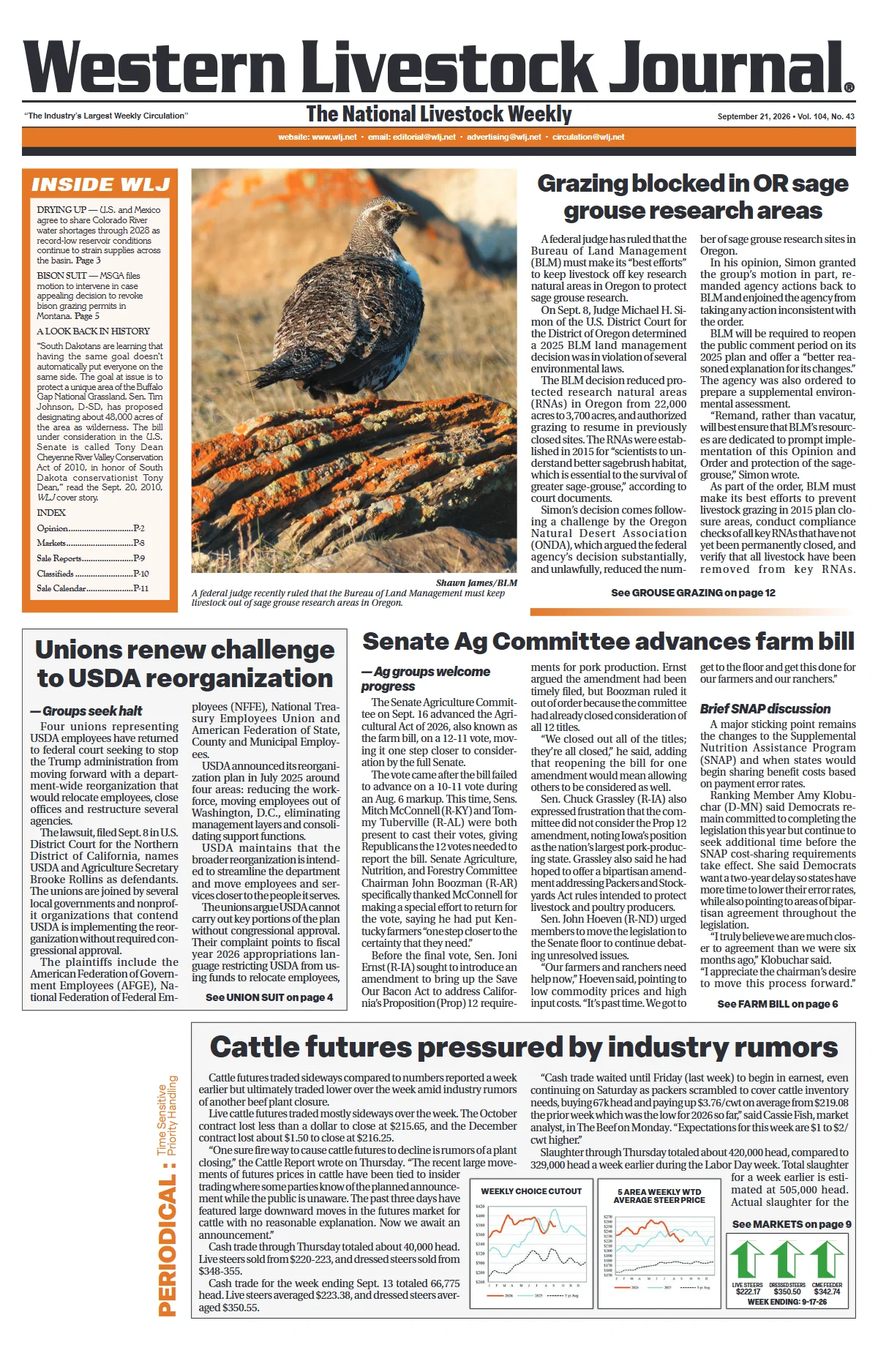
The U.S. cattle inventory has fallen to 86 million head, the lowest level since 1951, after years of drought and poor forage conditions reduced the national herd by 8.5 million head from its 2019 peak. The tight supply pushed live cattle futures to a record $251/cwt in May.
Record beef prices have fundamentally changed breeding decisions on many dairy farms, according to CoBank. Instead of producing dairy replacement heifers from every cow, producers are increasingly using beef semen on lower-performing females while breeding their best cows with gender-sorted dairy semen to produce future replacements.
The approach generates immediate income from high-value beef-on-dairy calves while maintaining enough heifers to support the milking herd. CoBank notes that selling a crossbred calf provides cash almost immediately, whereas raising a replacement heifer requires roughly two years before she enters production.
That strategy, however, has significantly tightened replacement supplies. CoBank reports dairy heifer inventories have fallen to their lowest level since 1978, with the number of dairy heifers weighing more than 500 pounds down 19%, or more than 909,000 head, since 2016. USDA data show replacement heifers now average more than $3,000 per head, while top-quality animals have recently sold for $3,400-4,400 at auctions in Minnesota and Wisconsin.
Beef revenue boosts retention
Rather than aggressively culling cows amid tight replacement supplies, the report notes dairy producers have extended the productive lives of existing cows.
CoBank estimates that from August 2023 through August 2025, dairy farmers retained more than 600,000 cows that would otherwise have been slaughtered. Although culling has increased modestly over the past several months, slaughter levels remain well below those of previous years.
The result has been a growing dairy herd despite replacement shortages. According to the report, the U.S. dairy herd now exceeds 9.6 million head, the largest in roughly 30 years, and has expanded by 254,000 cows since January 2025.
CoBank said that much of that decision comes down to beef revenue. Five years ago, calf and cull cow sales accounted for roughly 5% of dairy farm income. Today, CoBank estimates those sales contribute 12-15% of revenue on many dairies, with some operations approaching 20% on a per-hundredweight basis.
The growing value of beef-on-dairy calves has made beef sales a major profit driver for many dairy operations. CoBank said the “beef check is now driving margins more than the milk check.”
CoBank, citing data from the National Association of Animal Breeders, reports that beef semen sales to dairies jumped 62% from 2020 to 2025, and dairy producers now purchase nearly 83% of all beef semen sold nationwide.
The report describes today’s breeding strategy as a “triple play” that combines gender-sorted semen, genomic testing and beef semen to maximize both genetic progress and calf value.
Recovery to begin in 2027
Despite the current shortage, CoBank believes the rebuilding process has already begun.
The report projects 438,800 fewer replacement heifers will enter dairy herds during 2026, following another decline in 2025, for a combined reduction of 796,000 head over the two years.
However, stronger sales of gender-sorted dairy semen during 2024 and 2025 are expected to reverse that trend. CoBank forecasts an additional 285,400 replacement heifers entering milking herds in 2027, followed by another 74,900 in 2028, for a combined gain of 360,200 head.
The recovery is expected to be gradual rather than immediate because of the dairy industry’s lengthy biological cycle between breeding decisions and the entry of mature cows into production.
Regional demand will also influence replacement values. CoBank notes that roughly $13 billion in new dairy processing investments in states including Texas, Wisconsin, Michigan, Idaho and the I-29 corridor will likely keep replacement demand elevated in those regions even as national inventories begin to recover.
The report highlights that dairy remains an increasingly important contributor to U.S. beef supplies. CoBank estimates roughly one in every five pounds of beef now originates from the dairy sector, either through cull cows or beef-on-dairy offspring, making dairy breeding decisions an increasingly influential factor for the cattle industry as a whole. — Charles Wallace, WLJ contributing editor