The most recent USDA Livestock and Poultry: World Markets and Trade report shows that beef production among major world producers for 2027 is projected at 60.031 million metric tons (mmt), down fractionally from 2026 and down 3.7% from the peak in 2025.
Among major beef-producing countries, production is down in Brazil, the U.S., China, the European Union (EU), Australia, Russia and South Africa. Beef production is projected to increase in 2027 in India, Argentina, Mexico and Canada.
Total global beef exports have been mostly steady since 2025 with 2027 projected to be fractionally lower than 2026 at 13.885 mmt (Figure 1). This follows a relatively steady increase in the previous decade prior to 2025.

Figure 2 shows projected 2027 beef exports for major exporting countries. Brazil is the largest beef exporter, accounting for 29.5% of the total, with Australia at No. 2 with 16.1% and India in third place with a 14% share of total beef exports. Exports from India includes meat from water buffalo, known as carabeef.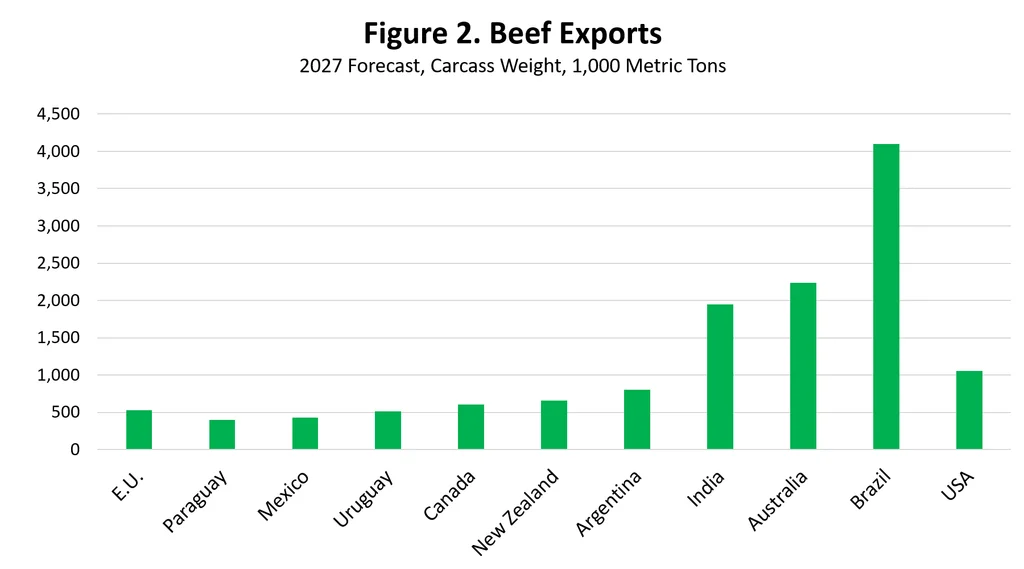
The U.S. is fourth with 7.6%, followed by Argentina at 5.8% of total beef exports. Of the top 10 beef exporters, the remaining six countries all account for less than 5% of total beef exports and include New Zealand, Canada, the EU, Uruguay, Mexico and Paraguay.
Projected 2027 beef imports are heavily concentrated into China/Hong Kong, with 30.4% of the global total and the U.S. with 22.5% of total beef imports (Figure 3). Next is Japan with a 5.7% share and South Korea accounting for 5% of total beef imports.
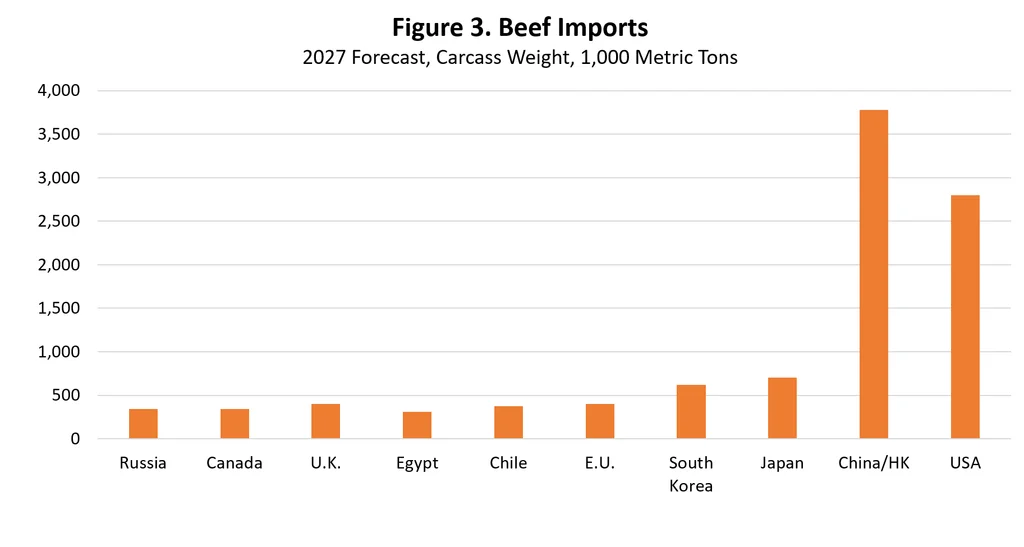
Smaller beef-importing countries include the EU, the United Kingdom, Chile, Canada, Russia, and Egypt. The top 10 beef importers account for 80% of total global beef imports.
Beef trade continues to grow and is increasingly important in global beef markets. In 2026, beef exports were 23.2% of total global beef production, up from 16% a decade ago in 2017. — Derrell S. Peel, Oklahoma State University Extension livestock marketing specialist